组成图示
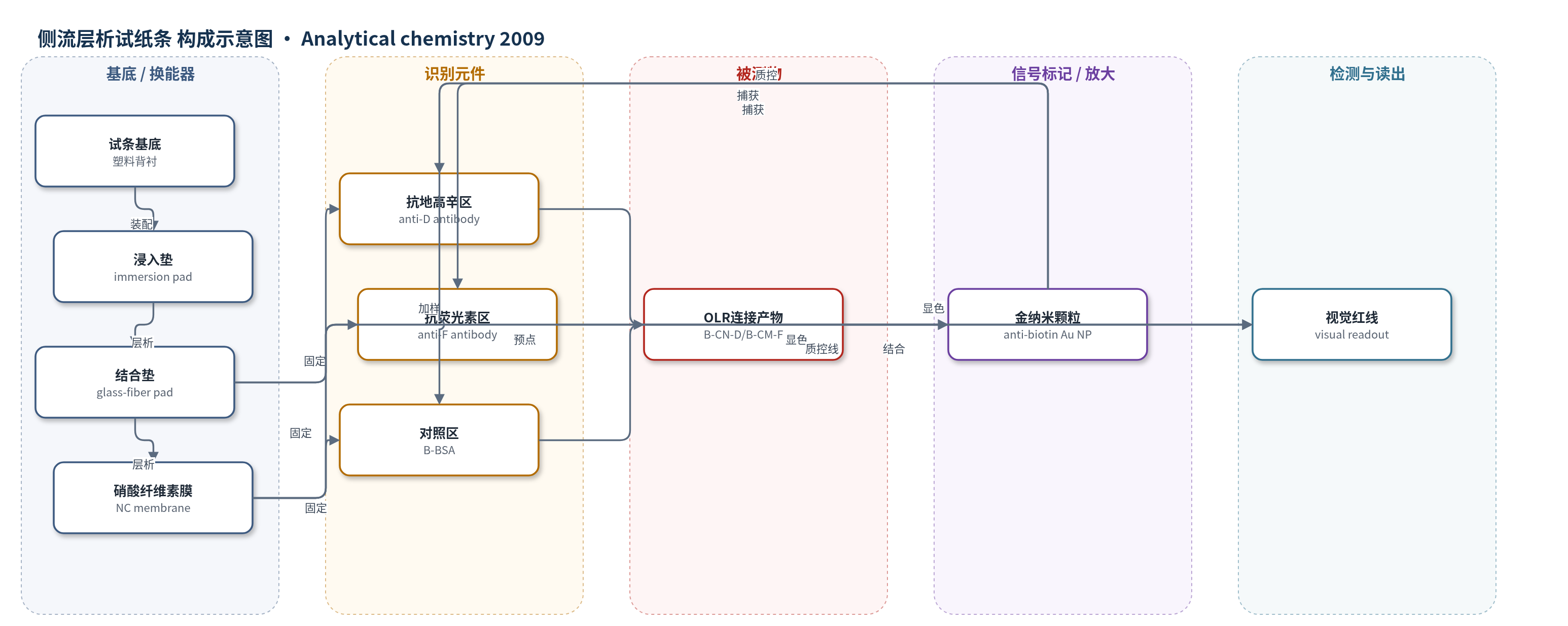
点击图片查看大图 · 依据论文自动绘制
传感器类型
侧流层析试纸条
检测对象
单核苷酸多态性(SNP,ADRB3 T387C);样品基质:全血提取的基因组 DNA(whole blood/genomic DNA)
检测原理
先以 PCR 扩增 ADRB3 目标片段,再进行单次 OLR。生物素化通用探针 C 与 5′磷酸化等位基因特异性探针 N 或 M 杂交到目标 DNA;只有 SNP 位点完全互补时,DNA 连接酶才在探针间形成磷酸二酯键,生成 B-CN-D 或 B-CM-F 双标记连接产物。热变性后,产物加到试条结合垫,其生物素端结合抗生物素偶联金纳米颗粒。层析迁移中,地高辛端被 anti-D 检测区捕获,荧光素端被 anti-F 检测区捕获,金纳米颗粒在相应区积累形成红色线;过量金纳米颗粒被 B-BSA 对照区捕获。等位基因存在与否及比例决定红线出现位置和颜色密度,杂合型出现双红线,信号随等位基因产物量增加而增强。
检测灵敏度
原文未报告 LOD、线性范围、灵敏度斜率或 R^2。
效应效果
该试条具有良好选择性:anti-D 区仅响应 B-CN-D,anti-F 区仅响应 B-CM-F,未连接 D/F 寡核苷酸及交叉产物不产生信号;OLR 在 65 °C 时非特异信号显著降低。对 22 份全血样本进行 ADRB3 T387C 基因分型,结果与测序完全一致;正常和突变纯合样本的等位基因分数分别高于 0.95 和低于 0.1,杂合样本接近 0.6。重现性方面,N/N 样本 anti-F 和 anti-D 区 CV 为 5.2% 和 7.7%,M/M 样本为 4.5% 和 12%。方法无需专用仪器,20 min 内完成视觉检测,单次 OLR 和单试条同时判别两等位基因,作者认为其适合低成本即时 SNP 基因分型。
传感器的构成
- 试条基底:塑料背衬(plastic adhesive backing),承载浸入垫、结合垫、硝酸纤维素膜和吸收垫。
- 浸入垫:immersion pad,浸入显影液后启动层析流动。
- 结合垫:玻璃纤维结合垫(glass-fiber conjugate pad),预点抗生物素偶联金纳米颗粒(antibiotin-Au NP),释放报告物。
- 诊断膜:硝酸纤维素膜(nitrocellulose membrane, Immunopore FP Whatman),承载检测区与对照区。
- 检测区1:抗地高辛抗体(anti-digoxigenin antibody, anti-D, Fab fragments),固定于膜上,捕获地高辛标记的正常等位基因连接产物 B-CN-D。
- 检测区2:抗荧光素抗体(anti-fluorescein antibody, anti-F),固定于膜上,捕获荧光素标记的突变等位基因连接产物 B-CM-F。
- 对照区:生物素化牛血清白蛋白(biotinylated BSA, B-BSA),固定于膜上,结合过量抗生物素-Au NP,形成质控红线。
- 信号标记物:金纳米颗粒(Au NP, 40 nm)经抗生物素抗体偶联,作为视觉报告物,与生物素化连接产物结合并在检测区积累显红色。
中文摘要
单核苷酸多态性(SNP)虽可用等位基因特异性寡核苷酸直接杂交识别,但酶法基因分型具有更高特异性和稳健性。在酶法中,寡核苷酸连接反应(OLR)因连接需两个杂交事件而具有最高等位基因判别能力。本文报道一种 DNA 生物传感器,用于同时视觉检测两种等位基因,并显著优于现有 OLR 产物检测方法。该传感器仅需一次连接反应,数分钟内完成,无需专用仪器,无需多次孵育和洗涤,干试剂格式减少移液步骤,对操作人员要求更低。检测原理为:PCR 扩增后,使用生物素化通用探针和分别标记地高辛与荧光素的两种等位基因特异性探针进行单次 OLR;正常和突变等位基因的连接产物分别被生物素与地高辛或荧光素双标记。产物被固定在试条两个检测区的抗地高辛或抗荧光素抗体捕获,并与抗生物素功能化金纳米颗粒报告物反应;过量纳米颗粒结合固定在对照区的生物素化白蛋白。基因型由两个检测区出现的特征红色线判定。该 DNA 生物传感器是迈向即时 SNP 基因分型的重要一步。
英文摘要
Although single nucleotide polymorphisms (SNPs) can be identified by direct hybridization with allele-specific oligonucleotide probes, enzyme-based genotyping methods offer much higher specificity and robustness. Among enzymatic methods, the oligonucleotide ligation reaction (OLR) offers the highest specificity for allele discrimination because two hybridization events are required for ligation. We report the development of a DNA biosensor that offers significant advantages over currently available methods for detection of OLR products: It allows simultaneous visual discrimination of both alleles using a single ligation reaction. Detection is complete within minutes without the need for any specialized instruments. It does not involve multiple cycles of incubation and washing. The dry-reagent format minimizes the pipetting steps. The need for qualified personnel is much lower than current methods. The principle of the assay is as follows: Following PCR amplification, a single OLR is performed using a biotinylated common probe and two allele-specific probes labeled with the haptens digoxigenin and fluorescein. Ligation products corresponding to the normal and mutant allele are double-labeled with biotin and either digoxigenin or fluorescein, respectively. The products are captured by antidigoxigenin or antifluorescein antibodies, or both, that are immobilized at the two test zones of the biosensor and react with antibiotin-functionalized gold nanoparticle reporters. The excess nanoparticles bind to biotinylated albumin that is immobilized at the control zone of the biosensor. The genotype is assigned by the characteristic red lines that appear at the two test zones. The proposed DNA biosensor constitutes a significant step toward point-of-care SNP genotyping.