组成图示
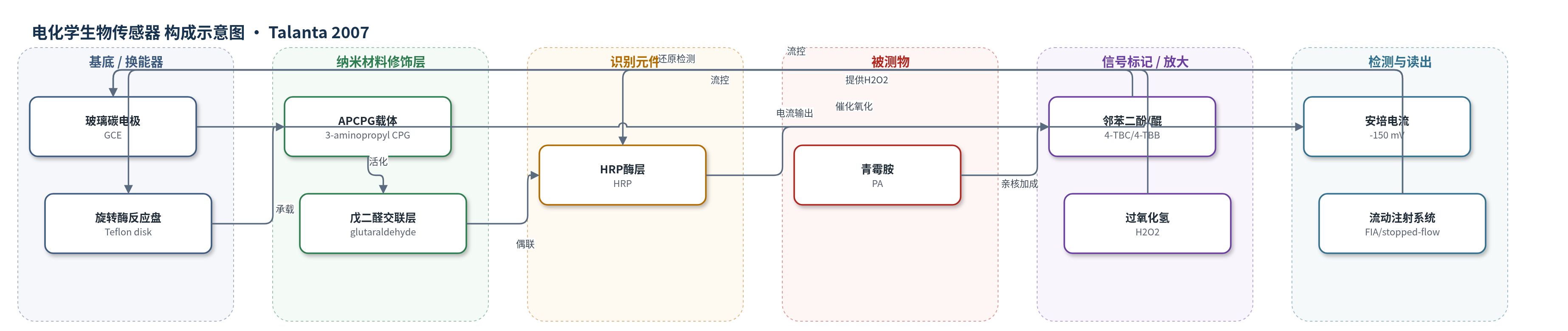
点击图片查看大图 · 依据论文自动绘制
传感器类型
电化学生物传感器
检测对象
青霉胺(penicillamine, PA);样品基质:药物制剂(胶囊)、磷酸盐缓冲液标准/加标样品
检测原理
该传感器以固定化辣根过氧化物酶(HRP)为催化元件,在过氧化氢(H2O2)存在下将4-叔丁基邻苯二酚(4-TBC)氧化为4-叔丁基苯醌(4-TBB)。无青霉胺(PA)时,4-TBB在玻璃碳电极(GCE)-150 mV处被还原,产生较大阴极电流。加入PA后,其巯基与4-TBB发生Michael型亲核加成,生成4-TBC-PA硫代醌衍生物,消耗可还原醌,使还原电流随PA浓度增加而降低。ΔI与PA浓度成正比。旋转盘增强传质,连续流/停流程序化操作积累产物并提高响应,实现安培检测。
检测灵敏度
LOD: 7 nM;线性范围: 0.02–80 μM;校准方程: ΔI (μA) = 8.7 × 10⁻³ + 0.543 [CPA];灵敏度斜率: 0.543 μA/μM;r = 0.998
效应效果
体系在pH 7、0.1 mM H2O2、900 rpm和150 μl进样体积下表现最佳;50–150 μl范围内灵敏度约提高3倍。重复标准溶液(n=5)标准误差小于3%;日内/日间CV分别为1.35/0.45%、0.77/0.84%、0.97/1.21%,偏差最大3.22%。纯PA与含辅料合成胶囊样品结果一致(2.49±0.007 vs 2.49±0.006 μM,CV 0.80%和0.41%),常见辅料不干扰。商品胶囊测定均值约250.01和249.98(SD 0.09、0.11)。方法响应时间<1 min,处理速度约50样品/h,作者认为比表中已有方法更灵敏、快速、低成本。
传感器的构成
- 换能器电极:玻璃碳电极(GCE),位于旋转酶盘上方,在-150 mV下安培检测4-TBC/4-TBB还原电流
- 旋转酶反应盘:特氟龙(Teflon)圆盘,内嵌微型磁搅拌棒,承载固定化酶并旋转增强传质
- 载体基质:3-氨基丙基修饰控孔玻璃(APCPG),提供氨基用于酶固定化
- 交联活化层:5% w/w戊二醛(glutaraldehyde),活化APCPG氨基形成醛基以偶联HRP
- 催化/识别元件:辣根过氧化物酶(HRP,EC 1.11.1.7),在H2O2存在下催化氧化4-TBC
- 反应介导物:4-叔丁基邻苯二酚(4-TBC)与过氧化氢(H2O2),生成4-叔丁基苯醌(4-TBB)并与PA反应
- 电化学池:Ag/AgCl/3.0 M NaCl参比电极(BAS RE-6)与Pt丝对电极,配合磷酸盐缓冲液完成测量
中文摘要
本文通过在线联用旋转生物传感器与连续流/停流/连续流处理,验证了以4-叔丁基邻苯二酚(4-TBC)为介导物的酶系统可实现高灵敏度检测。将辣根过氧化物酶(HRP)固定于旋转圆盘上,在过氧化氢存在下催化氧化4-TBC,其醌式产物在玻璃碳电极表面于-150 mV发生反向电化学还原并被安培检测。当溶液中加入青霉胺(PA)等含硫醇化合物时,硫醇与4-TBC的醌式衍生物发生Michael型加成反应,生成相应硫代醌衍生物,使还原峰电流随PA浓度增加而成比例降低。体系在pH 7附近响应最高。该方法可在0.02–80 μM范围内测定PA(r=0.998),检出限为7 nM,处理速度可达每小时50个样品。所构建的HRP旋转生物传感器被成功应用于药物制剂中PA含量的测定。
英文摘要
The high sensitivity that can be attained using an enzymatic system and mediated by 4-tert-butylcatechol (4-TBC) has been verified by on-line interfacing of a rotating biosensor and continuous flow/stopped-flow/continuous-flow processing. Horseradish peroxidase, HRP, [EC 1.11.1.7], immobilized on a rotating disk, in presence of hydrogen peroxide catalyzed the oxidation of 4-TBC, whose back electrochemical reduction was detected on glassy carbon electrode surface at -150mV. Thus, when penicillamine (PA) was added to the solution, these thiol-containing compounds participate in Michael type addition reactions with 4-TBC to form the corresponding thioquinone derivatives, decreasing the peak current obtained proportionally to the increase of its concentration. The highest response for PA was obtained around pH 7. This method could be used to determine PA concentration in the range 0.02-80muM (r=0.998). The determination of PA was possible with a limit of detection of 7nM, in the processing of as many as 50 samples per hour. The HRP-rotating biosensor was successfully applied to the determination of PA in pharmaceutical formulations.