组成图示
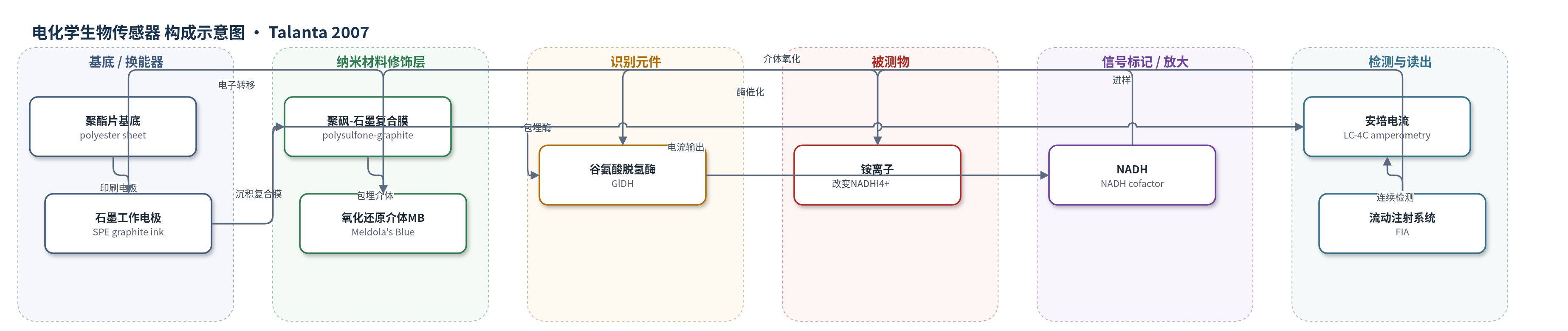
点击图片查看大图 · 依据论文自动绘制
传感器类型
电化学生物传感器
检测对象
NADH(烟酰胺腺嘌呤二核苷酸)、铵(ammonium, NH4+);样品基质:磷酸盐缓冲溶液/流动注射载液(NADH检测用0.05 M磷酸盐缓冲液+0.05 M KCl pH 6.5;铵检测用含2.5 mM α-酮戊二酸和0.2 mM NADH的pH 7.3磷酸盐缓冲液)
检测原理
未修饰电极直接氧化NADH需高过电位并产生自由基副产物,导致电极污染。介体(MB、3,4-DHB、p-BQ、o-PDA、DCPIP)在SPE表面或聚砜–石墨复合膜中发生可逆氧化还原,在较低电位接受NADH电子并回传至石墨电极,使安培电流与NADH浓度线性相关。对铵检测,GlDH催化α-酮戊二酸与NH4+反应并消耗NADH,使载液中NADH浓度下降;MB介导NADH氧化,电流变化量与NH4+浓度成正比。聚砜–石墨复合膜固定介体并提供导电通道,减少介体流失和表面污染,提高流动注射连续检测稳定性。
检测灵敏度
NADH: 线性范围: 2 × 10⁻⁵–5 × 10⁻⁴ M;灵敏度: 1009 ± 38 μA M−1(MB-聚砜复合膜)、96 ± 29 μA M−1(MB电聚合);铵: 线性范围: 5 × 10⁻⁵–2 × 10⁻² M;灵敏度: 15 μA M−1
效应效果
未修饰SPE连续20次注入2×10⁻⁴ M NADH后信号损失约40%,铂电极损失60%;介体修饰后污染显著降低。复合膜NADH传感器重复性RSD为1–2%(n=20),灵敏度重现性RSD为0.4–1.5%(n=5)。MB、3,4-DHB、o-PDA复合膜电极15天内保持100%灵敏度;p-BQ和DCPIP前15天受影响。铵生物传感器灵敏度RSD为1.9%(n=5),同批电极间RSD为4%,4℃保存1个月灵敏度损失4%。对维生素C和尿酸无干扰,响应时间t95%为12–30 s,分析时间约1 min;未报告实际样品加标回收率。
传感器的构成
- 基底/换能器电极:0.5 mm聚酯片(clear polyester sheets)上丝网印刷银墨(Electrodag 418 SS)、石墨墨(Electrodag 423 SS)和绝缘墨(Electrodag 451 SS),形成SPE,石墨工作电极为安培换能器
- 介体修饰层(电聚合策略):Meldola蓝(MB)、3,4-二羟基苯甲醛(3,4-DHB)、对苯醌(p-BQ)、邻苯二胺(o-PDA)或二氯酚吲酚(DCPIP)电聚合于SPE表面,介导NADH电子转移
- 介体修饰层(复合膜策略):聚砜(polysulfone)–石墨粉(graphite)复合膜,含MB等氧化还原介体,丝网印刷于SPE表面并经冷水相转化固化,提供导电通道并固定介体
- 识别元件:谷氨酸脱氢酶(GlDH, EC 1.4.1.3)在相转化过程中包埋于聚砜–石墨复合膜,催化铵相关反应
- 电子供体/信号分子:载液中的NADH(0.2 mM)和α-酮戊二酸(α-ketoglutarate, 2.5 mM)参与酶反应,NADH氧化产生安培信号
- 信号读出:流动注射系统中LC-4C恒电位仪在-0.1 V vs SCE下检测NADH氧化电流
中文摘要
本研究比较了两种制备介体修饰丝网印刷电极(SPE)的方法,用于流动注射系统中烟酰胺腺嘌呤二核苷酸(NADH)辅酶的可靠检测,并选择最佳策略开发基于脱氢酶的紧凑生物传感器。第一种策略将不同氧化还原介体电聚合到SPE表面;第二种策略采用聚砜–石墨复合材料,通过丝网印刷技术沉积到SPE表面。两种方法均能有效地将氧化还原介体引入SPE构型。最后,基于谷氨酸脱氢酶(GlDH)–Meldola蓝(MB)–聚砜复合膜生物传感器建立了铵的流动检测系统。复合膜中氧化还原介体的稳定性以及电极表面可忽略的污染效应提高了传感器的重复性和重现性,这对流动系统连续分析很重要。优化后的生物/传感器在流动注射系统中表现出良好灵敏度和短响应时间。良好的分析性能加上简单快速的传感器构建,使聚砜复合膜成为开发新型脱氢酶基SPE的有吸引力的电化学换能材料。
英文摘要
This work presents a comparative study between two different methods for the preparation of mediator-modified screen-printed electrodes, to be used as detectors in a reliable flow injection system for the determination of the nicotinamide adenine dinucleotide (NADH) coenzyme. The best strategy was selected for the final development of compact biosensors based on dehydrogenase enzymes. For the first immobilisation strategy, different redox mediators were electropolymerised onto the SPE surface. The second immobilisation strategy was carried out using polysulfone-graphite composites, which were deposited by screen-printing technology onto the screen-printed electrode (SPE) surface. Both methods achieved an effective and reliable incorporation of redox mediators to the SPE configuration. Finally, a flow system for ammonium determination was developed using a glutamate dehydrogenase (GlDH)-Meldola's Blue (MB)-polysulfone-composite film-based biosensor. The stability of the redox mediators inside the composite films as well as the negligible fouling effect observed on the electrode surface improve the repeatability and reproducibility of the sensors, important features for continuous analysis in flow systems. Furthermore, the optimised bio/sensors, incorporated in a flow injection system, showed good sensitivities and short response times. Such a good analytical performance together with the simple and fast sensor construction are interesting characteristics to consider the polysulfone-composite films as attractive electrochemical transducer materials for the development of new dehydrogenase-based SPEs.