组成图示
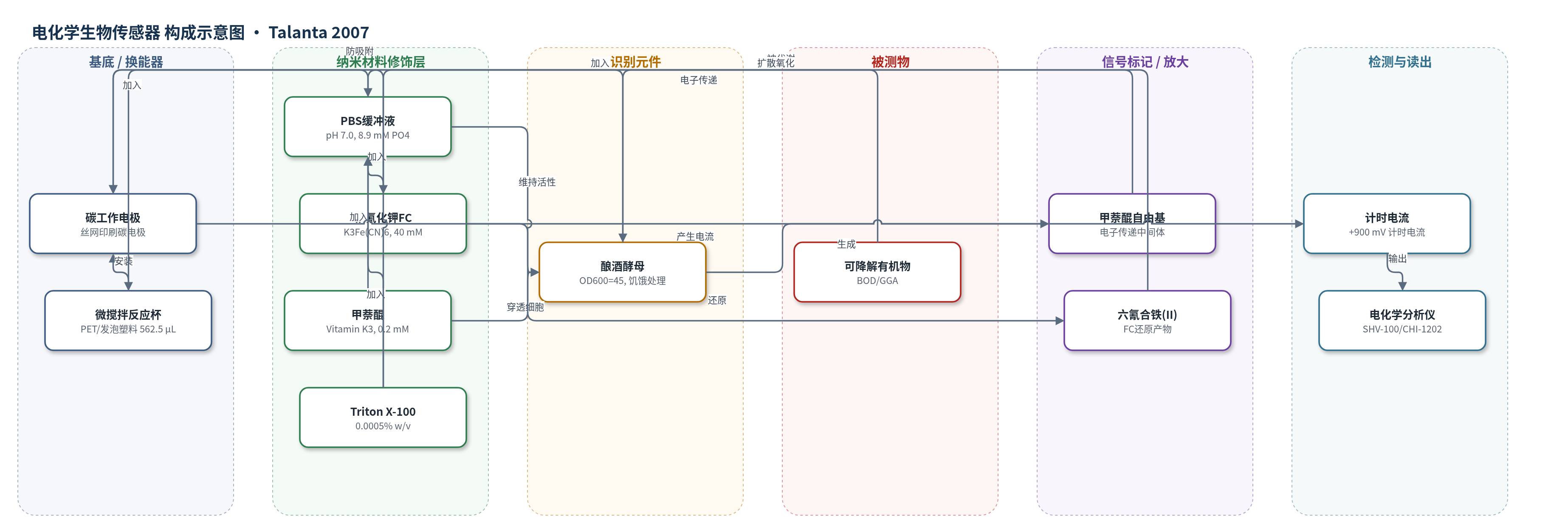
点击图片查看大图 · 依据论文自动绘制
传感器类型
电化学生物传感器
检测对象
生化需氧量(BOD, biochemical oxygen demand);样品基质:河水、海水、人工海水、葡萄糖谷氨酸(GGA)标准液、纯有机物溶液
检测原理
酿酒酵母作为全细胞识别元件,代谢水样中的可生物降解有机物,细胞内还原酶中心或代谢还原当量将电子传递给穿透酵母外膜的脂溶性介体甲萘醌,形成甲萘醌自由基。甲萘醌自由基将电子传递给水溶性铁氰化钾(FC),使FC被还原为六氰合铁(II)。六氰合铁(II)扩散至丝网印刷碳工作电极,在+900 mV下被氧化回FC,产生计时电流。有机物浓度越高,酵母代谢产生的还原当量越多,FC还原量越大,终点电流越大。Triton X-100减少甲萘醌在电极表面的吸附,PBS维持酵母活性,微搅拌改善传质。信号放大来自双介体电子穿梭与全细胞代谢循环,而非外源标记物。
检测灵敏度
LOD: 0.5 μM FF mixture;线性范围: 1 μM–10 mM FF mixture(hexacyanoferrate(II));灵敏度斜率: y = 14.7x + 0.467;R^2 = 0.9995;R.S.D.av = 1.26%;BOD线性范围: 6.6–220 mg O2 L−1;R.S.D.av = 6.6%
效应效果
该传感器对14种纯有机物的BOD响应与BOD5、BODDO、BODSPV、BODLUM和BODSM方法比较,酵母类方法之间谱图相似,葡萄糖响应最高。抗干扰方面,5.00–20.0 g/L Cl−仅有轻微影响,人工海水(18.4 g/L Cl−)响应为对照的77%;1.0 mg/L Fe3+、Cu2+、Mn2+、Cr3+和Zn2+无显著影响,相对值为98.8%–103%。酵母悬液4°C保存14天响应保持93%,6天测试RSD为9.1%,30天降至73%。河水与海水加标样品(BOD 0、75、150 mg O2/L)与BOD5法比较,相关系数分别为0.998和0.989。作者认为该方法耐盐、可快速测定海水BOD,并有望开发一次性双介体传感器芯片和便携系统。
传感器的构成
- 基底/换能器电极:丝网印刷碳电极片(screen-printed carbon electrode, SPE),两电极系统,工作电极面积18 mm2,用于氧化六氰合铁(II)并输出电流
- 传感器壳体:PET片与发泡塑料板(expanded plastic boards)构成562.5 μL微搅拌反应杯,内置8.0 mm微搅拌条
- 缓冲介质:PBS(pH 7.0,含KH2PO4、Na2HPO4、NaCl、KCl),维持离子强度与酵母活性,最终磷酸盐约8.9 mM
- 水溶性电子介体:铁氰化钾(ferricyanide, FC,K3Fe(CN)6,最终40 mM),接受甲萘醌自由基电子生成六氰合铁(II)
- 脂溶性电子介体:甲萘醌(menadione, Vitamin K3,最终0.2 mM),穿透酵母外膜,将细胞代谢电子传递至FC
- 表面活性剂:Triton X-100(最终0.0005% w/v),减少甲萘醌在碳电极表面吸附,保持电极可重复使用
- 识别元件:酿酒酵母(Saccharomyces cerevisiae)悬液(OD600=45,饥饿处理),全细胞代谢可生物降解有机物并驱动介体循环
- 信号标记物:六氰合铁(II)(ferrocyanide, K4Fe(CN)6),FC还原产物,在工作电极+900 mV氧化产生计时电流
中文摘要
本文报道了一种基于双介体(DM)系统的生化需氧量(BOD)快速测定方法,采用铁氰化钾(ferricyanide, FC)与脂溶性介体甲萘醌(menadione)以及真核微生物酿酒酵母(Saccharomyces cerevisiae)。作者构建了体积为560 μL、带微搅拌的两电极微生物传感器。计时电流响应在1 μM至10 mM六氰合铁(II)范围内呈线性(r2=0.9995,14点,n=3,平均RSD为1.3%)。优化条件表明,用于溶解甲萘醌的乙醇浓度会影响响应;在15 min反应条件下,葡萄糖谷氨酸(GGA)标准液在6.6–220 mg O2/L范围内获得良好关系(5点,n=3,RSD.av为6.6%)。传感器对14种纯有机物的响应与BOD5及其他BOD生物传感器方法比较,结果与使用Trichosporon cutaneum的BOD传感器相似。20.0 g/L氯离子和人工海水(18.4 g/L Cl−)仅有轻微影响,提示可用于海水;1.0 mg/L的Fe3+、Cu2+、Mn2+、Cr3+和Zn2+无影响。河水与海水实际样品测定结果与BOD5法比较良好。酵母悬液4°C保存14天仍稳定,响应保持93%,6天测试RSD为9.1%。
英文摘要
A new biochemical oxygen demand (BOD) sensing method employing a double-mediator (DM) system coupled with ferricyanide and a lipophilic mediator, menadione and the eukaryote Saccharomyces cerevisiae has been developed. In this study, a stirred micro-batch-type microbial sensor with a 560muL volume and a two-electrode system was used. The chronamperometric response of this sensor had a linear response between 1muM and 10mM hexacyanoferrate(II) (r(2)=0.9995, 14 points, n=3, average of relative standard deviation and R.S.D.(av)=1.3%). Next, the optimum conditions for BOD estimation by the DM system (BOD(DM)) were investigated and the findings revealed that the concentration of ethanol, used to dissolve menadione, influenced the sensor response and a relationship between the sensor output and glucose glutamic acid concentration was obtained over a range of 6.6-220mgO(2)L(-1) (five points, n=3, R.S.D.(av) 6.6%) when using a reaction mixture incubated for 15min. Subsequently, the characterization of this sensor was studied. The sensor responses to 14 pure organic substances were compared with the conventional BOD(5) method and other biosensor methods. Similar results with the BOD biosensor system using Trichosporon cutaneum were obtained. In addition, the influence of chloride ion, artificial seawater and heavy metal ions on the sensor response was investigated. A slight influence of 20.0gL(-1) chloride ion and artificial seawater (18.4gL(-1) Cl(-)) was observed. Thus, the possibility of BOD determination for seawater was suggested in this study. In addition, no influence of the heavy metal ions (1.0mgL(-1) Fe(3+), Cu(2+), Mn(2+), Cr(3+) and Zn(2+)) was observed. Real sample measurements using both river water and seawater were performed and compared with those obtained from the BOD(5) method. Finally, stable responses were obtained for 14 days when the yeast suspension was stored at 4 degrees C (response reduction, 93%; R.S.D. for 6 testing days, 9.1%).