组成图示
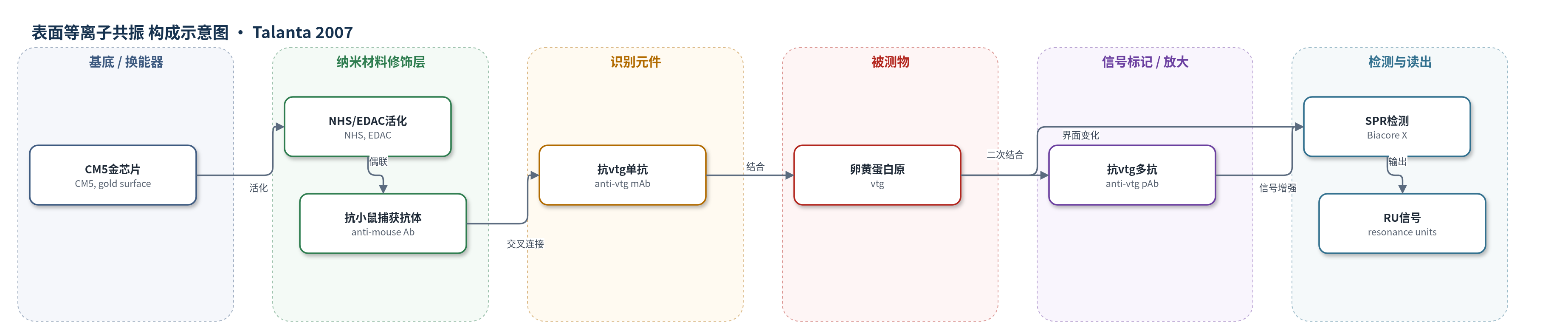
点击图片查看大图 · 依据论文自动绘制
传感器类型
表面等离子共振(SPR)生物传感器
检测对象
卵黄蛋白原(vitellogenin, vtg);样品基质:鲤鱼血浆、鲤鱼黏液、缓冲液加标样品
检测原理
该传感器基于SPR免疫检测。CM5芯片表面经NHS/EDAC活化后,先偶联anti-mouse捕获抗体,再用NHS/EDAC将anti-vtg mAb交联固定,形成可再生识别界面。样品中的vtg与固定mAb特异性结合,使金膜表面附近质量与折射率发生变化,导致SPR共振条件改变;Biacore X将这种变化转换为共振单位(RU)信号。vtg浓度越高,结合量越大,RU响应越大,在1–10 ppm范围内近似线性。可选加入anti-vtg pAb结合vtg另一表位,增加界面质量,使主响应增强约30%。检测后用NaOH解离vtg,保留抗体层以便再生。
检测灵敏度
LOD: 1 ppm;线性范围: 1–10 ppm;R^2 = 0.98;y = 6.9x + 2.9
效应效果
传感器对BSA(100 ppm)无结合,显示对vtg具有特异性。缓冲液校准平均CV为7%(n=3/浓度),鲤鱼血浆样品平均CV为12.9%(n=10)。血浆稀释1:500建立矩阵校准,样品稀释1:1000分析;黏液稀释1:100,过滤可改善基质效应。E2暴露鲤鱼与对照组区分良好,5 d后血浆vtg响应较高。与ELISA比较,R2=0.85(n=9)。表面制备少于1 h,样品分析约20 min,NaOH再生约30 s,适合快速筛查。
传感器的构成
- 基底/换能器:CM5芯片(金表面共价连接羧甲基葡聚糖,CM5),提供SPR换能界面
- 活化层:NHS(N-羟基琥珀酰亚胺)与EDAC(N-(3-二甲氨基丙基)-N'-乙基碳二亚胺)活化羧基,形成氨基偶联位点
- 捕获抗体层:anti-mouse抗体(抗小鼠抗体)作为捕获抗体,用于定向固定mAb
- 识别元件:mouse monoclonal anti-carp vtg antibodies(mAb,抗鲤鱼vtg单克隆抗体),通过NHS/EDAC与捕获抗体交联固定
- 封闭剂:ethanolamine(乙醇胺)封闭剩余活化位点
- 信号放大元件:rabbit polyclonal anti-vtg antibodies(pAb,兔抗vtg多克隆抗体),结合vtg不同表位,增强SPR信号约30%
- 再生剂:NaOH(0.5–10 mM)解离vtg免疫复合物,保留捕获抗体和mAb
中文摘要
卵黄蛋白原(vtg)是评估鱼类暴露于环境雌激素的敏感且简便的生物标志物。本研究旨在建立一种可在数分钟内完成、用于快速筛查鱼类vtg的光学免疫传感器。作者将表面等离子共振(SPR)技术(Biacore X)与免疫检测相结合,用于检测鲤鱼(Cyprinus carpio)血浆和黏液中的vtg。抗vtg单克隆抗体通过捕获抗体以化学交联方式固定在传感器表面,简单再生过程使传感器表面可重复使用。传感器以鲤鱼vtg进行优化,并用vtg加标样品以及17β-雌二醇(E2)暴露鱼的血浆和黏液进行测试。vtg可在缓冲液、血浆和黏液中达到ppm级检出,且对照组与暴露组区分良好。与ELISA比较,两种方法相关系数R2=0.85(n=9),表明该免疫化学生物传感器可用于鱼血浆vtg分析。检测时间为20 min,适合快速样品筛查。
英文摘要
Vitellogenin (vtg) has proven to be a sensitive and simple biomarker for assessing exposure of fish to environmental estrogens. The aim of this work was to develop a rapid, in the order of minutes, screening method for the detection of fish vtg. The surface plasmon resonance technique (Biacore Xtrade mark) was coupled with immunodetection for the determination of fish vtg in plasma and mucus from carp (Cyprinus carpio). Monoclonal anti-vtg antibodies were linked on the sensor surface through chemical cross-linking via a capturing antibody. A simple regeneration process allowed the reuse of the sensor surface. Sensor optimisation was carried out using carp vtg. The developed immunosensor was tested with vtg spiked samples and with plasma and mucus from fish exposed to 17beta-estradiol (E2). Vitellogenin could be detected in the ppm range in buffer as well as in plasma and mucus. Good discrimination between control and exposed samples was obtained. The results were compared with ELISA and a correlation coefficient of R(2)=0.85 (n=9) between the two methods indicated that the immunochemical biosensor could be used for the analysis of vtg in fish plasma samples. The assay time was 20min hence allowing for rapid sample screening.