组成图示
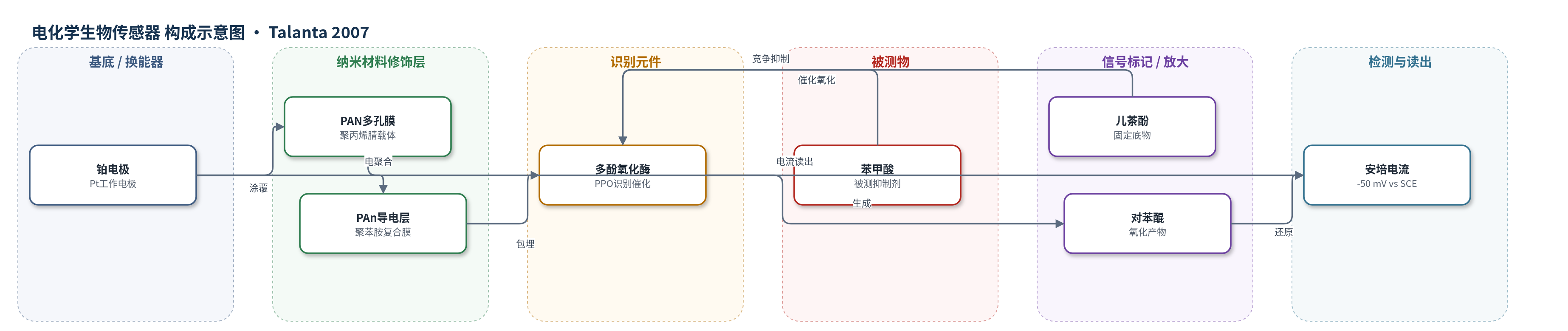
点击图片查看大图 · 依据论文自动绘制
传感器类型
电化学生物传感器
检测对象
苯甲酸(benzoic acid);样品基质:牛奶、酸奶、雪碧、可乐等食品/饮料样品及缓冲溶液
检测原理
该传感器将PPO共包埋于PAn–PAN复合膜中,PPO催化固定浓度儿茶酚氧化生成对苯醌,对苯醌在−50 mV(vs SCE)发生电化学还原,产生与酶活性相关的安培电流。苯甲酸作为竞争性抑制剂,与儿茶酚竞争PPO的儿茶酚酶活性位点,使酶催化速率下降,对苯醌生成减少,电流降低。测定无苯甲酸时电流I1和加入苯甲酸后电流I2,以抑制率Inhi%=(I1−I2)/I1×100表征苯甲酸浓度;抑制作用可逆,PBS冲洗后信号恢复。动力学分析表明Imax基本不变而Kapp M随苯甲酸增加,符合竞争性抑制,表观Ki为38 μM。
检测灵敏度
LOD: 0.2 μM (0.0244 mg L−1);线性范围: up to 20 μM;灵敏度斜率: 1.67 (% μM−1);R^2 = 0.994
效应效果
传感器对乳酸、山梨酸、柠檬酸、糖精钠和咖啡因(100 μM)的干扰为1–4%,抗坏血酸使信号增加11%。7个独立制备电极的苯甲酸测定重现性RSD为6.2%。连续30次测量活性几乎不变;4°C PBS中存储约12周响应基本不变。牛奶、酸奶、雪碧和可乐样品测定结果与HPLC官方方法一致,相对误差分别为+5.8%、+5.5%、−3.1%和+2.3%。其检出限0.2 μM(0.0244 mg/L)低于HPLC的0.5 mg/L和GC的1 mg/L。作者认为该方法快速、灵敏、操作简便,可作为传统方法替代用于食品中苯甲酸监测。
传感器的构成
- 工作电极:铂箔(Pt)作为导电基底与安培换能器
- 多孔载体层:聚丙烯腈(PAN)膜涂覆于Pt表面并经相转化形成微孔膜,提供酶固定化基质
- 导电固定化层:聚苯胺(PAn)在苯胺存在下原位电聚合形成PAn–PAN复合膜,提供导电通道并包埋酶
- 生物催化元件:多酚氧化酶(PPO)共包埋于PAn–PAN复合基质,催化儿茶酚氧化生成对苯醌
- 检测底物:儿茶酚(catechol)以固定浓度加入缓冲液,其氧化产物对苯醌在−50 mV被还原产生安培电流
中文摘要
报道了一种基于聚苯胺–聚丙烯腈复合基质的新型灵敏稳定酚类安培生物传感器,用于苯甲酸测定。该电化学传感器基于苯甲酸对多酚氧化酶(PPO)催化其底物儿茶酚活性的抑制作用,在0.1 M磷酸盐缓冲液(pH 6.5)中进行。选择相对于饱和甘汞电极(SCE)−50 mV电位和恒定20 μM儿茶酚浓度进行安培抑制测量。评估了无苯甲酸和存在苯甲酸时的米氏常数(Kapp M)和最大电流(Imax),并推断了可能的抑制机制。苯甲酸对PPO电极的抑制作用可逆,呈典型竞争性抑制,表观抑制常数为38 μM。该传感器可检测低至2×10⁻⁷ M的苯甲酸。此外研究了温度、溶液pH对抑制的影响及干扰。抑制研究表明该电化学传感器适用于牛奶、酸奶、雪碧和可乐等实际样品中苯甲酸的监测。
英文摘要
A novel sensitive and stable phenols amperometric biosensor, based on polyaniline-polyacrylonitrile composite matrix, was applied for determination of benzoic acid. The electrochemical biosensor functioning was based on the inhibition effect of benzoic acid on the biocatalytic activity of the polyphenol oxidase (PPO) to its substrate (catechol) in 0.1M phosphate buffer solution (pH 6.5). A potential value of -50 mV versus SCE, and a constant catechol concentration of 20 microM were selective to carry out the amperometric inhibition measurement. The kinetic parameters Michaelis-Menten constant (K(M)(app)) and maximum current (I(max)) in the absence and in the presence of benzoic acid were also evaluated and the possible inhibition mechanism was deduced. The inhibiting action of benzoic acid on the polyphenol oxidase electrode was reversible and of the typical competitive type, with an apparent inhibition constant of 38 microM. This proposed biosensor detected levels of benzoic acid as low as 2x10(-7)M in solution. In addition, the effects of temperature, pH value of solution on the inhibition and the interferences were investigated and discussed herein. Inhibition studies revealed that the proposed electrochemical biosensor was applicable for monitoring benzoic acid in real sample such as milk, yoghurt, sprite and cola.