组成图示
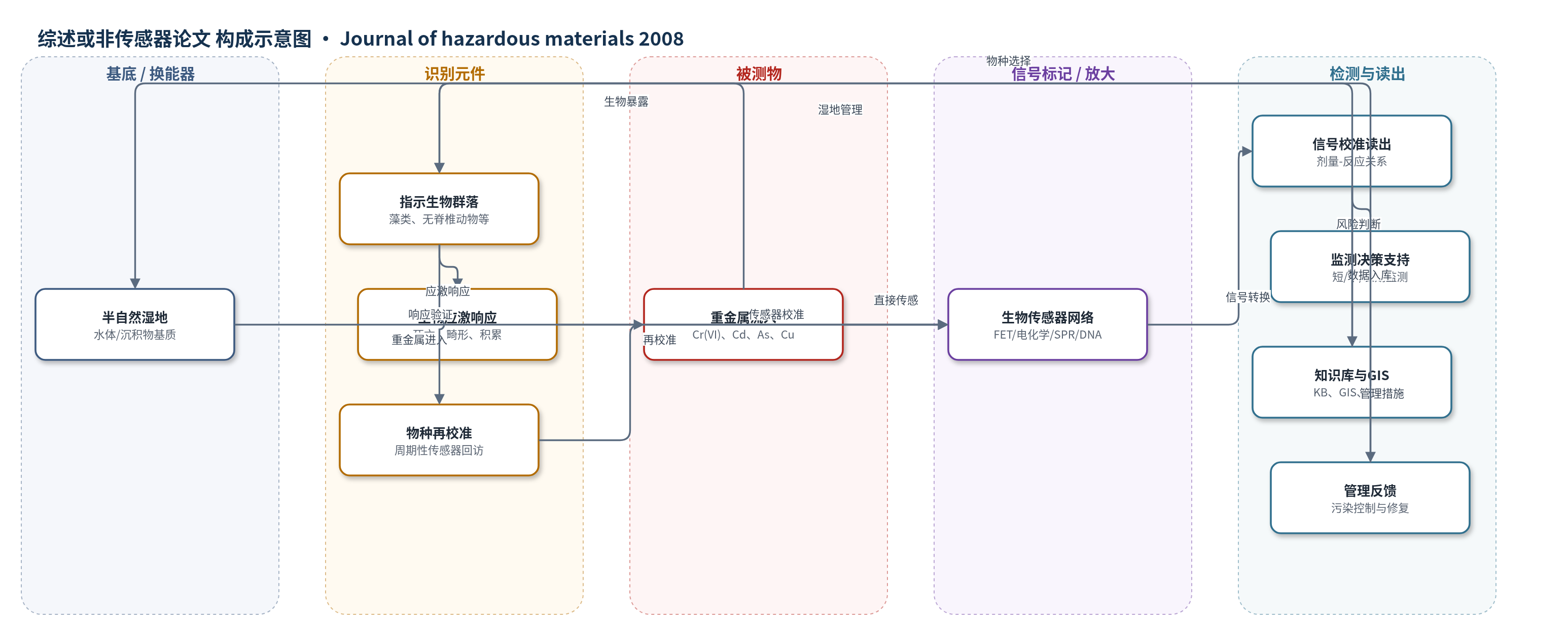
点击图片查看大图 · 依据论文自动绘制
传感器类型
综述或非传感器论文
检测对象
铬(chromium, Cr,尤其铬(VI), Cr(VI))、镉(cadmium, Cd)、砷(arsenic, As)、铜(copper, Cu);样品基质:半自然湿地水体、沉积物及生物组织/生物群落。
检测原理
该方案并非单一传感器件,而是将湿地生物群落的应激响应与生物传感器定量校准相结合。重金属(尤其铬(VI))进入半自然湿地后,通过水体、沉积物和食物链暴露于指示物种,引起急性毒性、生长/行为改变、酶或细胞系统变化以及长期生物积累/放大。基于物种生化或细胞系统构建的生物传感器,如场效应晶体管(FET)、电化学、表面等离子共振(SPR)和DNA传感器,可检测金属硫蛋白、P450、固氮酶、呼吸活性或物种DNA丰度等变化,并将其转换为电信号或光学信号。通过建立剂量–反应关系、干扰/基质效应研究和周期性传感器回访,将生物信号校准为重金属浓度或风险指标,实现短期警报、中期影响评估和长期暴露监测。
检测灵敏度
原文未报告LOD、线性范围、灵敏度斜率、R^2。
效应效果
该框架在希腊Voiotia地区试点用于铬监测。文中报告区域总铬浓度在10–200 μg/l之间,铬(VI)曾达69 μg/l,超过50 μg/l限值。通过模糊多准则PROMETHEE对短、中、长期生物群落备选方案排序:短期方案A1在低、高偏好分辨率下均最优,敏感性分析显示稳健;中期方案A3与A5存在不可比性,因此同时采用A3和A5以提高可靠性;长期方案A6稳健。作者主张该方案可降低长期仪器监测成本、提高生态相关性,并逐步转向自然生物监测,但需要志愿者参与和更多实施验证。原文未报告RSD、加标回收率或与ELISA/HPLC/qPCR的定量对比。
传感器的构成
- 监测框架:生物传感器网络与湿地生物群落动态整合,用于重金属流入监测与物种校准
- 候选识别元件:金属硫蛋白复合物(metallothionein complex)、P450系统、固氮酶(nitrogenase)、DNA探针等,用于响应铬(VI)或物种变化
- 候选换能器:场效应晶体管(FET)、电化学(electrochemical)、表面等离子共振(SPR)、DNA生物传感器等技术,用于将生物响应转换为信号
- 样品基质:半自然湿地水体、沉积物及生物组织,用于铬(Cr)、镉(Cd)、砷(As)、铜(Cu)等重金属监测
中文摘要
本文提出一种用于半自然湿地重金属浓度生物监测的框架,基于生物群落与相关生物传感器之间的稳健动态整合。该协同方案旨在降低不确定性和监测成本,提高污染控制与治理的可靠性。研究重点在于建立一套功能完整且可靠的网络方法,用于监测重点流入物,并建立剂量–反应关系、对生物监测物种进行校准。生物监测网络在监测区域内每个湿地初始同时包含生物传感器和指示物种,作为验证阶段;当生物传感器验证物种监测效率后,生物传感器网络按循环模式移至下一湿地,直至所有湿地均具备完全功能的自然监测方案。通过周期性生物传感器回访对物种进行再校准,方案逐步达到包含季节性的准稳态,从而保证可靠性与稳健性。该框架目前在希腊Voiotia地区试点用于评估铬水平,并覆盖短期、中期和长期监测需求。现有结果支持将该方案用于重金属监测,同时指出长期可行性需要志愿者参与。
英文摘要
This work introduces a semi-natural wetland biomonitoring framework for heavy metal concentrations based on a robust dynamic integration between biological assemblages and relevant biosensors. The cooperative/synergistic scheme developed minimizes uncertainty and monitoring costs and increases reliability of pollution control and abatement. Attention is given to establishing a fully functioning and reliable network approach for monitoring inflows and achieving dose-response relations and calibration of biomonitoring species. The biomonitoring network initially consists of both, biosensors and species, as a validation phase in each wetland of the surveillance area; once the species monitoring efficiency is verified by the biosensors, the biosensor network moves to the next wetland and so on, following a circular pattern until all area wetlands have a fully functional natural monitoring scheme. By means of species recalibration with periodic revisiting of the biosensors, the scheme progressively reaches a quasi steady-state (including seasonality), thus ensuring reliability and robustness. This framework, currently pilot-tested in Voiotia, Greece, for assessing chromium levels, has been built to cover short-, medium- and long-term monitoring requirements. The results gathered so far, support the employment of the proposed scheme in heavy metal monitoring, and, further, arise the need for volunteer involvement to achieve long-term viability.