组成图示
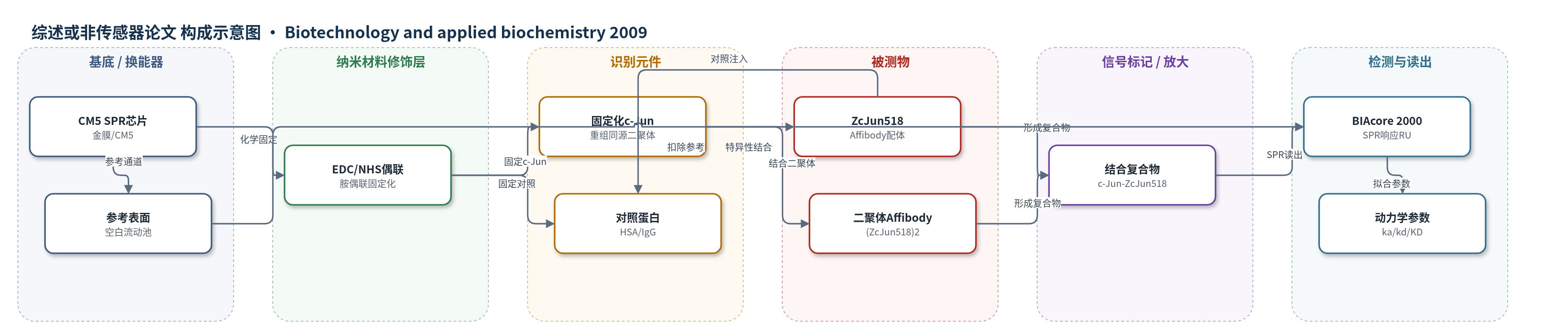
点击图片查看大图 · 依据论文自动绘制
传感器类型
综述或非传感器论文
检测对象
c-Jun 转录因子(c-Jun);在 SPR 动力学实验中分析物为 Affibody 配体 ZcJun518;样品基质:重组蛋白溶液、大肠杆菌裂解液、C8161 细胞。
检测原理
该研究采用 SPR 生物传感器实时监测 Affibody 配体与 c-Jun 的结合。重组 c-Jun 通过 EDC/NHS 胺偶联固定在 CM5 芯片表面,形成识别层;Affibody ZcJun518 或二聚体在流动池中流过,与固定化 c-Jun 特异性结合。结合事件使芯片表面质量/折射率发生变化,导致表面等离子共振角偏移,仪器以共振单位 RU 记录响应。响应随 Affibody 浓度升高而增大,通过 0.68–5.43 μM 多浓度注入拟合得到结合/解离速率和表观 KD。二聚体因双价结合使解离降低,表观亲和力提高约三倍。HSA、IgG 固定化表面和空白参考表面用于扣除非特异结合,10 mM DTT 用于再生。
检测灵敏度
未报告 LOD、线性范围、灵敏度斜率或 R^2。
效应效果
ZcJun518 对 c-Jun 具有特异性,在 SPR 中不结合 HSA 和人 IgG;C24S 突变体及其他变体无结合。亲和捕获实验显示,ZcJun518 能从含 3.9 mg/ml 大肠杆菌裂解液的复杂背景中捕获 0.1 mg/ml c-Jun,而单独裂解液无信号。Western blot 中生物素化 (ZcJun518)2 可检测裂解液中的 c-Jun 单体和二聚体,背景低。Alexa 488 标记 ZcJun518 对 C8161 细胞呈强细胞内荧光,阴性对照 Zwt 无染色。竞争实验表明其表位不同于抗 N 端抗体和 DNA TRE 位点。作者认为该 Affibody 可用于 c-Jun 检测及胞内成像。
传感器的构成
- 基底/换能器:CM5 SPR 芯片,提供表面等离子共振检测界面
- 化学偶联层:EDC/NHS 胺偶联,将 c-Jun 氨基共价固定到芯片表面
- 识别元件:重组 c-Jun 同源二聚体,固定化密度 1700 RU,用于结合 Affibody 配体
- 分析物/配体:Affibody 配体 ZcJun518 及其二聚体 (ZcJun518)2,N 端 His6 标签,作为结合探针
- 对照识别层:人 IgG 和 HSA 固定化表面,用于评估非特异性结合
- 参考表面:空白流动池,用于扣除缓冲液折射率与非特异信号
- 运行/再生介质:HBS-EP 缓冲液(5 mM Hepes、150 mM NaCl、3.4 mM EDTA、0.005% P20,pH 7.4);10 mM DTT 用于再生
中文摘要
c-Jun 是高度致癌转录因子,参与多种癌症发生。本研究从噬菌体展示的 Affibody 非免疫球蛋白支架蛋白文库中筛选结合 c-Jun 的亲和配体。在大肠杆菌中重组表达 c-Jun 同源二聚体,并通过 ELISA 验证其特异性结合含 c-Jun 应答元件的双链 DNA 发夹,不结合对照序列。经五轮噬菌体筛选,ZcJun518 在 BIAcore 生物传感器中与固定化 c-Jun 特异性结合,表观解离常数约 5 μM。构建头尾二聚体 (ZcJun518)2 后表观亲和力提高约三倍,提示协同效应。亲和捕获和 Western blot 显示,ZcJun518 在大肠杆菌裂解液复杂背景中仍特异性识别 c-Jun;Alexa 488 标记 ZcJun518 可染色 c-Jun 过表达的 C8161 细胞,共聚焦显微镜呈细胞内分布。竞争实验表明其表位不同于抗 N 端抗体及 DNA 发夹结合位点。研究讨论了 Affibody 用于转录因子胞内检测的潜力。
英文摘要
c-Jun is a highly oncogenic transcription factor involved in the development of different types of cancer. In the present study we have generated c-Jun-binding-affinity proteins from a phage-displayed library of so-called 'Affibody ligands', developed by combinatorial engineering of a non-immunoglobulin-based scaffold protein. Homodimeric c-Jun protein was recombinantly produced in Escherichia coli and, prior to selection, the quality of the target protein was investigated by binding analyses, which indicated specific binding to a double-stranded DNA hairpin construct containing a c-Jun response element, but not to a control sequence. Isolated Affibody variants from the phage selection were expressed in E. coli, purified by affinity chromatography and their interaction with c-Jun was analysed. In biosensor analyses, one Affibody ligand, denoted Z(cJun518), was shown to interact with immobilized c-Jun protein with an apparent dissociation constant of 5 microM. By constructing a head-to-tail homodimeric version of Z(cJun518), its apparent affinity for c-Jun could be increased threefold, suggesting co-operativity effects in the binding to the immobilized c-Jun protein. Further characterization of the Z(cJun518) Affibody molecule demonstrated, in both affinity-capture and Western-blotting experiments, its ability to interact selectively with c-Jun, even when the c-Jun target was present in a complex protein background consisting of a bacterial cell lysate. Z(cJun518) could also be used to stain the c-Jun-overexpressing cell line C8161 visualized by confocal fluorescence microscopy. Results from competition experiments indicated that the binding epitope on c-Jun for the Z(cJun518) Affibody molecule was separate from the binding sites of both a polyclonal antibody raised against the unstructured N-terminal domain and a double-stranded DNA hairpin containing a c-Jun response element. The potential intracellular use of Affibody ligands directed against transcription factors and other oncogenic factors is discussed.