组成图示
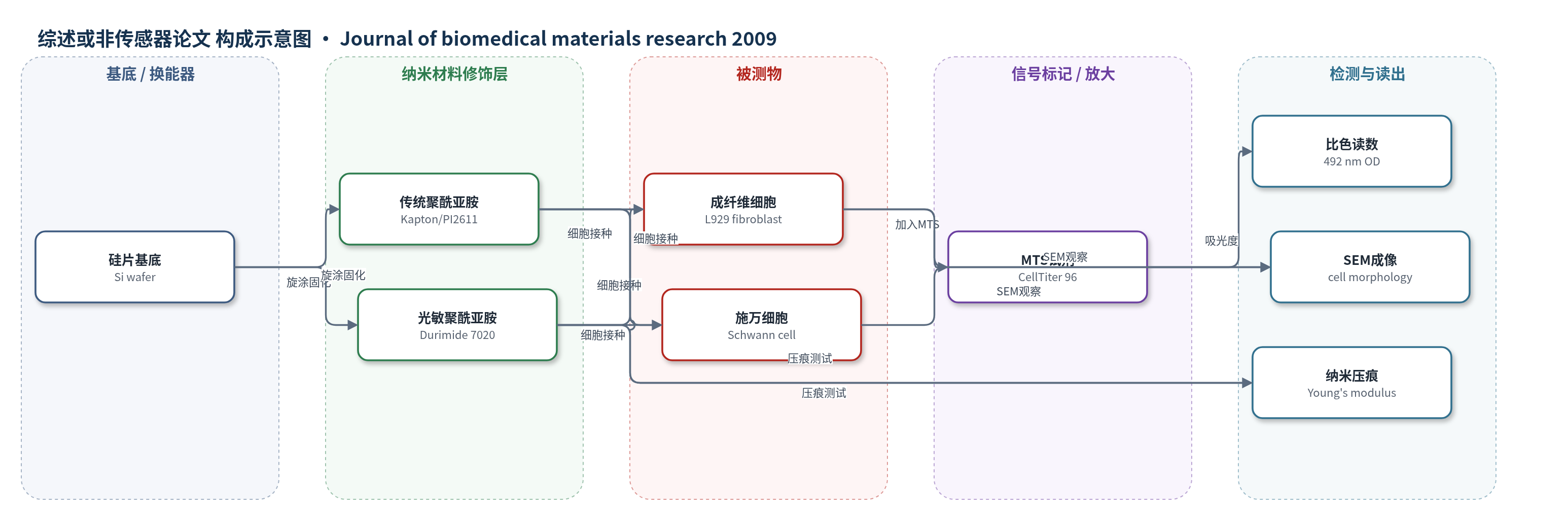
点击图片查看大图 · 依据论文自动绘制
传感器类型
综述或非传感器论文
检测对象
无明确被测分析物;材料样品:聚酰亚胺(PI)、光敏聚酰亚胺(PSPI);样品基质:DMEM 细胞培养液、PBS、L929 成纤维细胞与施万细胞培养体系。
检测原理
本文并非传感检测,而是材料生物相容性评估。将 PI/PSPI 薄膜浸提后暴露于 L929 成纤维细胞,活细胞线粒体脱氢酶将 MTS 还原为水溶性甲臜产物,492 nm 吸光度与活细胞数量成正比,用于判断材料浸提物是否引起细胞毒性。将细胞接种于薄膜表面 24 h 后,经固定、脱水、临界点干燥和喷金,用 SEM 观察细胞黏附、铺展、伪足和形态,以评价表面细胞相容性。将薄膜在 37°C PBS 中定期更换浸泡 24 周,用纳米压痕连续刚度测量法测定杨氏模量,评估材料在模拟生理环境中的长期力学稳定性。
检测灵敏度
原文未报告 LOD、线性范围、灵敏度斜率或相关系数。
效应效果
材料在 PBS 中浸泡 24 周后仍保持良好稳定性,吸水率低于 2 wt%,PSPI 薄膜热重分析显示 500°C 前仅损失约 2 wt%,600°C 以上发生热降解。纳米压痕显示三种材料杨氏模量约为 3–6 GPa;长期 PBS 浸泡后 PSPI7020 模量下降最小(ΔE/E 5.4%),PI2611 为 7.3%,Kapton HN 为 7.7%。MTS 细胞毒性试验中,各材料浸提物对 L929 成纤维细胞活力无显著影响,与聚乙烯阴性对照相当。SEM 显示 PSPI 上成纤维细胞铺展和伪足形成优于 PI2611,施万细胞在各材料上黏附铺展相似。作者认为 PSPI 适合用作神经导管等植入材料。
传感器的构成
- 基底:硅片(Si wafer),用于旋涂聚酰亚胺薄膜的支撑基底。
- 对照薄膜:Dupont Kapton HN(PI,挤出聚酰亚胺薄膜),作为传统 PI 对照材料。
- 旋涂薄膜:HD Microsystem PI2611(PI,可旋涂聚酰亚胺),旋涂并热固化后用于细胞与力学测试。
- 光敏薄膜:FujiFilm Durimide 7020(PSPI,光敏聚酰亚胺),旋涂、热固化后用于光敏材料评估。
- 细胞培养液:DMEM + 10% FCS + 1% L-glutamine,用于 L929 成纤维细胞和施万细胞培养。
- 活力检测试剂:MTS(CellTiter 96 Aqueous One Solution),活细胞将其还原为甲臜用于比色检测。
- SEM 固定体系:4% 戊二醛、1% OsO4、乙醇梯度、临界点干燥和喷金,用于细胞形貌观察。
- 力学测试体系:Berkovich 金刚石压头纳米压痕仪(NANOINDENTER XP),用于测量杨氏模量。
中文摘要
聚酰亚胺(PI)因热稳定性高、化学耐受性好且可制成薄而柔性的薄膜,已广泛用于生物传感器封装和神经植入物基底。光敏聚酰亚胺(PSPI)具有类似物理性能,并可通过光刻直接图形化,但此前生物相容性数据较少。本研究按 ISO 10993 标准对两种商用 PI(Dupont Kapton HN、HD Microsystem PI2611)和一种 PSPI(FujiFilm Durimide 7020)进行体外评估。PI2611 与 Durimide 7020 旋涂于硅片,在 150–450°C 固化并高压灭菌。采用扫描电镜观察细胞培养前后形貌,MTS 法检测细胞活力,纳米压痕法考察材料在细胞培养环境中的力学稳定性。结果显示,PSPI 与聚乙烯阴性对照及传统 PI 相比无细胞毒性;成纤维细胞在 PSPI 上的黏附、形态和铺展良好,优于 PI2611;施万细胞在各材料上表现相似。结果表明 PSPI 可用于生物微系统和神经假体应用。
英文摘要
Polyimides have been widely used for biosensor encapsulation and more recently as substrates for neural implants. They have excellent thermal stability, high chemical resistance, and can be prepared as thin, flexible films. Photosensitive polyimides present similar physical properties to polyimides, and have the advantage that they can be photo-lithographically patterned. However, to date little data on their biocompatibility has been reported. Two commercially available polyimides (PI) and one photo-sensitive polyimide (PSPI) were evaluated in vitro using the ISO 10993 standard on biocompatibility. The materials were Dupont Kapton foil HN, HD Microsystem PI2611, and Fujifilm Durimide 7020 (PSPI). PI2611 and Durimide 7020 were spin-coated on silicon wafers, cured at temperatures ranging from 150 to 450 degrees C, and sterilized by autoclave. All materials were evaluated using a scanning electron microscope pre- and postcell culture. Cell viability was determined by an MTS assay. Their mechanical properties and stability during cell culture as a function of time and environment were investigated by nanoindentation. The MTS results show that PSPI is noncytotoxic compared with the negative control of polyethylene and the conventional PIs tested. Fibroblast adhesion, morphology, and spreading were good and better on the PSPI substrate than on the PI2611. Schwann cell appearance was similar on each of the PIs and the PSPI tested. The results suggest that PSPIs may have potential use for biological microsystem and neuroprosthetic applications.