组成图示
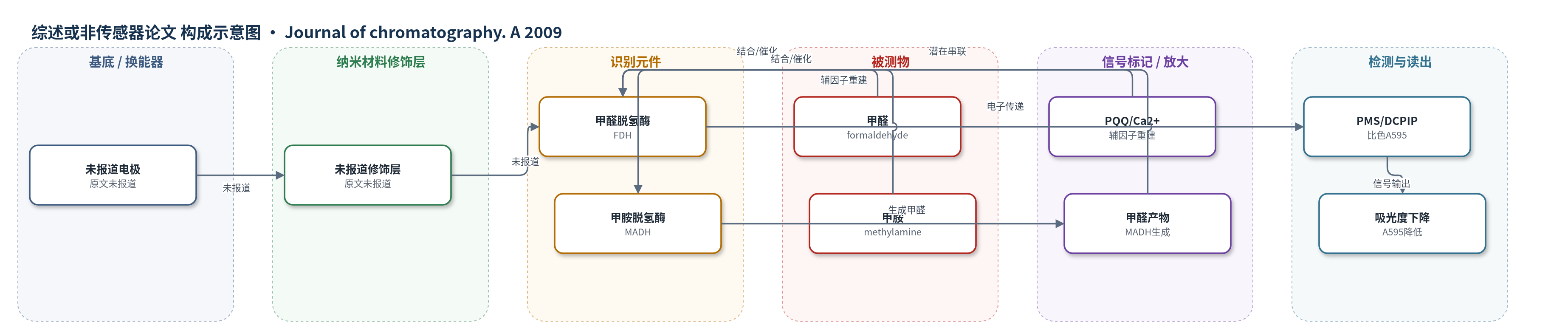
点击图片查看大图 · 依据论文自动绘制
传感器类型
综述或非传感器论文
检测对象
甲醛(formaldehyde)、甲胺(methylamine)、甲醇(methanol);样品基质:Hyphomicrobium zavarzinii ZV580 无细胞提取物及色谱分离组分
检测原理
本文未构建实际传感器,而是报道酶活检测与酶分离。脱氢酶催化底物氧化:甲醛脱氢酶(FDH)氧化甲醛,甲胺脱氢酶(MADH)将甲胺转化为甲醛。反应释放的电子先传给辅因子,再经甲氧基苯醌硫酸盐(PMS)传递给二氯酚吲哚酚(DCPIP),DCPIP被还原后由蓝变黄,595 nm吸光度下降。新FDH需Ca2+和PQQ重建活性,且对NaCl敏感。若将酶固定于换能器,底物浓度越高,氧化还原循环速率越快,吸光度或电化学信号变化越大;MADH生成的甲醛还可与FDH串联,用于甲胺的间接检测。
检测灵敏度
未报道
效应效果
先前报道的FalDH经亲和色谱和羟基磷灰石色谱均未获得有活性酶,说明该蛋白可能因辅因子丢失或突变失活。新分离的甲醛脱氢酶对甲胺和甲醇无交叉反应,需约50 μM Ca2+和PQQ重建,加入PQQ后比活性很高;但对NaCl敏感,0、10、50、100、200 mM NaCl下活性明显受抑制。甲胺脱氢酶对甲醛和甲醇无交叉反应,由约12和43 kDa两种亚基组成,可能是罕见的βγ-甲胺脱氢酶,且对盐环境较不敏感。原文未报告LOD、线性范围、RSD、回收率或与ELISA/HPLC/qPCR的定量对比,主要价值在于为甲醛/甲胺生物传感器提供候选酶。
传感器的构成
- 基底或换能器电极材料:未报道(原文未涉及传感器电极)
- 纳米材料修饰层:未报道(原文未涉及纳米修饰)
- 识别元件:甲醛脱氢酶(formaldehyde dehydrogenase, FDH)/甲胺脱氢酶(methylamine dehydrogenase, MADH)作为潜在催化识别元件
- 辅助因子:吡咯喹啉醌(pyrroloquinoline quinone, PQQ)与钙离子(Ca2+)用于新FDH活性重建
- 电子载体:甲氧基苯醌硫酸盐(phenazine methosulphate, PMS)用于酶活比色检测
- 显色底物:二氯酚吲哚酚(dichlorophenolindophenol, DCPIP)还原后吸光度下降
- 分离介质:羟基磷灰石(hydroxyapatite, HA)与阴离子交换树脂(Resource Q)用于酶纯化
中文摘要
脱氢酶是开发电化学生物传感器的有趣候选物。大多数脱氢酶具有较宽底物谱,但也存在高特异性酶。例如,Hyphomicrobium zavarzinii ZV580 中已描述一种特异性甲醛脱氢酶。从天然来源分离酶而非重组表达使分离更具挑战性,因为亲和标签等常用工具不可用。本文开发用于此类分离任务的色谱方法。先前描述的甲醛脱氢酶通过两种方法分离,一种基于亲和色谱,另一种基于羟基磷灰石。两种方法均未获得有活性酶。此外,在无细胞提取物中发现两种此前未描述的脱氢酶:甲醛脱氢酶和甲胺脱氢酶。两种酶均可通过羟基磷灰石和阴离子交换色谱序列纯化至近纯。新甲醛脱氢酶需要钙和吡咯喹啉醌重建才有活性。该酶对甲胺或甲醇无交叉反应。甲胺脱氢酶催化甲胺转化为甲醛,因此可作为逆反应的技术催化剂。该酶由两种亚基组成,可能是罕见的βγ-甲胺脱氢酶。
英文摘要
Dehydrogenases are interesting candidates for the development of electrochemical biosensors. Most dehydrogenases are characterised by a comparatively broad substrate spectrum, yet highly specific enzymes exist as well. A specific formaldehyde dehydrogenase has, e.g., been described for the organism Hyphomicrobium zavarzinii ZV580. Isolation of enzymes from their natural source instead of a recombinant expression renders the isolation more challenging, as common tools such as affinity tags are no longer available. In this contribution, we develop chromatographic procedures for such isolation tasks. The previously described formaldehyde dehydrogenase was isolated by two procedures, one based on affinity chromatography, the other on hydroxyapatite. Neither procedure yielded an active enzyme. In addition two dehydrogenases, a formaldehyde and a methylamine dehydrogenase, were found in the cell free extract, which had not been described previously. Both enzymes could be isolated to near purity by a sequence of hydroxyapatite and anion exchange chromatography. The new formaldehyde dehydrogenase requires reconstitution with calcium and pyrroloquinoline quinone in order to become active. The enzyme shows no cross-reactivity with methylamine or methanol. The methylamine dehydrogenase catalyses the conversion of methylamine into formaldehyde, hence it could become a technical catalyst for the inverse reaction. This enzyme consists of two types of subunit and may be one of the rare alpha,beta-methylamine dehydrogenases.