组成图示
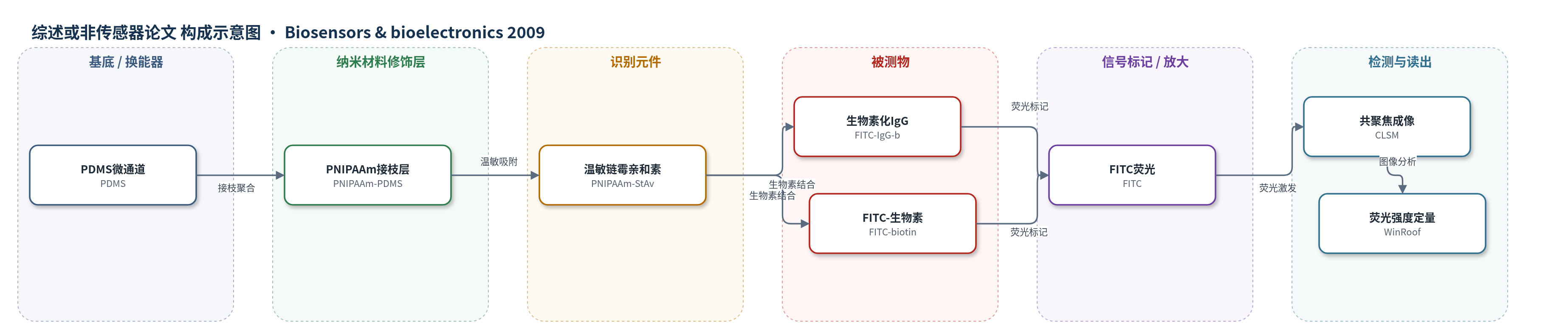
点击图片查看大图 · 依据论文自动绘制
传感器类型
综述或非传感器论文
检测对象
链霉亲和素(streptavidin, StAv)、生物素化IgG(biotinylated IgG, IgG-b)、FITC-生物素(FITC-biotin);样品基质:PBS缓冲液中的PDMS微通道表面
检测原理
PNIPAAm具有约32 °C的下临界溶液温度(LCST)。温度高于LCST时,PNIPAAm链脱水并转变为疏水构象;低于LCST时重新水化。PNIPAAm修饰的链霉亲和素(PNIPAAm-StAv)在37 °C下通过其疏水PNIPAAm链与PDMS或PNIPAAm-PDMS表面发生疏水相互作用而吸附;冷却至10 °C后PNIPAAm链水化,吸附蛋白解吸。生物素与链霉亲和素之间的高亲和非共价结合(Ka约10^14–10^15 M^-1)使生物素化IgG或FITC-生物素被特异性捕获。FITC标记的荧光强度随表面吸附蛋白量增加而增强,由CLSM成像并定量。PNIPAAm-PDMS表面通过空间位阻和降低表面疏水性减少IgG物理吸附,提高温敏吸附/解吸对比度。该体系不依赖酶或核酸放大,而依赖温敏相变与生物素-亲和素识别。
检测灵敏度
原文未报告LOD、线性范围、灵敏度斜率或相关系数。
效应效果
ATR-FTIR显示PNIPAAm酰胺峰,证实接枝成功。PNIPAAm-PDMS接触角43 °C为99.9±7.8°,25 °C为69.7±5.9°;未处理PDMS为113.2±1.2°和114.5±1.1°,表明温敏亲疏水变化。PNIPAAm-StAv产率10.5%,氨基保留46%,平均每个分子保留一个生物素结合位点;37 °C沉淀回收77% PNIPAAm-StAv和19% FITC-生物素。CLSM显示PNIPAAm-StAv及FITC-IgG-b在37 °C吸附、10 °C解吸;裸PDMS上IgG-b物理吸附更高,PNIPAAm-PDMS降低后10 °C洗涤残留少于1%。作者认为可重复使用,适用于生物传感器芯片再生和芯片上蛋白操控。
传感器的构成
- 基底/微通道:PDMS(聚二甲基硅氧烷)微通道,软光刻制作并经O2等离子体键合,提供柔性透明微流控表面
- 表面修饰层:PNIPAAm(聚N-异丙基丙烯酰胺)通过UV引发接枝聚合接枝到PDMS,LCST约32 °C,温度响应改变亲疏水性并降低非特异吸附
- 识别元件:PNIPAAm-StAv(PNIPAAm修饰链霉亲和素),由PNIPAAm-COOH经NHS/DCC活化与StAv偶联,保留生物素结合位点,介导生物素化蛋白结合与温敏吸附
- 目标模型蛋白:FITC-IgG-b(荧光素异硫氰酸标记生物素化IgG)或FITC-biotin(荧光素标记生物素),作为生物素化生物分子模型
- 信号标记物:FITC(荧光素异硫氰酸)荧光标记,用于共聚焦激光扫描显微镜成像定量
- 读出系统:CLSM(共聚焦激光扫描显微镜)配合水循环温控,激发488/495 nm、发射518/520 nm,WinRoof软件分析荧光强度
中文摘要
微通道表面蛋白吸附的可控性对提高生物传感器与生物芯片的灵敏度、准确性和重现性至关重要。本研究在聚二甲基硅氧烷(PDMS)微通道表面,利用温敏聚合物聚N-异丙基丙烯酰胺(PNIPAAm)实现了温度响应蛋白吸附。为建立通用蛋白吸附控制方法,作者采用生物素—链霉亲和素化学,合成了共价修饰PNIPAAm的链霉亲和素(PNIPAAm–StAv)。PNIPAAm修饰使亲水性链霉亲和素在37 °C吸附于PDMS微通道表面,并在10 °C解吸。进一步将生物素化免疫球蛋白G(IgG-b)与PNIPAAm–StAv偶联,实现了IgG-b的温度响应吸附。PNIPAAm修饰的PDMS表面降低了部分疏水性IgG-b的物理吸附,从而获得高对比度温敏吸附:37 °C吸附的IgG-b在10 °C洗涤后残留少于1%。该可控吸附体系有望用于生物传感器芯片再生和芯片上蛋白操控。
英文摘要
The control of protein adsorption on microchannel surfaces is important for biosensors. In this study, we demonstrated protein adsorption method that is controlled through temperature change, i.e., thermoresponsive protein adsorption, on polydimethylsiloxane (PDMS) microchannel surfaces using a thermoresponsive polymer, poly(N-isopropylacrylamide) (PNIPAAm). To provide general protein adsorption control method, we adopted biotin-streptavidin chemistry and synthesized streptavidin covalently modified with PNIPAAm (PNIPAAm-StAv). Modification of streptavidin, a hydrophilic protein, with PNIPAAm induced successful thermoresponsive adsorption on a PDMS microchannel surfaces: PNIPAAm-StAv adsorbed at 37 degrees C and desorbed at 10 degrees C on the surfaces. We also demonstrated the thermoresponsive adsorption of biotinylated immunoglobulin G (IgG-b) using PNIPAAm-StAv. Conjugation of IgG-b with PNIPAAm-StAv induced successful thermoresponsive IgG-b adsorption on PDMS. Modification of PDMS surfaces with PNIPAAm reduced physical adsorption of the partially hydrophobic IgG-b on the surface and contributed to the high-contrast thermoresponsive adsorption of IgG-b: less than 1% of the IgG-b adsorbed at 37 degrees C was detected after the PNIPAAm-PDMS surface was washed at 10 degrees C. The controllable adsorption of this system is expected to be applied to the regeneration of biosensor chips and to on-chip protein manipulation.