组成图示
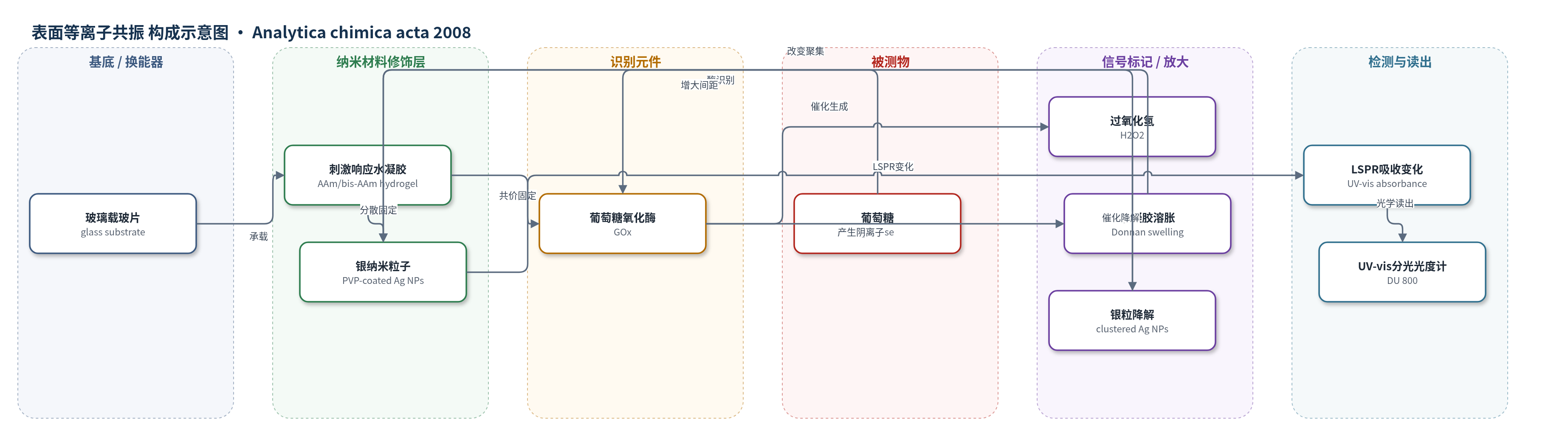
点击图片查看大图 · 依据论文自动绘制
传感器类型
表面等离子共振(SPR)生物传感器
检测对象
葡萄糖(glucose, d-glucose);样品基质:磷酸盐缓冲液(PBS, 20 mM, pH 7.4)溶液,作者亦提及唾液/泪液等无创样品。
检测原理
葡萄糖氧化酶(GOx)特异性催化葡萄糖氧化,生成葡萄糖酸、还原型 FAD 阴离子和过氧化氢(H2O2)。还原型 FAD 阴离子与葡萄糖酸使刺激响应水凝胶内部负电荷增加,形成 Donnan 电位和渗透压,引起水凝胶溶胀,使分散其中的 PVP 包覆银纳米粒子(Ag NPs)平均间距增大,LSPR 吸收强度下降。同时,H2O2 在银催化下分解并降解高度聚集的 Ag NPs,进一步改变 LSPR 吸收。葡萄糖浓度越高,酶反应产物越多,水凝胶溶胀和 Ag NPs 降解越显著,LSPR 吸收变化越大。最终用 UV-vis 分光光度计在 300–800 nm 记录吸收强度变化,实现葡萄糖定量。
检测灵敏度
LOD: 10 pM
效应效果
该传感器对葡萄糖具有良好选择性:在 1 mM 葡萄糖、蔗糖、甘露醇、磷酸盐缓冲液和 Milli-Q 水测试中,仅葡萄糖引起明显 LSPR 吸收下降。pH 5.0–9.0 范围内,固定化 GOx 最佳活性约在 pH 6.0–7.4;NaCl 浓度 0–1000 mM 时,LSPR 吸收强度随盐浓度升高而降低,但酶反应引起的吸收变化未被完全抑制。检测限为 10 pM。论文未报告 RSD、实际样品回收率或与 ELISA/HPLC/qPCR 的定量对比。作者认为该传感器无需昂贵电化学装置,具有低成本、高灵敏、结构简化的特点,可发展为医疗检测试剂盒,并适用于唾液、泪液等非侵入性葡萄糖监测。
传感器的构成
- 基底:玻璃载玻片(slide glass substrate, S-1111),承载水凝胶–银纳米粒子复合层并用于 UV-vis 光学测量。
- 水凝胶网络:丙烯酰胺(AAm)与 N,N'-亚甲基双丙烯酰胺(bis-AAm)在 2,2-二乙氧基苯乙酮(DEAP)引发下光聚合形成刺激响应水凝胶,提供可溶胀识别微环境。
- 纳米材料层:PVP 包覆银纳米粒子(PVP-coated Ag NPs, 20 nm, 0.01% w/v)分散于水凝胶中,产生 LSPR 吸收并响应粒子间距与聚集状态变化。
- 识别元件:葡萄糖氧化酶(GOx, E.C.1.1.3.4)经 EDC/NHS 共价固定于水凝胶中,特异性催化葡萄糖氧化。
- 信号放大元件:酶反应生成的过氧化氢(H2O2)催化分解并降解聚集 Ag NPs;还原型黄素腺嘌呤二核苷酸(FAD)阴离子与葡萄糖酸产生 Donnan 渗透压使水凝胶溶胀。
- 缓冲/洗涤层:磷酸盐缓冲液(PBS, 20 mM, pH 7.4)用于洗涤、孵育和去除未固定 GOx。
- 读出系统:UV-vis 分光光度计(DU 800)在 300–800 nm 记录 LSPR 吸收强度变化。
中文摘要
本文报道了一种基于局域表面等离子共振(LSPR)的光学生物酶传感器的开发,该传感器采用刺激响应水凝胶–银纳米粒子复合材料构建。通过将葡萄糖氧化酶(GOx)固定于刺激响应水凝胶中,形成酶识别元件。当葡萄糖等样品溶液接触传感器表面时,水凝胶内银纳米粒子之间的平均距离增大,导致 LSPR 吸收强度下降;同时,GOx 催化葡萄糖氧化产生的过氧化氢可分解并降解高度聚集的银纳米粒子,从而引起与葡萄糖浓度相关的显著 LSPR 吸收变化。基于上述机制,对传感器进行了表征。结果表明,该 LSPR 光学生物酶传感器能够特异性测定葡萄糖浓度,检测限为 10 pM。因此,该传感器有望用于低成本、结构简化且高灵敏的医疗检测试剂盒,并可用于非侵入性生物监测。
英文摘要
In this paper, the development of a localized surface plasmon resonance (LSPR)-based optical enzyme biosensor using stimuli-responsive hydrogel-silver nanoparticles composite is described. This optical enzyme biosensor was constructed by immobilizing glucose oxidase (GOx) into the stimuli-responsive hydrogel. When a sample solution such as glucose was applied to the surface of this optical enzyme biosensor, the interparticle distances of the silver nanoparticles present in the stimuli-responsive hydrogel were increased, and thus the absorbance strength of the LSPR was decreased. Furthermore, hydrogen peroxide, which was produced by the enzymatic reaction, induced the degradation of highly clustered silver nanoparticles by the decomposition of hydrogen peroxide. Hence, a drastic LSPR absorbance change, which depends on the glucose concentrations, could be observed. On the basis of the abovementioned mechanism, the characterization of the LSPR-based optical enzyme biosensor was carried out. It was found that the LSPR-based optical enzyme biosensor could be used to specifically determine glucose concentrations. Furthermore, the detection limit of this biosensor was 10 pM. Therefore, this LSPR-based optical enzyme biosensor has the potential to be applied in cost-effective, highly simplified, and highly sensitive test kits for medical applications.