组成图示
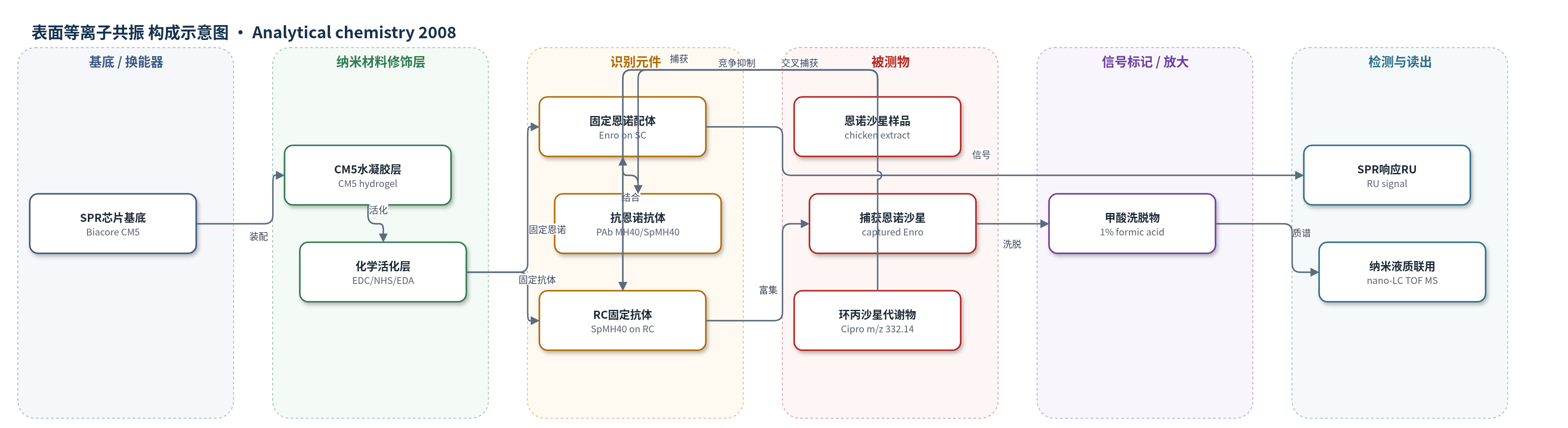
点击图片查看大图 · 依据论文自动绘制
传感器类型
表面等离子共振(SPR)生物传感器
检测对象
恩诺沙星(enrofloxacin, Enro)、环丙沙星(ciprofloxacin, Cipro);样品基质:鸡肌肉提取物(chicken muscle extracts)
检测原理
检测采用SPR抑制免疫传感器(iBIA)与亲和芯片捕获-质谱确认。样品中的恩诺沙星(Enro)先与抗Enro抗体混合,再注入固定有Enro的筛选芯片(SC)。若样品无Enro,抗体结合芯片上Enro,界面质量增加,SPR响应升高;若样品含Enro,Enro与抗体结合并竞争抑制抗体与芯片Enro的结合,响应下降,下降幅度与Enro浓度相关。疑似阳性样品重新注入固定抗体的回收芯片(RC),Enro被水凝胶抗体层捕获,经水相洗涤后用1%甲酸洗脱,进入环型接口和nano-LC ESI TOF MS,通过保留时间和准确质量(m/z 360.17)确认身份。系统无酶促放大,主要依靠亲和捕获实现选择性富集和质谱前处理。
检测灵敏度
IC50: 2.2 pg µL-1(Enro, SC A, SpMH40);IC50: 2.4 pg µL-1(鸡肌肉提取物);Cipro IC50: 85.4 pg µL-1;CR: 3%
效应效果
iBIA单样品分析时间约8.5 min。SC A最大响应约750 RU,Enro IC50为2.2 pg µL-1;鸡肌肉提取物中IC50为2.4 pg µL-1,未见基质非特异结合。RC A可稳定使用>50个循环,每循环固定抗体损失<20 RU(<0.1%),最大捕获量约500 pg(≈1.4 pmol),为理论值34%。在0.5、1、5 MRL鸡肌肉样品中均完成筛选,并在1 MRL实际样品中通过nano-LC TOF MS确认Enro(m/z 360.17),同时检出代谢物Cipro(m/z 332.14),且经LC/MS/MS独立确认。三芯片系统在0.5 MRL(提取物2.5 pg µL-1)仍给出清晰XIC峰。
传感器的构成
- 基底/换能器:Biacore 3000 SPR传感器芯片(CM5):提供表面等离子共振换能与信号读出
- 水凝胶修饰层:CM5羧甲基葡聚糖多孔水凝胶(100–200 nm):提供羧基官能团用于共价固定
- 活化/间隔层:EDC/NHS活化羧基,SC中用EDA作双功能间隔臂:形成酰胺键连接配体或抗体
- 识别元件(SC):恩诺沙星(Enro)经羧基-EDC/NHS-EDA固定:作为iBIA竞争配体
- 识别元件(RC):抗Enro/Cipro多克隆抗体SpMH40或单克隆抗体MAb72F:亲和捕获目标物
- 封闭层:1 M乙醇胺(EA):封闭未反应活化基团,降低非特异结合
- 洗脱/转移介质:1%甲酸洗脱液与HBS-EP缓冲液(含P20):洗脱捕获物并转移至loop接口
中文摘要
本文报道了一种将表面等离子共振(SPR)抑制免疫传感器(iBIA)筛选与纳米液相色谱-电喷雾电离飞行时间质谱(nano-LC ESI TOF MS)在线耦合的纳米亲和芯片接口。该接口基于可重复使用的回收芯片(RC),其表面为修饰抗体的纳米生物吸附剂,并可用SPR生物传感器表征性能。作者比较了多种水凝胶化学,标准Biacore CM5芯片与亲和纯化的多克隆抗体组合具有最高捕获能力。流程包括:样品制备;用筛选芯片(SC)进行iBIA筛选;疑似不合格样品重新注入RC,在亚纳克水平捕获分析物;洗脱捕获物并通过环型接口进入nano-LC ESI TOF MS进行鉴定。以恩诺沙星为模型化合物,在鸡肌肉实际样品中完成筛选与身份确认,并鉴定其代谢物环丙沙星。研究还证明可将SC、RC与芯片式nano-LC TOF MS组成更稳健的三芯片系统,用于快速筛选和已知/未知化合物鉴定。
英文摘要
The on-line nanoscale coupling of a surface plasmon resonance (SPR)-based inhibition biosensor immunoassay (iBIA) for the screening of low molecular weight molecules with nano-liquid-chromatography electrospray ionization time-of-flight mass spectrometry (nano-LC ESI TOF MS) for identification is described. The interface is based on a reusable recovery chip (RC) that contains a nanoscale biosorbent composed of a hydrogel layer modified with antibodies raised against the analyte featuring the unique possibility of performance characterization using the SPR biosensor. Various hydrogel chemistries were evaluated, and the standard Biacore CM5 chip showed the highest capture capacity in combination with affinity-purified polyclonal antibodies. The procedure has four stages: the samples are prepared (1) and screened using a screening chip (SC) in the iBIA (2). Suspected noncompliant samples as being noncompliant are reinjected over the RC, and the analyte is captured at subnanogram level (3). The captured analyte is released, and the eluate is analyzed with nano-LC ESI TOF MS via a loop-type interface (4). The coupling of the technologies proved effective for screening enrofloxacin, a model compound, in incurred chicken muscle samples followed by identity confirmation in suspected noncompliant samples. Ciprofloxacin, a known metabolite of enrofloxacin, was identified as well in incurred chicken samples. This demonstrates the potential of the technologies coupled by means of a RC for the rapid screening and identification of known as well as unknown compounds. Finally, we demonstrate the feasibility of combining the two biosensor chips (SC and RC) with a robust chip-based nano-LC chip TOF MS system, thus providing a robust alternative triple-chip system.