组成图示
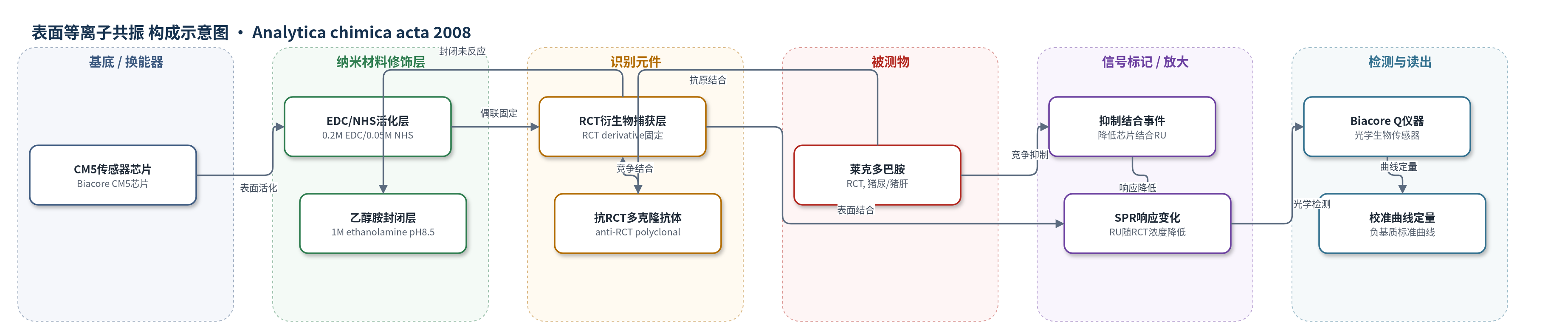
点击图片查看大图 · 依据论文自动绘制
传感器类型
表面等离子共振(SPR)生物传感器
检测对象
莱克多巴胺(ractopamine, RCT);样品基质:猪尿、猪肝
检测原理
该SPR生物传感器采用竞争抑制法。CM5芯片经EDC/NHS活化后,将RCT衍生物通过氨基偶联固定于表面,并用乙醇胺封闭未反应位点。样品中的RCT与抗RCT多克隆抗体预先混合,样品中RCT浓度越高,与抗体结合的RCT越多,抗体被抑制而与芯片表面RCT衍生物结合越少。混合液注入芯片后,表面结合量变化引起SPR界面折射率改变,Biacore Q记录相对响应单位RU,RU随样品RCT浓度升高而降低。尿中RCT葡萄糖醛酸苷先经β-葡萄糖醛酸酶水解为RCT,再经萃取和SPE净化后检测。最终依据负基质标准曲线定量。
检测灵敏度
生物传感器 LOD: 0.34 μg L−1(尿)、0.19 μg kg−1(肝);CCα <0.40 μg L−1(尿)、<0.50 μg kg−1(肝);生物传感器与LC–MS/MS相关系数: r2 = 0.99(尿)、r2 = 0.97(肝)。LC–MS/MS(组织): CCα = 9 ng kg−1;CCβ = 28 ng kg−1;线性验证浓度: 25、50、100、500 ng kg−1;r2 = 0.99;RSD = 17.3%、18.1%。
效应效果
抗体对RCT交叉反应为100%,对RCT葡萄糖醛酸苷在缓冲液、尿、肝中分别为78.0%、84.7%、21.8%,对沙丁胺醇、克伦特罗、利托君、沙美特罗等<1.0%,对异氧普≤2.7%,选择性良好。无关抗体Rmax<200 RU,抗RCT抗体Rmax>15000 RU,表明高亲和高特异。生物传感器与LC–MS/MS在尿、肝中相关系数r2分别为0.99和0.97。LC–MS/MS两条MRM过渡RSD为17.3%和18.1%。动物试验中尿在停药21天仍可检出,肝仅至5天;作者认为尿是检测RCT非法使用的优选基质,SPR筛查法可低于MRPL 3 μg/L和3 μg/kg。
传感器的构成
- 基底/换能器:CM5传感器芯片(Biacore CM5),提供SPR光学换能表面
- 活化层:EDC/NHS(0.2 M EDC/0.05 M NHS),活化芯片表面形成氨基反应位点
- 捕获配体层:RCT衍生物(RCT derivative),经氨基偶联固定,用于捕获抗体
- 封闭层:1 M ethanolamine pH 8.5,封闭未反应位点
- 识别元件:抗RCT多克隆抗体(anti-RCT polyclonal antibody),与样品中RCT竞争结合
- 运行缓冲液:HBS-EP buffer,维持抗体活性并输送样品
- 再生液:20/80 acetonitrile/250 mM NaOH,去除结合抗体恢复芯片表面
中文摘要
莱克多巴胺(ractopamine,RCT)属于β2-激动剂,已在包括美国和加拿大在内的20多个国家作为动物促生长剂获批,但在欧盟等150多个国家和地区被禁止或限制使用。随着中国因美国猪肉中检出RCT而禁止部分加工厂进口,欧洲亟需建立可靠、稳健的低浓度RCT检测方案。本研究开发了一种基于表面等离子共振(SPR)的光学生物传感器筛查方法,并与液相色谱-串联质谱(LC–MS/MS)确证方法进行比较,用于评估猪给药后尿和肝中RCT残留的检测能力。两种方法均可在尿和肝中检测低μg/kg水平药物。肝基质较不合适,停药5天后RCT残留不可检出;而尿在停药数周后仍可检出。生物传感器与LC–MS/MS在尿和肝中的相关系数r2分别为0.99和0.97。结论认为,基于肝的检测制度较难发现非法给药,尿是停药后较长时间内检测RCT残留的优良基质。
英文摘要
Ractopamine (RCT) is a member of the beta-2-agonist (beta-agonist) family. It is licensed for use as an animal growth promoter in more than 20 countries worldwide, including the United States and Canada, but is either not licensed or prohibited by over 150 others, including those within the European Union. The issue of the use of RCT in livestock bound for human consumption has risen to prominence recently following the decision by The People's Republic of China to ban the import of pork from a number of processing plants after finding traces of RCT in shipments from the U.S.A. In order to monitor for the illegal use of such compounds within Europe, there is a requirement to have a robust and reliable testing scheme capable of the detection of low concentrations of RCT. In the present study an optical biosensor screening assay was developed. The developed assay was compared with a liquid chromatography/mass spectrometry/mass spectrometry (LC-MS/MS) confirmatory procedure. These methods were used to study the ability to detect RCT in pigs following treatment. Both testing procedures were capable of detecting low microgkg(-1) concentrations of the drug in urine and liver. Liver was found to be a less suitable sample matrix, with RCT residue levels being undetectable after 5 days withdrawal of the drug. Urine samples however still contained detectable RCT residues several weeks after withdrawal. The correlation (as measured by r(2)) between the biosensor and LC-MS/MS methods was 0.99 and 0.97 for urine and liver samples, respectively. It is concluded that testing regimes based on RCT analysis in liver are less likely to detect illegal administration of the drug than those based on urine analysis. Urine samples provide an excellent matrix for the detection of RCT residues for an extended period post withdrawal.