组成图示
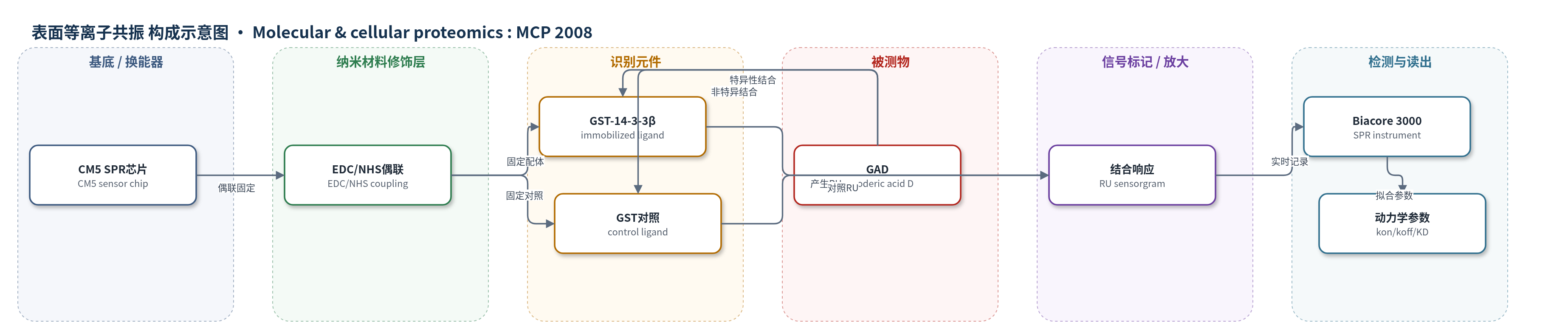
点击图片查看大图 · 依据论文自动绘制
传感器类型
表面等离子共振(SPR)生物传感器
检测对象
灵芝酸D(ganoderic acid D, GAD);样品基质为 HBS-EP 缓冲液(含 0.5% DMSO)
检测原理
SPR 检测基于表面等离子共振对界面质量变化的敏感响应。人重组 GST-14-3-3β 蛋白在 EDC/NHS 作用下通过表面氨基共价固定于 CM5 芯片,形成识别层;GST 固定于对照流道。将含 GAD 的 HBS-EP 缓冲液以 30 μl/min 注入流道,GAD 与固定 GST-14-3-3β 结合后,芯片表面质量/折射率发生变化,引起 SPR 响应单位(RU)升高;停止注入后 GAD 解离,RU 下降。结合相 RU 随 GAD 浓度增加而增大,解离相反映结合稳定性。Biacore 3000 以 1 Hz 连续记录传感器图,并用 1:1 Langmuir 模型拟合得到 kon、koff 和 KD。该方法无酶或纳米放大,直接实时检测小分子-蛋白结合。
检测灵敏度
原文未报告 LOD、线性范围、灵敏度斜率或相关系数。
效应效果
SPR 结果显示 GAD 与固定 GST-14-3-3β 的结合呈剂量依赖,RU 随 GAD 浓度增加而升高。拟合得到 kon=(5.02±0.24)×10^3 M^-1 s^-1、koff=(2.03±0.17)×10^-2 s^-1、KD=(4.04±0.32)×10^-6 M,χ²=0.32。对照 GST 表面显示较弱非特异结合,kon=(3.62±0.15)×10^3 M^-1 s^-1、koff=(2.92±0.21)×10^-2 s^-1、KD=(8.06±0.37)×10^-6 M,χ²=0.15。相同浓度下 GST-14-3-3β 的 RU 高于 GST,说明 GAD 对 14-3-3β 具有特异性结合,但可能伴随部分非特异相互作用。作者据此验证 INVDOCK 预测,支持 14-3-3 蛋白是 GAD 细胞毒性机制中的可能直接靶点。
传感器的构成
- 基底/换能器:CM5 传感器芯片,SPR 换能芯片,承载固定配体并检测界面结合响应
- 偶联试剂:EDC 和 NHS,用于 GST-14-3-3β 与 GST 的主胺共价偶联固定
- 识别元件:人重组 GST-14-3-3β 蛋白,固定于芯片流道,作为识别 GAD 的配体
- 对照元件:人重组 GST 蛋白,固定于另一流道,用于扣除非特异结合
- 运行缓冲液:HBS-EP(10 mM HEPES、150 mM NaCl、3 mM EDTA、0.005% surfactant P20,pH 7.4),维持结合环境
- 分析物:GAD 溶液(含 0.5% DMSO),注入流道与固定配体结合
- 信号读出:Biacore 3000 SPR 仪器,记录 RU 传感器图并拟合结合动力学
中文摘要
灵芝(Ganoderma lucidum)三萜类成分可抑制多种癌细胞生长,被认为是其抗肿瘤作用的基础。灵芝酸D(ganoderic acid D, GAD)是灵芝三萜主要成分之一。本文以 HeLa 人宫颈癌细胞为模型,发现 GAD 处理 48 h 后以剂量和时间依赖方式抑制细胞增殖,IC50 为 17.3±0.3 μM;流式细胞术和 DNA 片段化分析表明 GAD 诱导 G2/M 期阻滞和凋亡。为鉴定 GAD 的细胞靶点,作者采用双向凝胶电泳(2-DE)比较 GAD 处理后细胞蛋白表达谱,差异蛋白经 MALDI-TOF MS/MS 鉴定并由 Western blot 验证,共获得 21 个表达受调控蛋白。进一步用 INVDOCK 程序进行计算机药物靶点搜索,预测 GAD 可直接结合 14-3-3 蛋白家族六个亚型、annexin A5 和 aminopeptidase B。表面等离子共振(SPR)生物传感器分析证实 GAD 与 14-3-3β 存在直接结合。蛋白互作网络分析显示,21 个蛋白可被纳入一个功能关联网络,提示 14-3-3 蛋白可能在 GAD 细胞毒性机制中发挥核心作用。
英文摘要
Triterpenes isolated from Ganoderma lucidum could inhibit the growth of numerous cancer cell lines and were thought to be the basis of the anticancer effects of G. lucidum. Ganoderic acid D (GAD) is one of the major components in Ganoderma triterpenes. GAD treatment for 48 h inhibited the proliferation of HeLa human cervical carcinoma cells with an IC(50) value of 17.3 +/- 0.3 microM. Flow cytometric analysis and DNA fragmentation analysis indicated that GAD induced G(2)/M cell cycle arrest and apoptosis. To identify the cellular targets of GAD, two-dimensional gel electrophoresis was performed, and proteins altered in expressional level after GAD exposure of cells were identified by MALDI-TOF MS/MS. The regulation of proteins was also confirmed by Western blotting. The cytotoxic effect of GAD was associated with regulated expression of 21 proteins. Furthermore these possible GAD target-related proteins were evaluated by an in silico drug target searching program, INVDOCK. The INVDOCK analysis results suggested that GAD could bind six isoforms of 14-3-3 protein family, annexin A5, and aminopeptidase B. The direct binding affinity of GAD toward 14-3-3 zeta was confirmed in vitro using surface plasmon resonance biosensor analysis. In addition, the intensive study of functional association among these 21 proteins revealed that 14 of them were closely related in the protein-protein interaction network. They had been found to either interact with each other directly or associate with each other via only one intermediate protein from previous protein-protein interaction experimental results. When the network was expanded to a further interaction outward, all 21 proteins could be included into one network. In this way, the possible network associated with GAD target-related proteins was constructed, and the possible contribution of these proteins to the cytotoxicity of GAD is discussed in this report.