组成图示
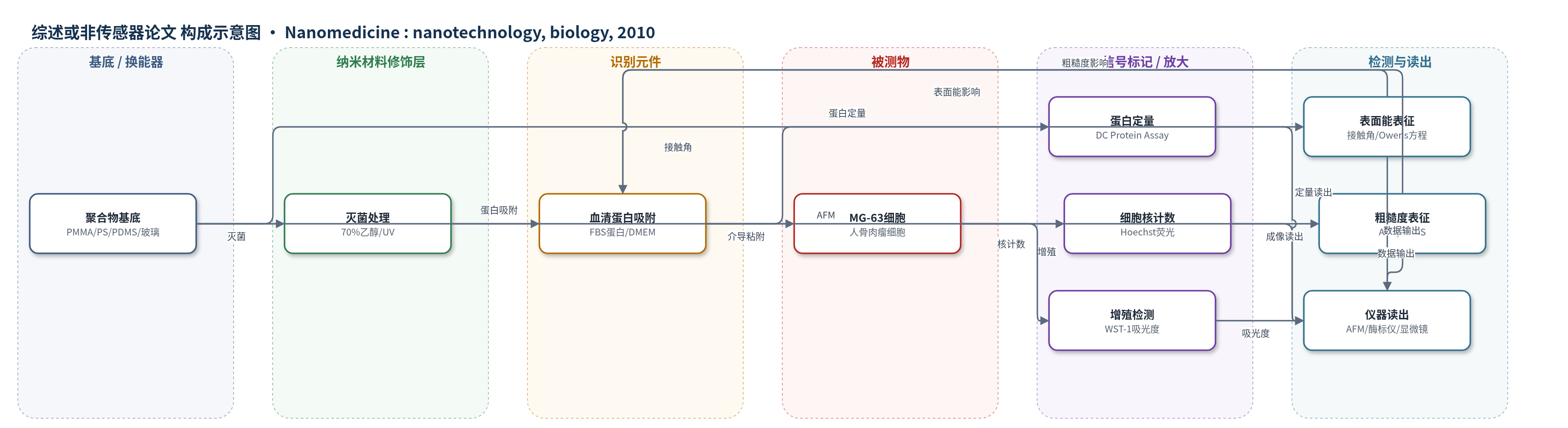
点击图片查看大图 · 依据论文自动绘制
传感器类型
综述或非传感器论文
检测对象
血清蛋白(serum proteins,FBS 蛋白)、MG-63 细胞(人骨肉瘤细胞);样品基质:DMEM 含 10% FBS 细胞培养液
检测原理
本文并非传感检测,而是研究聚合物表面性质对蛋白吸附和细胞行为的影响。聚合物基底经 70% 乙醇和 UV 灭菌后,用接触角结合 Owens 方程计算表面能的色散与极性分量,用 AFM 表征粗糙度。将基底浸入含 10% FBS 的 DMEM 中,血清蛋白在表面吸附并形成蛋白层;低表面能/疏水表面通常吸附更多蛋白,但蛋白可能发生构象变化。随后 MG-63 细胞接种于蛋白层上,细胞受体与吸附蛋白结合,影响粘附、铺展和增殖。信号读出包括 DC 蛋白法定量吸附蛋白、Hoechst 核计数评估粘附、WST-1 吸光度评估增殖。表面能、蛋白吸附量与细胞粘附/增殖之间通过界面生物相容性关联,而非电/光传感信号放大。
检测灵敏度
原文未报告检测灵敏度数值。
效应效果
灭菌未显著改变表面能;RRMS 均低于 4 nm(PMMA 3.82±1.33、PS 1.21±0.12、玻璃 0.62±0.38、PDMS 0.58±0.07 nm)。蛋白吸附量 PMMA 17.95±8.11、PDMS 17.00±1.26、PS 11.47±0.39、玻璃 9.57±3.57 μg/cm2,与表面能线性相关(r=0.98)。1 h 粘附率 PMMA 6.60%±2.60%、PS 8.15%±2.60%、PDMS 10.49%±1.24%;3 h 为 16.59%±1.38%、16.41%±8.78%、25.65%±9.79%。玻璃上细胞指数增殖,PMMA 第 3 天后线性增殖且第 7 天接近玻璃,PS 基本不变,PDMS 最低。作者认为 PMMA 适合微流控、生物传感器和组织工程。
传感器的构成
- 基底材料:PMMA、PS、PDMS 及玻璃,作为细胞培养与蛋白吸附研究基底。
- 表面状态层:70% 乙醇与 UV 灭菌后的聚合物/玻璃表面,用于评估表面能与粗糙度变化。
- 生物吸附层:DMEM 中 10% FBS 来源血清蛋白吸附层,介导 MG-63 细胞粘附。
- 检测读出层:DC 蛋白定量、Hoechst 核染色、WST-1 增殖试剂、AFM 与接触角测量,用于表征蛋白吸附和细胞行为。
中文摘要
聚合物材料广泛用于医学植入体中的细胞培养支架和组织再生支架,但生物传感器领域的新应用要求材料既兼容细胞生长,又适合技术加工。技术聚合物是制造一次性部件和其他传感元件的关键材料,因此必须表征其表面性质,尤其是加工和灭菌后。同时,理解技术聚合物与细胞接触时如何影响细胞行为也很重要。本研究旨在探讨表面能和表面粗糙度如何影响三种在研究和工业中广泛使用的聚合物材料的生物相容性:聚甲基丙烯酸甲酯(PMMA)、聚苯乙烯(PS)和聚二甲基硅氧烷(PDMS)。玻璃作为对照材料。研究通过接触角和原子力显微镜表征灭菌前后表面能与粗糙度,定量血清蛋白吸附,并用人骨肉瘤 MG-63 细胞评估粘附与增殖,以建立表面能量、蛋白吸附和细胞行为之间的联系。
英文摘要
UNLABELLED: Polymeric materials are widely used as supports for cell culturing in medical implants and as scaffolds for tissue regeneration. However, novel applications in the biosensor field require materials to be compatible with cell growth and at the same time be suitable for technological processing. Technological polymers are key materials in the fabrication of disposable parts and other sensing elements. As such, it is essential to characterize the surface properties of technological polymers, especially after processing and sterilization. It is also important to understand how technological polymers affect cell behavior when in contact with polymer materials. Therefore, the aim of this research was to study how surface energy and surface roughness affect the biocompatibility of three polymeric materials widely used in research and industry: poly(methyl methacrylate), polystyrene, and poly(dimethylsiloxane). Glass was used as the control material.
FROM THE CLINICAL EDITOR: Polymeric materials are widely used as supports for cell culturing in medical implants and as scaffolds for tissue regeneration. The aim of this research is to study how surface energy and surface roughness affect the biocompatibility of three polymeric materials widely used in research and industry: poly(methylmethacrylate) (PMMA), polystyrene (PS), and poly(dimethylsiloxane) (PDMS).