组成图示
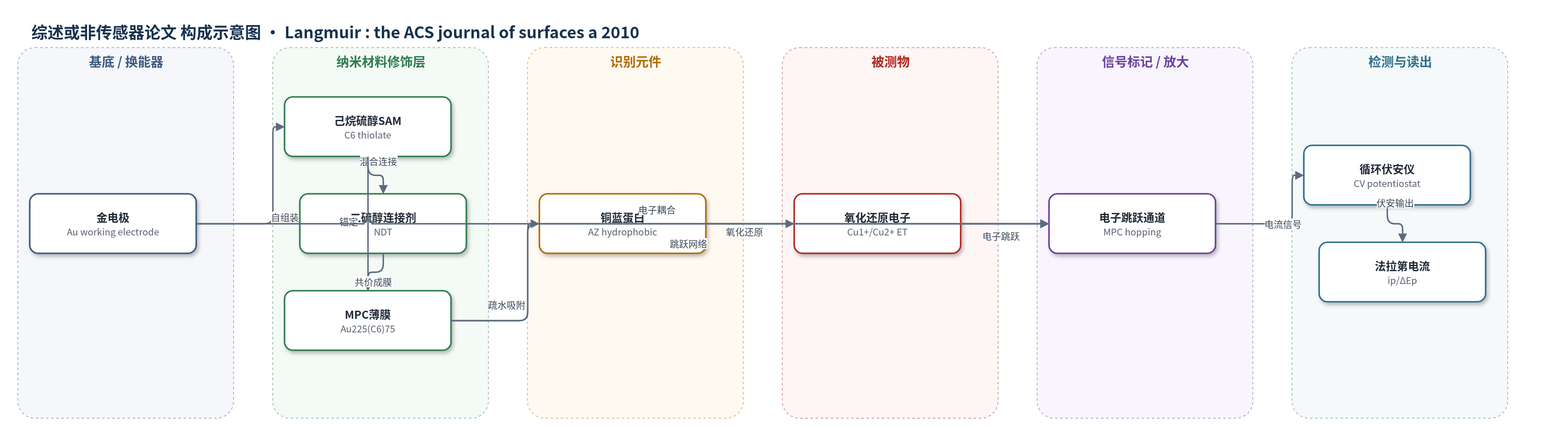
点击图片查看大图 · 依据论文自动绘制
传感器类型
综述或非传感器论文
检测对象
未报道实际分析物;研究对象为铜蓝蛋白(azurin, AZ),样品基质为 4.4 mM 磷酸钾缓冲液(KPB, pH 7.0)。
检测原理
AZ 通过疏水口袋非共价吸附到二硫醇连接的 MPC 薄膜上。循环伏安扫描时,AZ 铜中心发生 Cu(I)/Cu(II) 氧化还原,电子从金电极经 C6 锚定 SAM 进入 MPC 网络并传递至蛋白。MPC 网络由 Au225(C6)75 纳米簇构成,电子在簇间以极快跳跃方式传输(kHOP≈2×10^6 s^-1、kEX≈2×10^8 M^-1 s^-1),因此异相电子转移速率在约 20 nm 内几乎不随距离衰减;而 SAM 平台中电子隧穿随距离指数衰减(β≈0.9/CH2 或 0.8/Å)。信号表现为法拉第电流和峰分裂 ΔEp,可用 Laviron 模型计算表观 k_ET。
检测灵敏度
未报告 LOD、线性范围或 R^2;原文报告动力学参数:k_ET = 12–20 s^-1(短链 SAM);β = 0.9/CH2 或 0.8/Å;ΔEp 斜率 = 0.012 V/dip;k_ET 斜率 = -0.095/dip。
效应效果
AZ 在 MPC 薄膜上呈稳定可逆伏安,表面覆盖约 6.4±2.9 pmol/cm2,峰分裂仅 10–15 mV,ΔEp 随 dip cycle 增加斜率仅 0.012 V/dip;k_ET 在 8 个 dip cycle(约 20 nm)内仅小幅下降,斜率 -0.095/dip。SAM 平台在 9–11 个亚甲基后峰分裂显著增大,长链 ΔEp 约 100–300 mV,k_ET 呈指数隧穿衰减。作者未报告选择性、抗干扰、RSD 或实际样品回收率,但通过双电层电容、铁氰化钾探针、AFM 和截面 TEM 验证薄膜逐层组装与厚度(约 2.5 nm/dip,5 层约 10–12 nm),并主张 MPC 平台可提高蛋白负载与信噪比,用于安培生物传感器。
传感器的构成
- 基底/换能器电极:蒸镀金电极(Au,0.32 cm2),作为工作电极与电子转移界面。
- 初始自组装单分子层:己烷硫醇(C6 thiolate, H3C(CH2)5S-)SAM,锚定 MPC 并降低背景电容。
- 连接剂层:壬烷二硫醇(nonanedithiol, NDT),共价连接相邻 MPC 形成网络薄膜。
- 纳米材料修饰层:单分子层保护簇(MPC, Au225(C6)75)薄膜,提供电子跳跃通道与蛋白吸附平台。
- 识别元件/模型蛋白:铜蓝蛋白(azurin, AZ),通过疏水口袋非共价吸附于 MPC 表面。
- 信号标记物:无(原文未使用外部标记物)。
- 封闭剂/电子供体:无(原文未提及)。
中文摘要
本文用循环伏安法研究铜蓝蛋白(azurin, AZ)吸附于单分子层保护簇(MPC)薄膜修饰金电极的异相电子转移距离依赖性与动力学。MPC 薄膜由非水相己烷硫醇保护金纳米簇 Au225(C6)75 经壬烷二硫醇(NDT)共价连接形成,作为烷硫醇自组装单分子层(SAM)电极的替代蛋白吸附平台。在链长递增的 SAM 上,AZ 伏安由近可逆转为准可逆,峰分裂增大;短链 SAM 上 k_ET 为 12–20 s^-1,在 9–11 个亚甲基或约 1.23 nm 处指数衰减,β 为 0.9/CH2 或 0.8/Å,符合电子隧穿。AZ 吸附于厚度递增的 MPC 薄膜时呈可逆伏安,峰分裂仅 10–15 mV,电子转移速率在约 20 nm 内几乎不衰减。作者将其归因于 MPC 网络中极快电子跳跃的两步机制,认为该平台可构建更高蛋白负载界面并提高法拉第信号,对安培生物传感器设计有意义。
英文摘要
The distance dependence and kinetics of the heterogeneous electron transfer (ET) reaction for the redox protein azurin adsorbed to an electrode modified with a gold nanoparticle film are investigated using cyclic voltammetry. The nanoparticle films are comprised of nonaqueous nanoparticles, known as monolayer-protected clusters (MPCs), which are covalently networked with dithiol linkers. The MPC film assembly serves as an alternative adsorption platform to the traditional alkanethiolate self-assembled monolayer (SAM) modified electrodes that are commonly employed to study the ET kinetics of immobilized redox proteins, a strategy known as protein monolayer electrochemistry. Voltammetric analysis of the ET kinetics for azurin adsorbed to SAMs of increasing chain length results in quasi-reversible voltammetry with significant peak splitting. We observed rate constants (k degrees (ET)) of 12-20 s(-1) for the protein at SAMs of shorter alkanethiolates that decays exponentially (beta = 0.9/CH(2) or 0.8/A) at SAMs of longer alkanethiolates (9-11 methylene units) or an estimated distance of 1.23 nm and is representative of classical electronic tunneling behavior over increasing distance. Azurin adsorbed to the MPC film platforms of increasing thickness results in reversible voltammetry with very little voltammetric peaks splitting and nearly negligible decay of the ET rate over significant distances up to 20 nm. The apparent lack of distance dependence for heterogeneous ET reactions at MPC film assemblies is attributed to a two-step mechanism involving extremely fast electronic hopping through the MPC film architecture. These results suggest that MPC platforms may be used in protein monolayer electrochemistry to create adsorption platforms of higher architecture that can accommodate greater than monolayer protein coverage and increase the Faradaic signal, a finding with significant implications for amperometric biosensor design and development.