组成图示
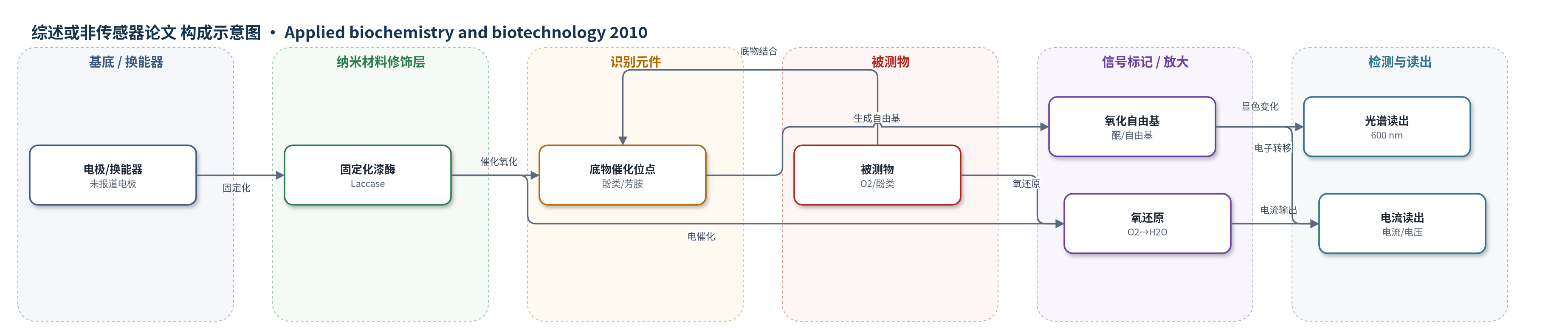
点击图片查看大图 · 依据论文自动绘制
传感器类型
综述或非传感器论文
检测对象
氧气(O2)、葡萄糖(glucose)、芳香胺(aromatic amines)、酚类化合物(phenolic compounds)、还原性底物;样品基质未明确
检测原理
文中所述漆酶生物传感器基于含四铜中心的漆酶催化单电子氧化反应。漆酶将酚类、芳胺等还原性底物氧化为自由基或醌类产物,同时分子氧在铜中心被还原为水。对于氧气传感器,一类通过监测漆酶 T1 铜被 O2 再氧化引起的 600 nm 可见光谱变化;另一类将漆酶固定在氧电极上,利用其电催化增强 O2 还原,产生电流或电压变化。对于酚类或芳胺传感器,可通过显色底物氧化后的光密度变化、与底物氧化偶联的 O2 消耗变化,或由电极替代 O2 接受底物电子来读出。被测物浓度越高,氧化产物、O2 消耗或电流响应通常越强。
检测灵敏度
原文未报告
效应效果
本文未报道具体传感器的选择性、抗干扰、稳定性、重现性(RSD)、实际样品加标回收率或 LOD 等性能数据,也未提供与 ELISA、HPLC、qPCR 等方法的定量对比。作者主要强调漆酶作为氧化酶可在温和条件下利用环境氧催化多种酚类、芳胺和还原性底物,适合用于生物传感器、酶活检测和免疫化学标记。漆酶标记抗体或抗原后可在凝胶或膜上通过局部酶活实现免疫检测。作者认为通过提高漆酶产量、优化催化活性和降低介体成本,可拓展其在农业、工业、医药和环境检测中的应用价值。
传感器的构成
- 未报道基底:原文未提供电极或基底材料
- 未报道修饰层:原文未提供纳米材料或固定化载体
- 识别元件:漆酶(Laccase)作为氧化酶催化酚类、芳胺等底物氧化
- 信号标记物:未报道;文中提及显色底物或氧电极信号
- 读出方式:600 nm 光谱变化或电流/电压变化
中文摘要
木质素为无定形、缺乏立体规整性且不易被水解攻击的高分子聚合物。尽管其结构稳定,仍能被多种微生物尤其是白腐真菌降解。白腐真菌可胞外产生木质素过氧化物酶(LiP)、锰过氧化物酶(MnP)和漆酶(laccase),三者是木质素降解的主要酶类。虽然并非所有白腐真菌都同时产生这三种酶,但漆酶在木质素降解中占有重要地位。漆酶属于氧化还原酶,又称苯二酚:氧氧化还原酶,底物特异性较低。含铜漆酶已在细菌、真菌、植物和昆虫等多种生物中被发现,多为胞外蛋白,少数为胞内酶。真菌漆酶参与形态发生、致病和木质素降解等过程。作为氧化酶,漆酶已用于农业、工业和医药领域。当前研究聚焦于基于漆酶的生物氧化、生物转化、生物传感器和有机化合物酶法合成。通过优化生理化学参数提高漆酶产量、深入理解反应机制并优化催化活性,可促进其在生物技术多领域的应用。
英文摘要
Lignin is amorphous in nature, lacks stereoregularity, and is not susceptible to hydrolytic attack. Despite its resistant nature, it is however degraded by various microorganisms, particularly, white-rot fungi. Such fungi are capable of extracellular production of lignin peroxidase, manganese peroxidase, and laccase, the three major enzymes associated with ligninolysis. Though all white-rot fungi do not produce all the three enzymes, laccase occupies an important place in ligninolysis. Laccase belongs to a diverse group of enzymes called oxidoreductases and is also known as benzenediol: oxygen oxidoreductase. They have low substrate specificity. The copper-containing enzyme laccase has been detected in a variety of organisms such as bacteria, fungi, plants, and insects. Mostly, these are extracellular proteins, although intracellular laccases have also been detected in some fungi and insects. Fungal laccases are believed to play a variety of roles, such as, morphogenesis, pathogenesis, and lignin degradation. As an oxidase, laccase is used in many agricultural, industrial, and medicinal applications. Current investigations are focused on laccase-based biooxidation, biotransformation, biosensor, and enzymatic synthesis of organic compounds. By enhancing laccase production using different physiochemical parameters, better understanding of the mechanism for the reactions of interest, and optimizing the catalytic activity of laccase, it can be used in a better way in diverse fields of biotechnology.