组成图示
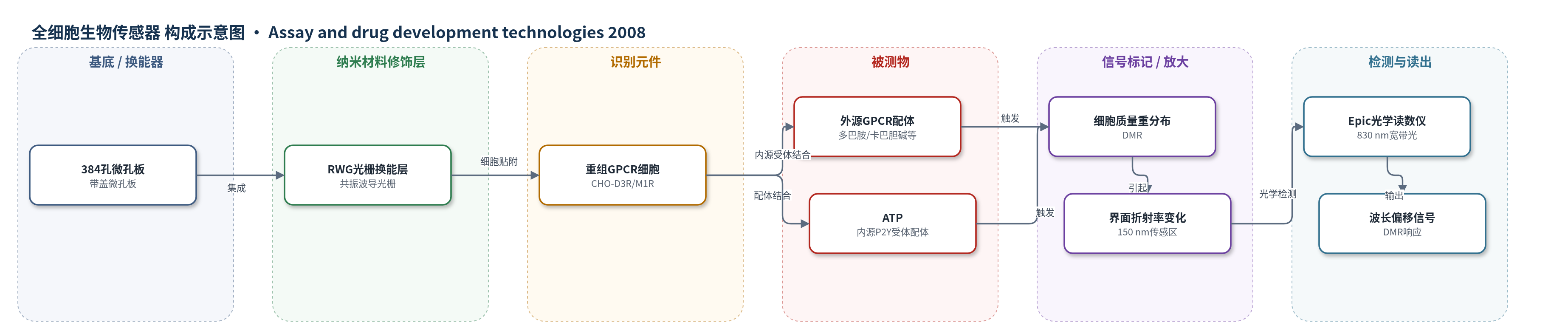
点击图片查看大图 · 依据论文自动绘制
传感器类型
全细胞生物传感器
检测对象
检测对象为作用于GPCR的化合物(多巴胺 dopamine、卡巴胆碱 carbachol、PD-128907、spiperone、oxotremorine、pilocarpine、amisulpride、haloperidol、telenzepine、scopolamine、atropine、ATP等),样品基质为CHO-GPCRa/CHO-GPCRb重组细胞及亲本CHO-K1细胞培养体系(无血清L-15培养基)。
检测原理
配体与贴附在RWG表面的CHO细胞表面GPCR结合后,激活Gi或Gq等G蛋白信号通路,引起受体转运、细胞骨架重排及细胞内容物在传感器表面附近150 nm内的动态质量重分布(DMR)。质量向传感器表面移动产生正DMR,远离表面产生负DMR。RWG光学生物传感器对复合生物传感器及附近细胞内容物的折射率变化敏感,Epic读数仪以830 nm宽带光垂直照射并测量反射光波长偏移。连续监测得到时间-波长曲线,峰强度随配体浓度呈剂量依赖,可计算EC50/IC50。该过程无标记,信号放大来自细胞信号级联和全局质量重分布;forskolin预处理可进一步区分Gi/Gq通路。
检测灵敏度
原文未报告LOD、线性范围、灵敏度斜率或相关系数。
效应效果
该DMR方法在384孔板中实现无创、无标记活细胞检测,整板读取约6 s,系统温度控制为26±0.2°C。12种化合物的DMR结果与cAMP和Ca2+流检测在激动剂/拮抗剂识别、效价排序上总体一致;M1R激动剂和拮抗剂仅在CHO-M1R细胞中活性,显示选择性。DMR还能检测内源P2Y受体对ATP的响应,EC50分别为127±18 nM(CHO-GPCRa)和232±52 nM(CHO-GPCRb)。通过forskolin预处理正确区分Gi偶联D3R和Gq偶联M1R,并可发现Ca2+流检测中遗漏的弱激动剂活性。作者认为其适用于GPCR药理学评价、机制研究和内源受体筛选。
传感器的构成
- 基底/换能器:384孔带盖微孔板,每孔集成共振波导光栅(RWG)光学生物传感器,作为光学换能器检测表面附近折射率变化
- 光学读出模块:Corning Epic微孔板读数仪,以830 nm宽带光从底部垂直照射并测量反射光波长偏移
- 识别/响应元件:CHO-GPCRa(人多巴胺D3受体,D3R)或CHO-GPCRb(人毒蕈碱乙酰胆碱M1受体,M1R)重组细胞,贴附于RWG表面,介导配体识别与信号转导
- 样品介质:无血清L-15培养基,用于细胞平衡、化合物添加和DMR连续监测
- 被测配体:12种化合物(多巴胺、卡巴胆碱、PD-128907、spiperone、oxotremorine、pilocarpine、amisulpride、haloperidol、telenzepine、scopolamine、atropine等)或ATP,与GPCR结合
- 信号标记物:无外源标记,细胞内容物动态质量重分布(DMR)作为光学信号
- 通路分析试剂:forskolin(腺苷酸环化酶激活剂),用于区分Gi/Gq偶联通路
中文摘要
Epic细胞检测技术(Corning Epic)采用共振波导光栅(RWG)光学生物传感器,通过测量细胞内容物动态质量重分布(DMR)来检测细胞对配体的响应。该DMR测量是一种无创、无标记方法,可用于评价化合物的药理学性质。本研究在384孔微孔板中,利用Corning Epic系统对12种化合物在两种重组表达G蛋白偶联受体(GPCR)的CHO细胞系中的活性进行双盲评价。通过分析细胞刺激后的DMR响应,可识别激动剂或拮抗剂,并评价其效能与效价。DMR结果与环磷酸腺苷(cAMP)和钙流检测数据良好一致。进一步分析成功识别两种GPCR激活的信号通路,并且DMR测量能够检测这些细胞中内源受体的响应。Epic DMR技术提供了一种通用平台,可用于无标记活细胞检测格式中对GPCR激活的细胞响应进行药理学评价。
英文摘要
The Epic cell assay technology (Corning Inc., Corning, NY) uses a resonant waveguide grating optical biosensor to measure cellular response to ligands manifested through dynamic mass redistribution (DMR) of cellular contents. The DMR measurement is a noninvasive, label-free assay that can be used to assess the pharmacological properties of compounds. In this study, a panel of 12 compounds was evaluated against two G protein-coupled receptor (GPCR) targets in recombinant expressed cell lines using the Corning Epic system in 384-well microplates. The evaluation was performed in a double-blinded fashion such that the identity and properties of both the GPCR targets and compounds were unknown to the researchers at the time of the study. Analysis of the DMR response from cell stimulation was used to identify compounds that functioned as agonists or antagonists and to evaluate the associated efficacy and potency. DMR results were shown to have good agreement with data obtained from cyclic AMP and calcium flux assays for compounds evaluated. A further analysis was performed and successfully identified the signaling pathways that the two GPCRs activated. In addition, the DMR measurement was able to detect responses from an endogenous receptor in these cells. The Epic DMR technology provides a generic platform amenable to pharmacological evaluation of cellular responses to GPCR activation in a label-free live cell assay format.