组成图示
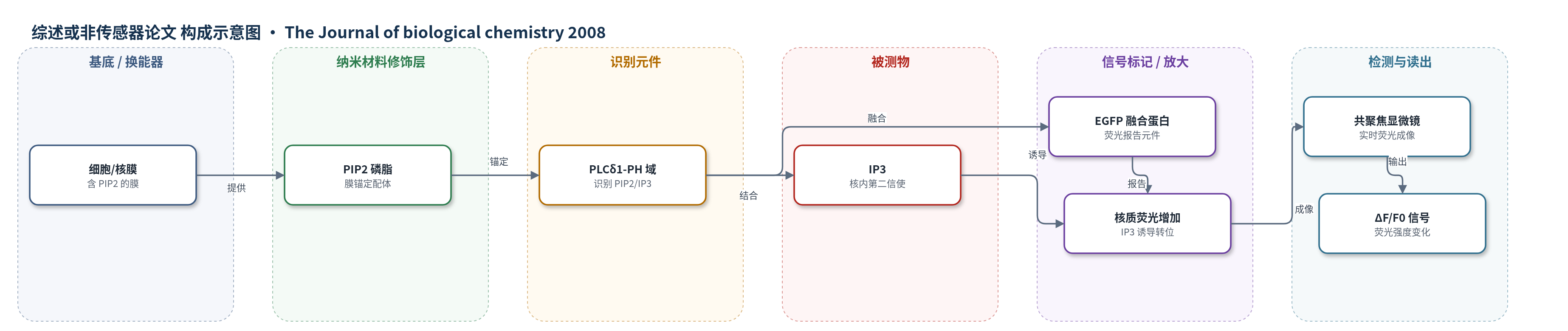
点击图片查看大图 · 依据论文自动绘制
传感器类型
综述或非传感器论文
检测对象
肌醇 1,4,5-三磷酸(IP3);样品基质:HEK293 细胞及其分离核、原代纹状体神经元及其分离核(细胞内/核内)
检测原理
该 PIP2/IP3 生物传感器由 PLCδ1 的 PH 结构域与 EGFP 融合构成。静息状态下,PH 域结合膜上的 PIP2,使 EGFP 定位于质膜或核内膜。当核 mGlu5 受体被谷氨酸/quisqualate 激活后,偶联 Gq/11 并激活 PI-PLC,水解 PIP2 生成 IP3 和 DAG。由于 PH 域对 IP3 的亲和力高于 PIP2,IP3 积累促使融合蛋白从膜转位至胞质或核质,导致 EGFP 荧光分布和局部强度改变。激光共聚焦显微镜实时记录 ΔF/F0,IP3 浓度升高时荧光信号增强或转位幅度增大。该过程无外源酶放大,主要依赖 PH 域对 IP3 的高亲和识别和膜-核质转位实现信号转换。
检测灵敏度
未报告
效应效果
该 PIP2/IP3 生物传感器在 HEK293 核和纹状体神经元中可实时显示 mGlu5 激活后的核 IP3 产生,且信号可被 mGlu5 拮抗剂 MPEP 阻断。F767S 突变体虽正常结合配体,但不能诱导核 Ca2+ 振荡;显性负性 Gαq 使核 Ca2+ 降低约 80%,胞质降低 80–85%。PLCβ1 siRNA 使胞质和核 Ca2+ 分别降低 78% 和 83%。药理学上,U73122 和 ET-18-OCH3 阻断核 Ca2+ 反应,而 D609 和 LY294002 无效;xestospongin C 抑制约 75%。放射性 IP 测定显示谷氨酸使细胞 IP 增加 41%、核 IP 增加 21%,IP3 分别增加约 25% 和 15%。作者据此主张核可独立于胞质产生局部 Ca2+ 信号。
传感器的构成
- 换能基底:细胞质膜/核内膜,提供 PIP2 结合位点并作为荧光定位参考
- 膜修饰层:磷脂酰肌醇-4,5-二磷酸(PIP2),作为 PLCδ1-PH 域的膜锚定配体
- 识别元件:PLCδ1(磷脂酶 C δ1)的 PH 结构域,高亲和力结合 PIP2 和 IP3
- 信号标记物:增强绿色荧光蛋白(EGFP),与 PH 域融合,报告膜-核质转位
- 被测物:肌醇 1,4,5-三磷酸(IP3),由 PI-PLC 水解 PIP2 产生
- 读出装置:激光共聚焦显微镜,实时采集 EGFP 荧光 ΔF/F0 变化
中文摘要
本文报道了激活的核代谢型谷氨酸受体5(mGlu5)如何偶联核Gq/11蛋白并产生肌醇1,4,5-三磷酸(IP3)介导的核内Ca2+释放。此前研究显示mGlu5可表达于异源细胞核膜或纹状体神经元内源核膜,并介导核Ca2+变化。作者采用药理学、光学和遗传学技术证明,核mGlu5受体激活后可在核内原位生成IP3。在HEK293细胞中表达阻断Gq/11偶联的mGlu5 F767S突变体,或在纹状体神经元中引入显性负性Gαq,均能阻止受体激活后的核Ca2+变化,表明核mGlu5通过Gq/11动员核Ca2+。核mGlu5介导的Ca2+反应可被磷脂酶C(PLC)抑制剂U73122、磷脂酰肌醇PLC抑制剂ET-18-OCH3或靶向PLCβ1的小干扰RNA阻断,说明PI-PLC参与。利用PIP2/IP3生物传感器直接检测肌醇磷酸产生,首次显示核mGlu5激活后可在核内生成IP3。此外,IP3受体和兰尼碱受体阻断剂均可阻止核内Ca2+升高。综上,核mGlu5受体与质膜受体类似,偶联Gq/11和PLC,通过IP3介导核内Ca2+释放;核可作为独立于胞质信号的自主细胞器,以特定、局部方式动员Ca2+。
英文摘要
Recently we have shown that the metabotropic glutamate 5 (mGlu5) receptor can be expressed on nuclear membranes of heterologous cells or endogenously on striatal neurons where it can mediate nuclear Ca2+ changes. Here, pharmacological, optical, and genetic techniques were used to show that upon activation, nuclear mGlu5 receptors generate nuclear inositol 1,4,5-trisphosphate (IP3) in situ. Specifically, expression of an mGlu5 F767S mutant in HEK293 cells that blocks Gq/11 coupling or introduction of a dominant negative Galphaq construct in striatal neurons prevented nuclear Ca2+ changes following receptor activation. These data indicate that nuclear mGlu5 receptors couple to Gq/11 to mobilize nuclear Ca2+. Nuclear mGlu5-mediated Ca2+ responses could also be blocked by the phospholipase C (PLC) inhibitor, U73122, the phosphatidylinositol (PI) PLC inhibitor 1-O-octadecyl-2-O-methyl-sn-glycero-3-phosphorylcholine (ET-18-OCH3), or by using small interfering RNA targeted against PLCbeta1 demonstrating that PI-PLC is involved. Direct assessment of inositol phosphate production using a PIP2/IP3 "biosensor" revealed for the first time that IP3 can be generated in the nucleus following activation of nuclear mGlu5 receptors. Finally, both IP3 and ryanodine receptor blockers prevented nuclear mGlu5-mediated increases in intranuclear Ca2+. Collectively, this study shows that like plasma membrane receptors, activated nuclear mGlu5 receptors couple to Gq/11 and PLC to generate IP3-mediated release of Ca2+ from Ca2+-release channels in the nucleus. Thus the nucleus can function as an autonomous organelle independent of signals originating in the cytoplasm, and nuclear mGlu5 receptors play a dynamic role in mobilizing Ca2+ in a specific, localized fashion.