组成图示
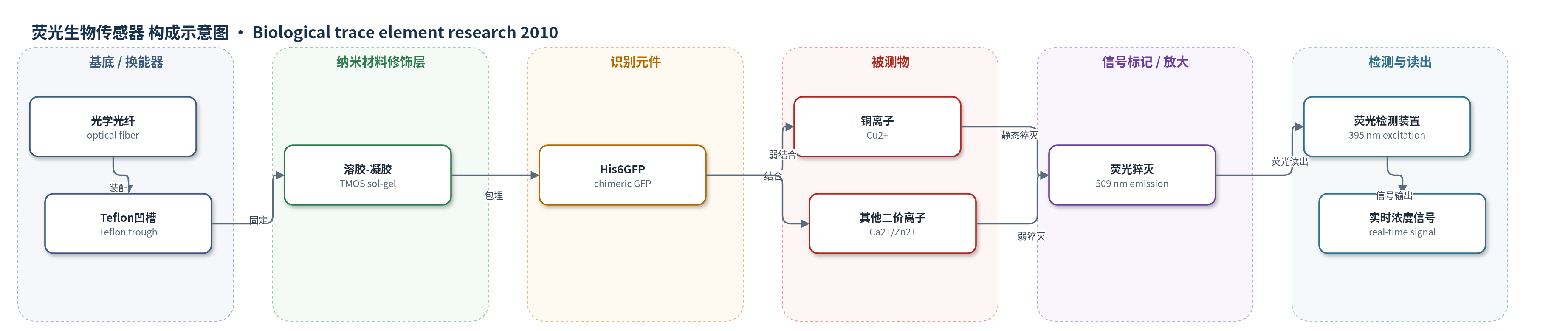
点击图片查看大图 · 依据论文自动绘制
传感器类型
荧光生物传感器
检测对象
铜离子(copper ions, Cu2+);样品基质为 HEPES 缓冲液/金属溶液(可拓展至饮用水等环境水样)
检测原理
His6GFP 的 N 端六组氨酸标签及分子内组氨酸促进 Cu2+ 在发色团附近富集;Cu2+ 与发色团形成非荧光基态复合物,发生静态猝灭,使 395 nm 激发下 509 nm 荧光发射强度随 Cu2+ 浓度升高而降低,发射峰位置基本不变。圆二色性谱图未显示明显二级结构改变,说明荧光降低主要来自基态静态猝灭,而非显著构象变化。His6GFP 被包埋于 TMOS 溶胶-凝胶并固定于光纤,溶胶-凝胶允许 Cu2+ 扩散进入并维持蛋白活性;光纤传输激发光并收集荧光,荧光检测装置实时监测 509 nm 发射变化,从而定量 Cu2+。EDTA 可螯合 Cu2+ 并恢复荧光,实现传感器再生。
检测灵敏度
检测范围: 0.5 μM–50 mM
效应效果
该传感器对 Cu2+ 选择性高,猝灭敏感性顺序为 Cu2+ >>> Zn2+ ≫ Ca2+。5 mM Cu2+ 与 5 mM Ca2+ 或 Mg2+ 混合时,钙、镁未对铜猝灭造成显著干扰;封装后 Fe2+ 猝灭较强,Mn2+、Cd2+、Zn2+ 仅使荧光降低约 15–20%,Ca2+、Mg2+ 影响极小。传感单元在 0.5 μM–50 mM 范围内实时定量 Cu2+,灵敏度可与常见荧光探针相比。其检出限虽比原子吸收光谱和 ICP-MS 低约 3–6 个数量级,但仍覆盖 WHO 建议的铜毒性剂量 31 μM(2 mg Cu/L)。EDTA 处理可恢复约 80% 荧光,显示可再生性;作者认为其操作简便、稳定性高,适合铜离子监测。文中未报告实际样品加标回收率、RSD 及与 ELISA/HPLC/qPCR 的直接对比。
传感器的构成
- 基底/换能器:光学光纤(optical fiber)与 Teflon 凹槽(Teflon trough),用于固定传感层并传输激发/发射光
- 包埋基质:溶胶-凝胶(Sol-gel,TMOS/水/HCl 预聚,NaOH 固化),包埋 His6GFP 并允许 Cu2+ 扩散
- 识别元件:His6GFP(chimeric hexahistidine green fluorescent protein),通过六组氨酸结合 Cu2+
- 信号标记物:His6GFP 自身荧光(509 nm 发射),Cu2+ 结合后发生静态猝灭
- 平衡介质:HEPES 缓冲液(5 mM HEPES, 0.85% NaCl, pH 7.1),维持蛋白微环境并作为样品介质
- 再生试剂:EDTA(50 mM 平衡/1 mM 恢复),螯合 Cu2+ 使荧光恢复
- 信号读出:荧光检测装置(fluorescence detecting device),395 nm 激发、509 nm 发射监测
中文摘要
本研究探索以嵌合金属结合绿色荧光蛋白 His6GFP 作为活性指示剂,通过光谱法测定铜离子。向 His6GFP 溶液中加入铜离子后,荧光强度随铜浓度升高而显著降低;在 500 μM 铜存在下荧光可快速下降约 60%,而锌、钙离子仅引起约 10–20% 的荧光变化。加入 EDTA 后,原始荧光可恢复至约 80%。金属离子存在时发射峰位置基本不变,但吸收光谱光密度降低,提示发色团基态可能受到静态猝灭影响。圆二色性测量显示,铜离子处理后 His6GFP 的整体二级结构谱图与对照无显著差异,主要表现为 195–196 nm 附近的尖锐正带和 215–216 nm 附近的宽负带,说明荧光降低主要源于静态猝灭而非明显构象改变,但也不能排除局部肽链重排。进一步将 His6GFP 包埋于溶胶-凝胶并固定于光纤,连接荧光检测装置,将传感单元浸入含铜溶液后可实时监测荧光猝灭。该传感单元在 0.5 μM–50 mM 范围内对铜离子具有较高灵敏度和选择性,显示荧光蛋白基生物分析工具用于铜离子测定的应用潜力。
英文摘要
In the present study, spectroscopic determinations of copper ions using chimeric metal-binding green fluorescent protein (His6GFP) as an active indicator have been explored. Supplementation of copper ions to the GFP solution led to a remarkable decrease of fluorescent intensity corresponding to metal concentrations. For circumstances, rapid declining of fluorescence up to 60% was detected in the presence of 500 microM copper. This is in contrast to those observed in the case of zinc and calcium ions, in which approximately 10-20% of fluorescence was affected. Recovery of its original fluorescence up to 80% was mediated by the addition of ethylenediamine tetraacetic acid. More importantly, in the presence of metal ions, the emission wavelength maximum remains unchanged while reduction of the optical density of the absorption spectrum has been observed. This indicates that the chromophore's ground state was possibly affected by the static quenching process. Results from circular dichroism measurements revealed that the overall patterns of circular dichroism spectra after exposure to copper ions were not significantly different from that of the control, where the majority of sharp positive band around 195-196 nm in combination with a broad negative deflection around 215-216 nm was obtained. Taken together, it can be presumed that copper ions exerted their static quenching on the fluorescence rather than structural or conformational alteration. However, notification has to be made that some peptide rearrangements may also occur in the presence of metal ions. Further studies were conducted to investigate the feasibility of using the His6GFP as a sensing unit for copper ions. The His6GFP was encapsulated in Sol-gel and immobilized onto the optical fiber connected with a fluorescence detecting device. The Sol-gel was doped into the metal solution where the quenching of fluorescence could be monitored in real time. The sensing unit provided a high sensitivity of detection in the range of 0.5 microM to 50 mM with high selectivity for copper ions. All these findings open up a high potential to apply the fluorescent protein-based bioanalytical tool for copper determination in the future.