组成图示
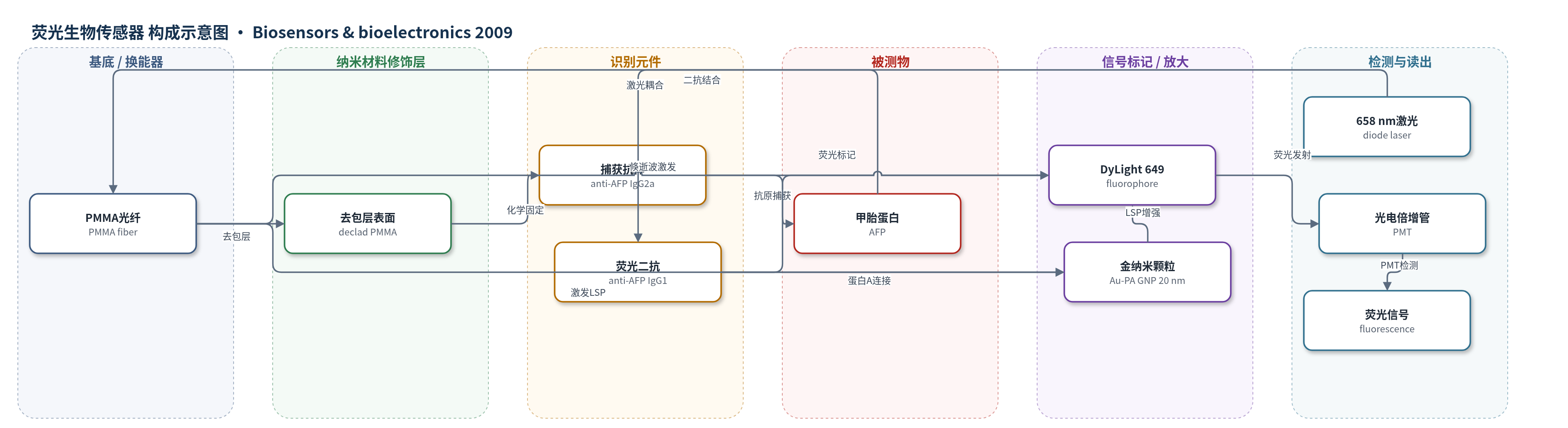
点击图片查看大图 · 依据论文自动绘制
传感器类型
荧光生物传感器
检测对象
甲胎蛋白(alpha-fetoprotein, AFP);样品基质:磷酸盐缓冲液(PBS)和人血清(human serum)
检测原理
传感器以去包层PMMA光纤为换能基底,表面固定抗AFP捕获抗体并用BSA封闭。样品中的AFP与捕获抗体结合后,加入DyLight 649标记的抗AFP二抗-Au-PA探针,形成夹心复合物。658 nm激光在光纤中传播,去包层区产生倏逝波,激发Au-PA表面局域表面等离子体(LSP),在金纳米颗粒附近形成强局域电磁场,高效激发邻近DyLight 649荧光团,产生LSPCF/金属增强荧光。每个探针含多个荧光团同时被激发,实现信号放大。结合AFP越多,荧光信号越强,经680.4 nm窄带滤光片由PMT检测,锁相放大器提高信噪比,从而获得与AFP浓度对数相关的响应。
检测灵敏度
LOD: 0.1 ng/mL (1.4 pM) in PBS;血清最低可测: 2.33 ng/mL;线性范围: 0 ng/mL–100 ng/mL (PBS, logistic scale);2.33 ng/mL–143.74 ng/mL (human serum, logistic scale);检测范围: 0.1 ng/mL–100 ng/mL (PBS);灵敏度斜率: y = 0.0025 Ln(x) + 0.0145 (PBS);y = 0.0028 Ln(x) + 0.0010 (human serum);R^2 = 0.9868 (PBS);R^2 = 0.9331 (human serum)
效应效果
该传感器PBS中AFP对数浓度线性R^2=0.9868,人血清R^2=0.9331,与商品ELISA可测范围2.33–143.74 ng/mL一致。非特异BSA背景不变,非特异结合可忽略;除背景外SNR>5,未报告长期稳定性与RSD。PBS中0.1、1、10、100 ng/mL误差百分比为14.04%、16.71%、7.63%、10.50%;血清2.33 ng/mL误差44.84%,143.74 ng/mL误差6.91%。PBS检出限0.1 ng/mL(1.4 pM)优于ELISA约9.9 ng/mL,血清检测限2.33 ng/mL与ELISA相当,并避免RIA放射性风险。作者认为其成本低、可一次性使用、光学结构简单,可作临床快速免疫分析。
传感器的构成
- 基底/换能器:PMMA塑料光纤(polymethyl methacrylate, PMMA fiber,1000 μm直径),去包层区1.4 cm²,传导658 nm激光并产生倏逝波
- 表面修饰:去包层PMMA表面经化学吸附共价固定捕获抗体,形成生物识别界面
- 识别元件:鼠源单克隆抗AFP捕获抗体(anti-AFP,IgG2a,Clone C3,Sigma),特异性捕获AFP
- 封闭剂:BSA(bovine serum albumin,10 mg/mL),封闭非特异结合位点
- 信号识别探针:DyLight 649标记的鼠源单克隆抗AFP二抗(anti-AFP,IgG1,Clone F1,GeneTex),识别AFP并提供荧光
- 信号放大元件:蛋白A-金纳米颗粒(Au-PA,GNP diameter 20 nm,Sigma),通过蛋白A连接二抗,提供LSP增强并作为间隔避免荧光猝灭
- 信号读出:658 nm diode laser激发,680.4 nm窄带干涉滤光片,PMT(photomultiplier tube)检测荧光,锁相放大器提高信噪比
中文摘要
本研究报道了一种基于局域表面等离子体耦合荧光(LSPCF)的光纤生物传感器,用于直接检测人血清中的甲胎蛋白(alpha-fetoprotein, AFP)。AFP是肝细胞癌和生殖细胞肿瘤的重要肿瘤标志物,健康成人血清水平通常低于25 ng/mL,升高可提示肝癌等疾病。该传感器以去包层聚甲基丙烯酸甲酯(PMMA)光纤为基底,表面化学固定抗AFP捕获抗体,并用牛血清白蛋白(BSA)封闭;检测时采用夹心免疫分析,荧光探针由DyLight 649标记的抗AFP二抗与蛋白A-金纳米颗粒(Au-PA)组成。658 nm激光激发光纤倏逝波,进而激发金纳米颗粒表面局域表面等离子体,高效增强邻近荧光团的发射。实验结果表明,PBS中AFP在0.1–100 ng/mL范围内呈对数线性响应,人血清中2.33–143.74 ng/mL范围内亦呈线性响应;PBS检出限为0.1 ng/mL(1.4 pM),血清最低可测浓度为2.33 ng/mL,性能与ELISA相当。该传感器具有成本低、可一次性使用、光学结构简单等优点,有望用于临床快速免疫检测。
英文摘要
In this study, we demonstrated that the fiber-optic biosensor based on localized surface plasmon coupled fluorescence (LSPCF) is capable of detecting alpha-fetoprotein (AFP) in human serum. The sensitivity of LSPCF fiber-optic biosensor is not only enhanced but also the specific selectivity is improved since the fluorophores are excited by the localized surface plasmon with high efficiency. Experimentally, this fiber-optic biosensor is able to detect AFP concentration in phosphate buffered saline (PBS) solution from 0.1ng/mL to 100ng/mL whereas the linear relationship between the AFP concentrations and the fluorescence signals is shown. Furthermore, a linear response between the fluorescence signals and the concentrations of AFP in human serum from 2.33ng/mL to 143.74ng/mL is also obtained. As a result, the detection limit of the LSPCF fiber-optic biosensor on AFP detection is comparable with the conventional enzyme-linked immunosorbent assay (ELISA). Additionally, the LSPCF fiber-optic biosensor benefits on inexpensive, disposable and simpler optical geometry that can become a high efficient immunoassay comparable with the conventional ELISA and radioimmunoassay (RIA) clinically.