组成图示
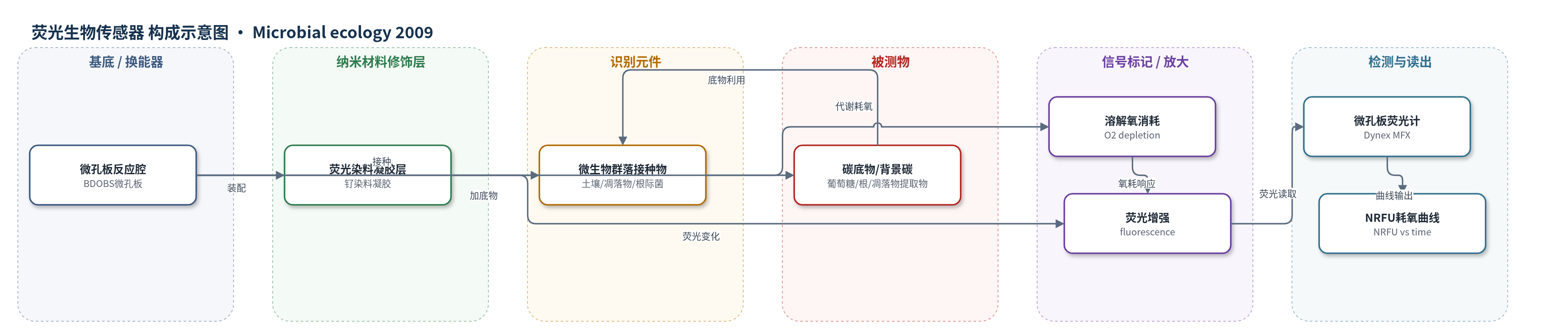
点击图片查看大图 · 依据论文自动绘制
传感器类型
荧光生物传感器
检测对象
微生物群落耗氧/底物利用(microbial oxygen consumption / substrate utilization),样品基质:土壤、凋落物、根际、水溶液
检测原理
将微生物接种物、碳底物和营养/缓冲液加入含荧光钌染料的 BDOBS 微孔板凝胶中。微生物以底物为能源进行有氧呼吸,消耗微孔板内溶解氧;荧光钌染料为氧敏感荧光团,溶解氧降低使其荧光增强。荧光计在 485 nm 激发、604 nm 发射下底部读取荧光,得到 NRFU 随时间变化。底物可利用性或群落活性越高,氧耗速率越快,荧光上升越快、峰高越大。添加 N/P 可解除营养限制,使背景碳利用产生第二峰;葡萄糖可触发 priming,提高背景碳利用。该方法无特异性识别元件,信号放大来自微生物代谢耗氧与时间积分。
检测灵敏度
—
效应效果
BDOBS 相比 Biolog 板可将培养时间从 1–4 天缩短至数小时,并允许 10–100 倍更低底物浓度,无需提取细胞,还可调节 pH 与营养。凋落物群落对葡萄糖、背景碳和天然底物的首次响应快于根际与 bulk soil(P<0.0001、P<0.0001、P<0.004);根提取物响应快于凋落物提取物(0.50 对 0.53 天,P=0.0037),高 N 下根底物峰高更高(P=0.0115)。N 添加加快葡萄糖/背景碳首次响应(P<0.0001),P 添加加快葡萄糖响应(P=0.0368)。所有生境均出现葡萄糖 priming 效应,且葡萄糖响应仅在 N 和 P 同时添加时出现。作者认为该方法适合快速评估土壤微生物活性、底物适应与营养限制。
传感器的构成
- 基底/反应腔:BD Oxygen Biosensor System 微孔板(microtiter plate),提供每孔反应空间与底部读光窗口
- 传感层:含荧光钌染料(fluorescing ruthenium dye)的凝胶(gel),随溶解氧消耗产生荧光变化
- 响应元件:土壤/凋落物/根际微生物群落接种物(microbial inoculum),通过有氧代谢消耗 O2
- 底物层:碳底物(carbon substrate,如葡萄糖、根提取物、凋落物提取物)及背景碳,驱动微生物耗氧
- 营养/缓冲层:缓冲/营养盐溶液(buffer/nutrient solution,含 CaCl2、FeSO4、MnSO4、NaMoO4、MgSO4 及 N/P 处理),调节 pH 与营养限制
- 读出装置:Dynex MFX 微孔板荧光计(Microplate Fluorometer),485 nm 激发、604 nm 发射,底部读取荧光
中文摘要
快速生理谱分析可评估有氧生境中影响微生物活性的因素。以往方法受富集偏差和培养条件限制。本文测试基于微孔板氧传感器系统(BDOBS)的生理谱方法,该系统允许更低底物添加并调节 pH 和营养。研究以佛罗里达 Merritt Island 保护区 scrub-oak 森林土壤微生物群落为对象,评估贫营养土壤微生物活性,并为 CO2 升高研究提供基线。比较凋落物、根际和 bulk soil 生境的生理活性空间差异,考察其对根和凋落物水溶性提取物的适应及 N、P 限制。所有群落主要受 N 限制,并有次级 P 限制,根际和 bulk soil 的 P 限制更强。凋落物群落暴露于凋落物提取物时总耗氧量更高,提示其对混合底物利用的适应。根提取物可被所有群落利用,未见生境特异性适应。所有生境均检测到 priming 效应;添加葡萄糖显著增加土壤有机碳利用。仅在同时添加 N 和 P 时才观察到葡萄糖响应,表明营养限制可能阻止碳固定,使碳从多孔土壤流失。
英文摘要
Rapid physiological profiling of heterotrophic microbial communities enables intensive analysis of the factors affecting activity in aerobic habitats, such as soil. Previous methods for performing such profiling were severely limited due to enrichment bias and inflexibility in incubation conditions. We tested a new physiological profiling approach based on a microtiter plate oxygen sensor system (Becton Dickinson Oxygen Biosensor System (BDOBS)), which allows for testing of lower substrate addition (i.e., lower enrichment potential) and manipulation of physiochemical assay conditions, such as pH and nutrients. Soil microbial communities associated with a scrub-oak forest ecosystem on Merritt Island Wildlife Refuge in central Florida, USA, were studied in order to evaluate microbial activity in a nutrient poor soil and to provide baseline data on the site for subsequent evaluation of the effects of elevated CO(2) on ecosystem function. The spatial variation in physiological activity amongst different habitats (litter, bulk soil, and rhizosphere) was examined as a function of adaptation to local resources (i.e., water soluble extracts of roots and leaf litter) and the degree of N and P limitation. All the communities were primarily N-limited, with a secondary P limitation, which was greater in the rhizosphere and bulk soil. The litter community showed greater overall oxygen consumption when exposed to litter extracts relative to the rhizosphere or soil, suggesting acclimation toward greater use of the mixed substrates in the extract. Root extracts were readily used by communities from all the habitats with no habitat specific acclimation observed. A priming effect was detected in all habitats; addition of glucose caused a significant increase in the use of soil organic carbon. Response to added glucose was only observed with N and P addition, suggesting that C may be lost to the groundwater from these porous soils because nutrient limitation prevents C immobilization.