组成图示
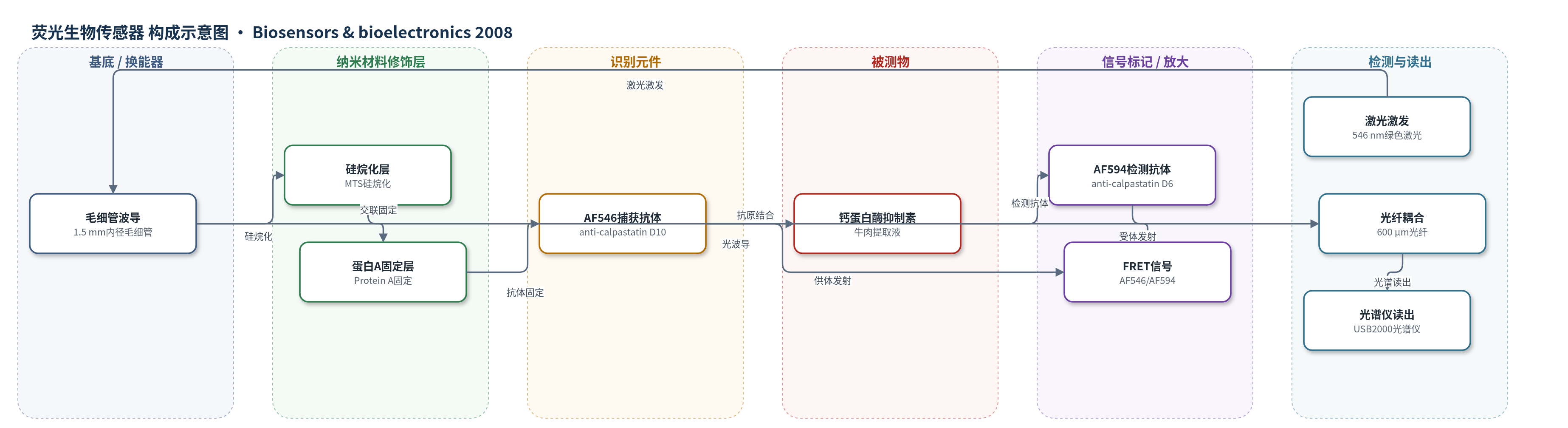
点击图片查看大图 · 依据论文自动绘制
传感器类型
荧光生物传感器
检测对象
钙蛋白酶抑制素(calpastatin);样品基质:牛肉背最长肌提取液(死后0 h和48 h)
检测原理
该传感器采用三明治免疫分析结合荧光共振能量转移(FRET)机制。毛细管内壁经MTS硅烷化和GMBS交联后固定Protein A,再固定AF546标记的抗calpastatin捕获抗体(D10)。样品中的calpastatin与捕获抗体结合后,加入AF594标记的检测抗体(D6),形成供体–抗原–受体复合物。546 nm激光激发AF546;当AF546与AF594距离足够近时发生FRET,使565–575 nm供体峰强度下降、605–615 nm受体峰强度上升。通过计算供体峰/受体峰(D/A)比值,可相对定量calpastatin含量。毛细管同时作为采样通道和光波导,增强荧光信号并降低光纤平台变异。
检测灵敏度
LOD: 120 ng/mL(文中引用Grant et al. 2005溶液法);R^2 = 0.6058;r = 0.7783
效应效果
在11个牛肉样品中,0 h和48 h calpastatin活性分别为2.20±0.46和0.82±0.22,毛细管传感器读数为91.40±3.53和61.40±9.92。0 h读数与粗蛋白显著相关(r=0.7190,P=0.013);合并0 h和48 h后,传感器与传统calpastatin活性呈中等回归(R2=0.6058,r=0.7783),单独时间点不显著(P=0.984、0.237)。0 h毛细管方差12.5,低于前柱光纤62.4(P=0.006)和后柱光纤36.2(P=0.047),标准差3.53低于光纤6.02–10.28;48 h方差无显著差异。作者认为其可用于实验室区分calpastatin浓度,并有望推进在线嫩度评估。
传感器的构成
- 基底/换能器:1.5 mm内径毛细管(capillary tube),作为样品通道和光波导,一端耦合600 μm芯径光纤。
- 表面修饰层:甲基三氯硅烷(MTS)硅烷化毛细管内表面,提供蛋白固定位点。
- 交联层:N-γ-马来酰亚胺丁氧基琥珀酰亚胺酯(GMBS)双功能交联剂,促进蛋白胺基结合。
- 固定蛋白层:Protein A,结合抗体Fc区,保持表位可用。
- 识别元件:AF546标记小鼠抗calpastatin IgG(D10),捕获calpastatin并作为FRET供体。
- 封闭剂:0.5 g/L非脂牛奶(nonfat milk)PBS,封闭非特异性结合。
- 信号标记物:AF594标记小鼠抗calpastatin IgG2(D6),与calpastatin形成三明治复合物并作为FRET受体。
- 读出装置:Ocean Optics USB2000微型光谱仪,采集565–575 nm供体峰和605–615 nm受体峰,计算D/A。
中文摘要
本研究开发了一种基于毛细管的光学生物传感器,用于检测牛肉嫩度指标钙蛋白酶抑制素(calpastatin)。从11头牛背最长肌中分别于死后0 h和48 h取样,样品经提取后,用传统实验室方法测定calpastatin活性,并用新开发的毛细管生物传感器检测,同时测定Warner–Bratzler剪切力(WBSF)和粗蛋白含量,比较各响应。研究还将毛细管生物传感器的响应与先前开发的光纤生物传感器进行比较。合并0 h和48 h采样期后,毛细管生物传感器对calpastatin活性的预测具有中等准确度(R2=0.6058)。0 h时毛细管生物传感器的变异小于0 h前柱和后柱光纤生物传感器(P=0.006和P=0.047),因此是更精确的测量系统。该研究进一步推进了calpastatin生物传感器的发展,使在线评估更接近现实。
英文摘要
A capillary-based optical biosensor has been developed to detect calpastatin, an indicator of meat tenderness. Longissimus muscle samples (n=11) were extracted from beef carcasses at 0 and 48h post-mortem. These samples were assayed for calpastatin by traditional laboratory methods and with a newly developed capillary tube biosensor as well as for Warner-Bratzler shear force (WBSF) and crude protein and the responses were compared. Additionally, the response from the capillary-based biosensor was compared to a previously developed optical fiber biosensor. When the 0 and 48h sampling periods were combined, the capillary tube biosensor was moderately accurate in predicting calpastatin activity (R(2)=0.6058). There was less variation in the 0h capillary tube biosensor compared to the 0h pre-column (P=0.006) and post-column optical fiber biosensors (P=0.047), therefore the capillary tube biosensor is a more precise system of measurement. This research further advances the development of a calpastatin biosensor and makes online assessment one step closer to reality.