组成图示
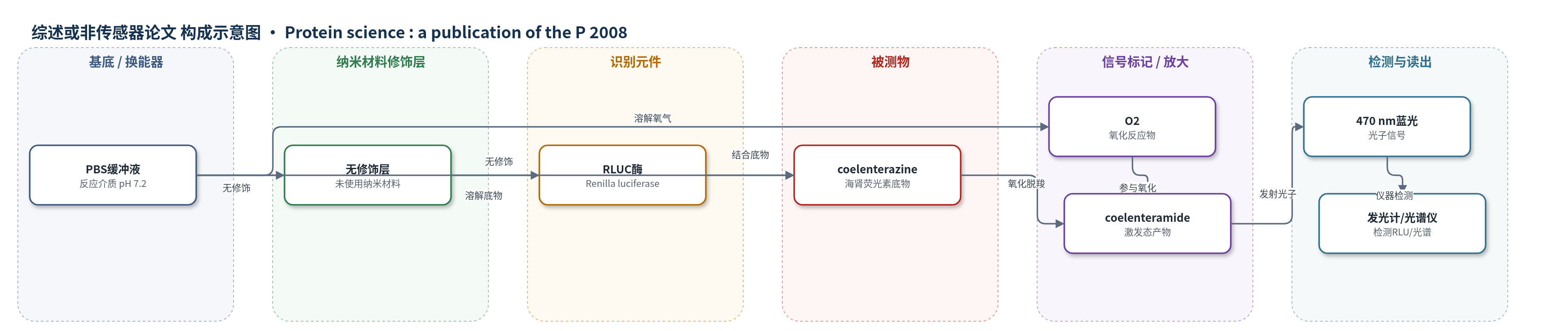
点击图片查看大图 · 依据论文自动绘制
传感器类型
综述或非传感器论文
检测对象
coelenterazine(海肾荧光素);样品基质:PBS 缓冲液、大肠杆菌 BL21 细胞裂解液及纯化 RLUC 酶体系
检测原理
RLUC 属于 α/β 水解酶折叠的脱羧加氧酶,其活性位点由催化三联体 D120、E144、H285 以及底物结合残基 N53、W121、P220 等构成。coelenterazine 进入活性位点后,R1 和 R3 羟基通过氢键与 N53、F262 等残基定位,使 C2 反应中心和 C3 羰基靠近催化三联体。H285 可能作为广义碱参与氧化/去质子化过程,O2 参与底物氧化,形成过氧中间体并发生分子内环化、脱羧,生成激发态 coelenteramide。产物去质子化酚盐形式弛豫时发射约 470 nm 蓝光,中性形式则产生约 400 nm 肩峰。发光强度随底物浓度和酶活性变化,可用发光计或光谱仪读出;DEPC 对 H285 的修饰可抑制发光,进一步证明该机制。
检测灵敏度
原文未报告 LOD、线性范围、灵敏度斜率或相关系数。
效应效果
本文未报告传感器选择性、抗干扰、稳定性、RSD、实际样品加标回收率或与 ELISA/HPLC/qPCR 的对比。酶学结果显示,野生型 RLUC 活性设为 100%,D120E 仅保留 1.1±0.95%,E144D 为 5.6±3.8%,H285A 为 11.3±1.9%,H285D/K/N 基本无活性;N53R 保留 90±10%,N53P 无活性;W121 各突变损失约 80%–99% 活性;P220G 和 P220L 活性分别达 548±167% 和 500±310%,提示可增强发光。DEPC 抑制 IC50 为 220 nM,kI 为 160 nM。作者认为该机制框架有助于理性改造 RLUC,降低 BRET 融合蛋白表达量、缩短测量时间并提高空间分辨率。
传感器的构成
- 反应介质/基底:PBS 缓冲液(pH 7.2),提供 RLUC 催化反应环境
- 修饰层:不适用,本文未报道纳米材料修饰层
- 识别/催化元件:Renilla luciferase(RLUC),结合并催化 coelenterazine 氧化脱羧
- 底物/信号前体:coelenterazine(海肾荧光素),被氧化脱羧生成发光产物
- 信号产物:coelenteramide 激发态,弛豫时发射约 470 nm 蓝光
- 读出方式:发光计/光谱发光仪,检测相对光单位(RLU)或发射光谱
中文摘要
海肾荧光素酶(RLUC)是基因表达检测和体内生物传感器应用中的多功能工具,但其催化机制尚未阐明。RLUC 与 α/β 水解酶家族相关,最近同源物为细菌脱卤酶,因此具有水解酶折叠的蛋白质如何作为脱羧加氧酶发挥作用成为关键问题。本研究以 coelenterazine 对 RLUC 同源模型和晶体结构进行分子对接,提出功能残基假说,并通过定点突变、异源表达和生物发光发射光谱验证。结果显示两组残基三联体对催化至关重要。推测催化三联体 D120、E144 和 H285 与 aequorin 活性位点残基仅有有限相似性,提示 RLUC 反应方案与 aequorin 机制显著不同。DEPC 抑制结果支持 H285 的催化作用。对同源脱卤酶 LinB 中参与产物结合的 N53、W121 和 P220 的多种替换也支持其参与催化。结合发光光谱,作者提出 RLUC 保守催化三联体直接参与 coelenterazine 脱羧反应产生生物发光,其他活性位点残基主要用于底物结合。
英文摘要
Renilla luciferase (RLUC) is a versatile tool for gene expression assays and in vivo biosensor applications, but its catalytic mechanism remains to be elucidated. RLUC is evolutionarily related to the alpha/beta hydrolase family. Its closest known homologs are bacterial dehalogenases, raising the question of how a protein with a hydrolase fold can function as a decarboxylating oxygenase. Molecular docking simulations with the coelenterazine substrate against an RLUC homology model as well as a recently determined RLUC crystal structure were used to build hypotheses to identify functionally important residues, which were subsequently tested by site-directed mutagenesis, heterologous expression, and bioluminescence emission spectroscopy. The data highlighted two triads of residues that are critical for catalysis. The putative catalytic triad residues D120, E144, and H285 bear only limited resemblance to those found in the active site of aequorin, a coelenterazine-utilizing photoprotein, suggesting that the reaction scheme employed by RLUC differs substantially from the one established for aequorin. The role of H285 in catalysis was further supported by inhibition using diethylpyrocarbonate. Multiple substitutions of N53, W121, and P220--three other residues implicated in product binding in the homologous dehalogenase Sphingomonas LinB--also supported their involvement in catalysis. Together with luminescence spectra, our data lead us to propose that the conserved catalytic triad of RLUC is directly involved in the decarboxylation reaction of coelenterazine to produce bioluminescence, while the other active-site residues are used for binding of the substrate.