组成图示
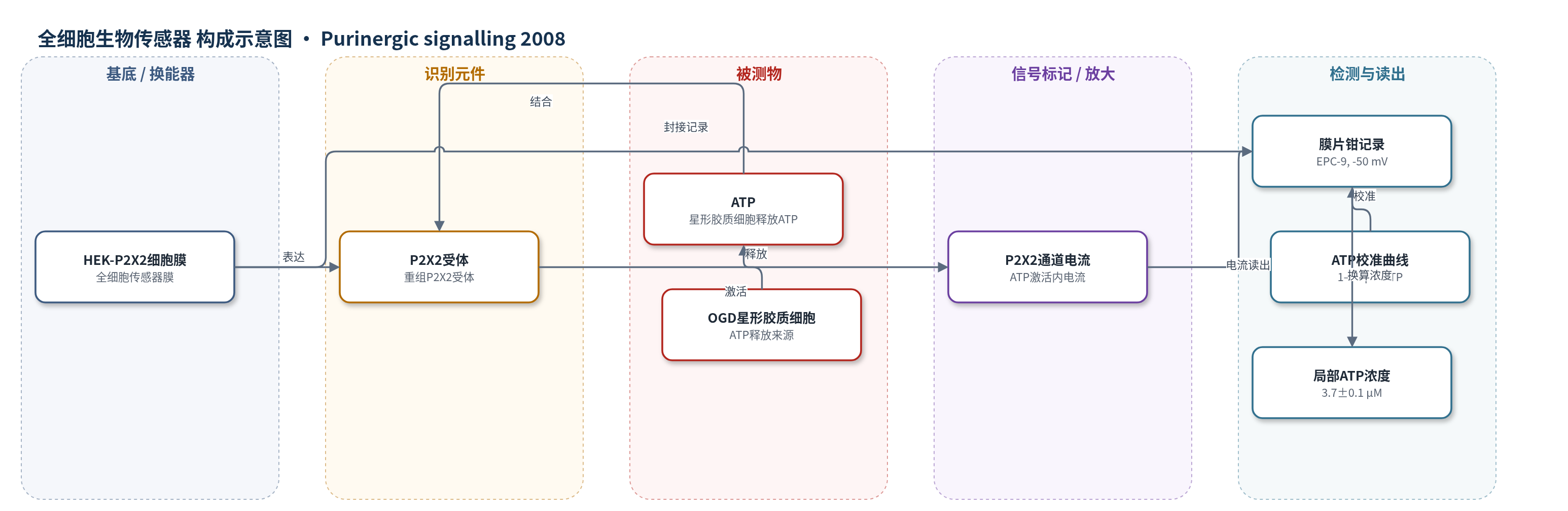
点击图片查看大图 · 依据论文自动绘制
传感器类型
全细胞生物传感器
检测对象
ATP(adenosine 5′-triphosphate, ATP);样品基质:单个小鼠星形胶质细胞表面局部细胞外液/培养液(OGD 条件)
检测原理
该传感器以稳定转染重组 P2X2 受体的 HEK293 细胞(HEK-P2X2)作为全细胞生物传感器。ATP 作为被测物与细胞膜上的 P2X2 嘌呤能受体结合,使 P2X2 阳离子通道开放,产生与 ATP 浓度相关的内电流。膜片钳系统在全细胞配置、-50 mV 保持电位下记录电流,电流幅度经 1–20 μM ATP 建立的浓度-电流校准曲线换算为局部 ATP 浓度。OGD 激活星形胶质细胞 maxi-阴离子通道后,ATP4− 经通道外排,传感器细胞贴近目标细胞表面即可检测局部 ATP 升高。该过程无酶促或核酸放大,信号直接来自受体通道电流。
检测灵敏度
校准范围: 1–20 μM ATP
效应效果
该生物传感器以 HEK-P2X2 细胞全细胞 P2X2 电流为读出,先用 1–20 μM ATP 建立校准曲线。OGD 刺激单个星形胶质细胞后,传感器在 7.2±1.0 min 延迟后记录到内电流尖峰,换算局部 ATP 浓度为 3.7±0.1 μM;apyrase 可消除响应,远离目标细胞的传感器无响应,表明信号来自目标细胞表面 ATP。批量荧光素-荧光素酶法显示基础释放低于 0.25 nM,OGD 后 15–20 min 升至约 2 nM 并维持至 30 min。作者认为该方法可检测单细胞表面局部 ATP 释放,并支持 maxi-阴离子通道为缺血性 ATP 释放主要途径。
传感器的构成
- 换能器基底:HEK293 细胞膜(HEK-P2X2 细胞),承载 P2X2 受体并作为全细胞生物传感器膜片
- 识别元件:重组 P2X2 嘌呤能受体(P2X2 purinergic receptors),稳定转染于 HEK293 细胞,特异性结合 ATP
- 信号换能:P2X2 阳离子通道,ATP 结合后开放并产生内电流,电流幅度反映局部 ATP 浓度
- 记录系统:EPC-9 膜片钳系统(HEKA Electronics),全细胞配置下于 -50 mV 保持电位记录电流
- 校准装置:手工局部微灌注装置(local microperfusion device),多入口管提供 1–20 μM ATP 建立校准曲线
- 样品界面:目标小鼠星形胶质细胞表面,生物传感器细胞轻触细胞表面以检测 OGD 释放的局部 ATP
中文摘要
ATP 是星形胶质细胞与神经元之间通讯的重要胶质递质。已有研究显示,非缺血条件下星形胶质细胞可因多种刺激释放 ATP。本研究采用荧光素-荧光素酶法发现,原代培养的小鼠星形胶质细胞在模拟缺血性应激的氧糖剥夺(OGD)条件下也发生大量 ATP 释放。利用生物传感器技术,单个星形胶质细胞表面局部 ATP 浓度可升高至约 4 μM。OGD 诱导的 ATP 释放可被 Gd3+ 和花生四烯酸抑制,但不受体积敏感外向整流 Cl− 通道、CFTR、MRP、连接蛋白或潘尼孔半通道、P2X7 受体以及胞吐囊泡转运阻断剂的影响。在单个星形胶质细胞的细胞贴附膜片钳记录中,OGD 激活了对 Gd3+ 和花生四烯酸敏感的 maxi-阴离子通道;该通道对 ATP4− 具有通透性,PATP/PCl 为 0.11。因此,缺血性应激可诱导星形胶质细胞释放 ATP,maxi-阴离子通道可能是缺血条件下主要的 ATP 释放途径。
英文摘要
ATP represents a major gliotransmitter that serves as a signaling molecule for the cross talk between glial and neuronal cells. ATP has been shown to be released by astrocytes in response to a number of stimuli under nonischemic conditions. In this study, using a luciferin-luciferase assay, we found that mouse astrocytes in primary culture also exhibit massive release of ATP in response to ischemic stress mimicked by oxygen-glucose deprivation (OGD). Using a biosensor technique, the local ATP concentration at the surface of single astrocytes was found to increase to around 4 muM. The OGD-induced ATP release was inhibited by Gd(3+) and arachidonic acid but not by blockers of volume-sensitive outwardly rectifying Cl(-) channels, cystic fibrosis transmembrane conductance regulator (CFTR), multidrug resistance-related protein (MRP), connexin or pannexin hemichannels, P2X(7) receptors, and exocytotic vesicular transport. In cell-attached patches on single astrocytes, OGD caused activation of maxi-anion channels that were sensitive to Gd(3+) and arachidonic acid. The channel was found to be permeable to ATP(4-) with a permeability ratio of P(ATP)/P(Cl) = 0.11. Thus, it is concluded that ischemic stress induces ATP release from astrocytes and that the maxi-anion channel may serve as a major ATP-releasing pathway under ischemic conditions.