组成图示
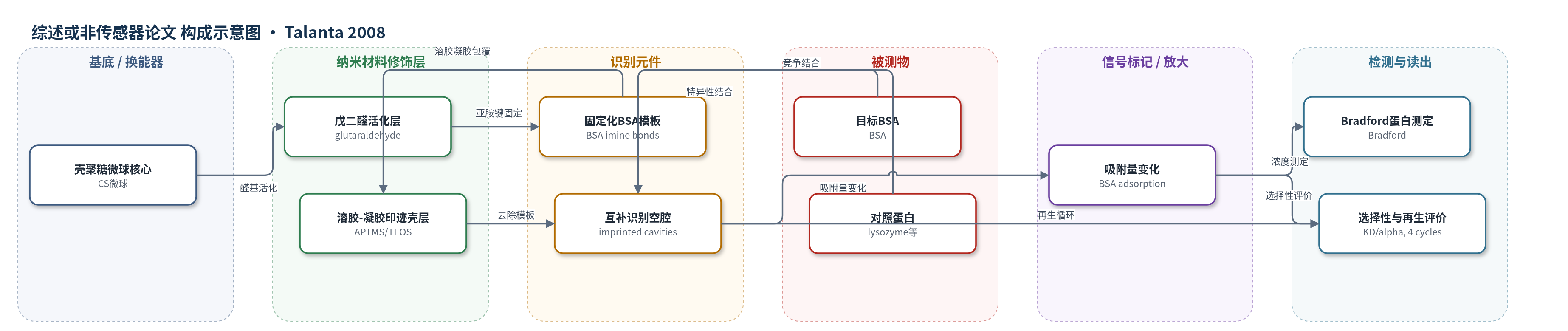
点击图片查看大图 · 依据论文自动绘制
传感器类型
综述或非传感器论文
检测对象
牛血清白蛋白(BSA);对照蛋白:β-淀粉酶(beta-amylase)、细胞色素C(cytochrome C)、转铁蛋白(transferrin)、溶菌酶(lysozyme);样品基质:pH 7磷酸盐/磷酸缓冲液(吸附实验),制备过程使用硼酸盐缓冲液(pH 8.2)和碳酸盐/碳酸氢盐缓冲液(pH 9)
检测原理
该材料并非电/光换能传感器,而是基于分子印迹的亲和吸附识别。首先,CS微球表面氨基经戊二醛活化形成醛基,与BSA表面赖氨酸/精氨酸氨基形成可逆亚胺键,使模板以稳定取向固定。随后APTMS与TEOS在pH 9水相中发生溶胶-凝胶缩合,在模板周围形成有机-无机杂化网络;用草酸破坏亚胺键去除BSA后,留下形状、尺寸和官能团分布互补的空腔。目标BSA进入空腔后,通过形状匹配、多氢键及亲水/疏水互补发生特异性结合,吸附量随BSA浓度升高而增加。实验通过Bradford法测定上清蛋白浓度,并以质量平衡计算吸附量,从而间接反映识别事件。
检测灵敏度
相关系数: γ2 = 0.9903
效应效果
在pH 7磷酸盐缓冲液中,I-MIP对BSA最大吸附量15.5 mg g−1湿珠,F-MIP为12.6 mg g−1,NIP为2.8 mg g−1。BSA 15 min内显著特异结合,约60 min平衡,F-MIP需110 min。I-MIP对BSA的KD为68.9,对转铁蛋白、溶菌酶、β-淀粉酶、细胞色素C分别为14.1、3.6、2.3、2.7,分离因子α为4.9、19.1、30、25.5。经1%乙酸/5% Tween 20洗脱,10天4次循环后容量保持(91±3)%。SEM显示印迹表面大量均匀孔,BET比表面积48.65 m2 g−1,平均孔径43.2 nm。作者认为其制备简便、亲和力和稳定性好,可用于下游处理和生物传感器。
传感器的构成
- 多糖微球核心:壳聚糖(CS)微球,经甲醛和环氧氯丙烷交联,提供氨基反应位点与机械支撑
- 模板固定化层:牛血清白蛋白(BSA)经戊二醛(glutaraldehyde)活化后与CS氨基形成亚胺键共价固定,作为印迹模板
- 溶胶-凝胶印迹壳层:3-氨基丙基三甲氧基硅烷(APTMS)与正硅酸乙酯(TEOS)在pH 9水相中溶胶-凝胶聚合,形成有机-无机杂化印迹层
- 识别空腔层:去除BSA后形成的形状、尺寸和官能团互补空腔,用于选择性识别BSA
- 洗脱再生介质:1%乙酸含5% Tween 20,用于洗脱再吸附BSA并恢复吸附容量
中文摘要
本文提出界面有机-无机杂化策略,制备用于蛋白识别的球形印迹材料。以壳聚糖(CS)经乳化交联形成高密度微球作为多糖核心;模板蛋白牛血清白蛋白(BSA)经戊二醛活化后与CS氨基形成亚胺键共价固定。随后,3-氨基丙基三甲氧基硅烷(APTMS)和正硅酸乙酯(TEOS)在多糖-蛋白表面经水相溶胶-凝胶过程室温聚合。去除模板后,印迹溶胶-凝胶表面在吸附实验中优先吸附模板蛋白,优于四种对照蛋白。生物信息学方法用于分析印迹与识别效果。评估了硅氧烷类型、pH、硅氧烷/水比对模板去除和选择性的影响。优化条件下,印迹表面形成大量均匀孔,再吸附动力学快且可重复使用。与游离模板材料相比,固定模板材料吸附容量更高。该材料制备简便、亲和力和可重复使用性好,适用于生物技术下游处理和生物传感器。
英文摘要
An interfacial organic-inorganic hybridization concept was applied to the preparation of a new spherical imprinted material for protein recognition. The functional biopolymer chitosan (CS), shaped as microsphere and high-density cross-linked, constituted of the polysaccharide core for surface imprinting. After the model template protein, bovine serum albumin, was covalently immobilized by forming imine bonds with the functional amine groups of CS, two kinds of organic siloxane (3-aminopropyltrimethoxysiloxane: APTMS, and tetraethoxysiloxane: TEOS) assembled and polymerized on the polysaccharide-protein surface via sol-gel process in aqueous solution at room temperature. After template removal, the protein-imprinted sol-gel surface exhibited a prevalent preference for the template protein in adsorption experiments, as compared with four contrastive proteins. Bioinformatics methods were also employed to investigate the imprinting process and the recognition effect. The influence of siloxane type, pH, siloxane/water ratio on template removal and recognition selectivity was assessed. Under optimized imprinting conditions, a large quantity of well-distributed pores was observed on the immobilized-template imprinted surface. The surface-imprinted adsorbent offered a fast kinetics for template re-adsorption and could be reused. Compared with the imprinted material prepared with free-template, material prepared with immobilized-template possessed higher adsorption capacity towards template protein. Easy preparation of the described imprinted material, high affinity and good reusability make this approach attractive and broadly applicable in biotechnology for down-stream processing and biosensor.