组成图示
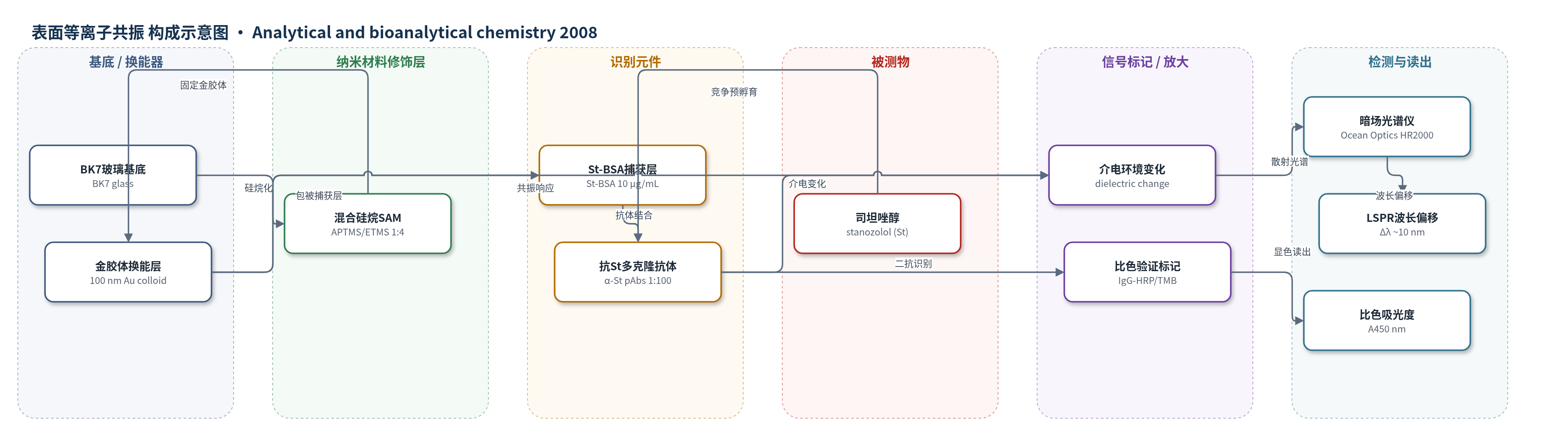
点击图片查看大图 · 依据论文自动绘制
传感器类型
表面等离子共振(SPR)生物传感器
检测对象
司坦唑醇(stanozolol, St);样品基质:缓冲液标准/样品(buffered solutions)
检测原理
该传感器以BK7玻璃为基底,经APTMS/ETMS混合硅烷化后固定100 nm金胶体,形成LSPR换能器。金胶体表面包被St-BSA作为捕获抗原。检测采用竞争免疫模式:样品或标准中的司坦唑醇(St)先与α-St pAbs预孵育,形成St-抗体复合物;随后加入St-BSA修饰表面,未结合St的抗体与St-BSA结合。St浓度越高,可结合抗体越少,金胶体周围介电常数变化越小,LSPR散射峰波长偏移(Δλ)越小,形成竞争抑制曲线。暗场光谱测量约550 nm散射峰偏移,经变斜率sigmoid拟合定量。IgG-HRP/TMB比色仅用于验证抗体结合和非特异结合。信号放大依赖金纳米颗粒局域场对近表面介电变化的高灵敏度,而非酶催化或核酸放大。
检测灵敏度
LOD: 2.4 nM or 0.7 μg/L St;标准范围: 1–10,000 nM;EC50: 92 and 103 nM;Hillslope: -0.9453 and -0.9954;R^2: 0.968 and 0.991
效应效果
该传感器通过非特异性结合对照显示高选择性,特异性>97%;α-St pAbs对硅烷化玻璃、BSA和At-BSA无明显结合,At-BSA对照仅产生<3%特异信号(0.4 nm共振偏移)。重现性良好,不同天独立实验RSD<5%(n=3, N=3),未报告实际样品加标回收率。金胶体密度在相同条件下可稳定>3个月。检测限2.4 nM(0.7 μg/L),低于IOC禁用物质色谱法MRPL;作者称灵敏度与标准SPR相当,并优于其他胶体系统报道的30–1000 nM检测限范围。每个样品约2 min,18个标准/样品总时间<80 min。方法简化装置、降低成本,适合类固醇快速筛查和微型化多路复用。
传感器的构成
- 基底:BK7玻璃(BK7 glass),经2 N NaOH/EtOH活化,提供硅烷化表面
- 硅烷化间隔层:APTMS/ETMS混合SAM(1-aminopropyltrimethoxysilane/ethyltrimethoxysilane,1:4,总1.13 mM),APTMS用于结合金胶体,ETMS用于间隔并减少非特异吸附
- 换能纳米层:100 nm金胶体(Au colloid),固定于玻璃表面,产生约550 nm LSPR散射共振
- 捕获包被层:St-BSA(stanozolol-bovine serum albumin偶联物,10 μg/mL),包被金胶体,提供司坦唑醇抗原表位
- 识别元件:α-St pAbs(anti-stanozolol polyclonal antibodies,1:100),与St-BSA特异性结合;竞争法中与St预孵育
- 辅助验证标记:IgG-HRP(anti-rabbit IgG-HRP)与TMB/H2O2,用于比色确认抗体结合,不参与LSPR信号
中文摘要
本文报道了一种基于胶体金的局域表面等离子共振(LSPR)生物传感器的系统制备与性能研究。玻璃基底经化学硅烷化修饰,通过混合硅烷和选择性混合优化控制金胶体密度。样品暴露于生物试剂后,利用暗场光谱监测金颗粒周围浅层介电常数变化。作者首先以生物素/链霉亲和素体系验证传感原理,并优化包被层和受体浓度,最终用于定量检测小分子合成同化激素司坦唑醇。通过广泛的非特异性结合测试,该体系获得>97%的高特异性,灵敏度低于标准色谱法确定的最低要求性能水平(MRPL)。文中还讨论了最终LSPR生物传感器的Hillslope和回归系数等最佳拟合参数。LSPR生物传感器重现性良好(RSD<5%),可快速建立校准曲线并测定样品,每个样品约2 min。该方法简化检测装置、降低成本,保持与标准SPR相当的灵敏度,并具备微型化和多路复用潜力。
英文摘要
This work reports the systematic preparation of biosensors through the use of functionalized glass substrates, noble metal gold colloid, and measurement by localized surface plasmon resonance (LSPR). Glass substrate was modified through chemical silanization, and the density of gold colloid was carefully controlled by optimizing the conditions of silanization through the use of mixed silanes and selective mixing procedures. At this point, samples were exposed to bioreagents and changes in the shallow dielectric constant around the particles were observed by dark-field spectroscopy. Biological binding of high affinity systems (biotin/streptavidin and antigen/antibody) was subsequently investigated by optimizing coating layers, receptor concentration profiling, and finally quantitative determination of the analyte of interest, which in this case was a small organic molecule-the widely used, synthetic anabolic steroid called stanozolol. For this system, high specificity was achieved (>97%) through extensive nonspecific binding tests, with a sensitivity measurable to a level below the minimum required performance level (MRPL) as determined by standard chromatographic methods. Analytical best-fit parameters of Hillslope and regression coefficient are also commented on for the final LSPR biosensor. The LSPR biosensor showed good reproducibility (<5% RSD) and allowed for rapid preparation of calibration curves and determination of the analyte (measurement time of each sample ca. 2 min). As an alternative method for quantitative steroidal analysis, this approach significantly simplifies the detection setup while reducing the cost of analysis. In addition the system maintains comparable sensitivity to standard surface plasmon resonance methods and offers great potential for miniaturization and development of multiplexed devices.