组成图示
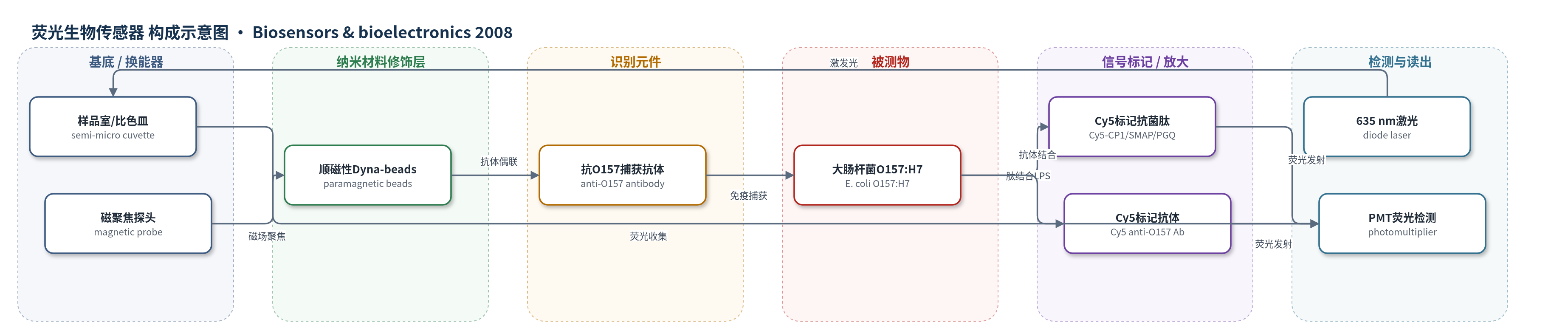
点击图片查看大图 · 依据论文自动绘制
传感器类型
荧光生物传感器
检测对象
大肠杆菌O157:H7(Escherichia coli O157:H7);样品基质:PBST缓冲液、苹果汁(初步)
检测原理
该检测采用免疫磁捕获与荧光读出。抗E. coli O157:H7抗体偶联的顺磁性Dyna-beads先特异性捕获样品中的目标菌;随后Cy5标记抗菌肽(如Cy5-CP1)通过静电和范德华作用结合细菌细胞壁LPS/膜表面。由于肽分子量小于抗体,可在菌体表面更高密度结合,使每个菌体携带更多Cy5荧光团,从而增强荧光信号。磁聚焦光纤荧光计将磁珠聚集到激发/发射光纤前,635 nm激光激发Cy5,PMT检测发射荧光。菌浓度越高,被捕获并标记的菌体越多,荧光越强;但肽对磁珠的非特异结合会抬高背景。
检测灵敏度
LOD: 10^4 CFU ml−1(Cy5 CP1,溶液结合法,P=0.032);LOD: 10^5 CFU ml−1(Cy5 anti-O157 antibody,溶液结合法,P=0.01);LOD: 10^4 CFU ml−1(Cy5 CP1,免疫磁捕获,P=0.056);LOD: 10^5 CFU ml−1(Cy5 anti-O157 antibody,免疫磁捕获,P=0.086);10^3 CFU ml−1(Cy5 CP1,免疫磁捕获,净正信号,未定为LOD)
效应效果
Cy5-CP1在溶液结合法和免疫磁捕获法中均较Cy5抗体灵敏度提高10倍,而Cy5-SMAP29和Cy5-PGQ未提高。免疫磁捕获中10^6 CFU ml−1时信噪比约2,随菌浓度降低而下降;增加肽量使背景升高,但信噪比仍约2,非离子去污剂不能有效降低背景,自由Cy5不结合磁珠,提示背景主要来自肽非特异结合。Cy5-CP1信号不随菌浓度比例变化,标准差较大,零细胞对照也有波动,作者认为非仪器相关。苹果汁初步结果显示其灵敏度至少比抗体高10倍。该方法结合抗体特异性与AMP高密度荧光标记,有望用于食品病原体快速检测。
传感器的构成
- 换能器/检测平台:磁聚焦光纤荧光计(magnetic focusing fiber optic fluorometer),含635 nm激光、PMT和光纤样品室,用于磁场聚焦磁珠并读取荧光
- 捕获载体:抗E. coli O157顺磁性Dyna-beads(paramagnetic Dyna-beads),作为免疫磁捕获载体并被磁场聚焦
- 识别元件:抗E. coli O157:H7多克隆抗体(anti-O157 polyclonal antibody),偶联于磁珠表面,特异性捕获目标菌
- 信号标记物:Cy5标记抗菌肽(Cy5-CP1、Cy5-SMAP29、Cy5-PGQ),经C端半胱氨酸马来酰亚胺连接,结合细菌LPS/细胞膜并发射荧光
- 对照标记物:Cy5标记抗E. coli O157抗体(Cy5 anti-O157 antibody),作为传统荧光抗体检测对照
- 样品介质:PBST(PBS + 0.05% Tween 20),用于细胞稀释、孵育和洗涤
- 候选封闭剂:BSA、非脂奶粉、胎牛血清、酪蛋白,用于降低Cy5-CP1对磁珠的非特异结合
中文摘要
本研究评估荧光标记抗菌肽(AMP)能否替代标记抗体,用于大肠杆菌O157:H7的三明治检测。AMP天然结合细菌细胞壁脂多糖(LPS),且分子量小于抗体,可在细胞表面更高密度结合,从而提高光学信号和灵敏度。作者将抗菌肽cecropin P1、SMAP29和PGQ经C端半胱氨酸与Cy5荧光染料通过马来酰亚胺连接化学标记。全细胞溶液结合初筛显示,Cy5-CP1对E. coli O157:H7的检测灵敏度较Cy5标记抗O157抗体提高10倍。在原型免疫磁珠生物传感器中,Cy5-CP1同样使检测灵敏度提高10倍。肽的抗菌活性与荧光检测灵敏度的相关性分析表明,抗菌活性不能预测该荧光检测方法的灵敏度。
英文摘要
Fluorescently labeled antimicrobial peptides were evaluated as a potential replacement of labeled antibodies in a sandwich assay for the detection of Escherichia coli O157:H7. Antimicrobial peptides naturally bind to the lipopolysaccharide component of bacterial cell walls as part of their mode of action. Because of their small size relative to antibodies peptides can bind to cell surfaces with greater density, thereby increasing the optical signal and improving sensitivity. This method combines the specificity of a capture antibody with the increased sensitivity provided by using a labeled peptide as a detection molecule. The antimicrobial peptides cecropin P1, SMAP29, and PGQ were labeled with the fluorescent dye Cy5 via maleimide linker chemistry. Preliminary screening using a whole-cell solution binding assay revealed that Cy5 cecropin P1 enhanced the detection of E. coli O157:H7 relative to a Cy5 labeled anti-E. coli O157:H7 antibody 10-fold. Detection sensitivity of antibody and peptide were also compared with a prototype immuno-magnetic bead biosensor. Detection using Cy5 cecropin P1 resulted in a 10-fold improvement in sensitivity. Correlation of peptide antimicrobial activity with detection of E. coli O157:H7 indicated that activity was not predictive of the sensitivity of the fluorescent assay.