组成图示
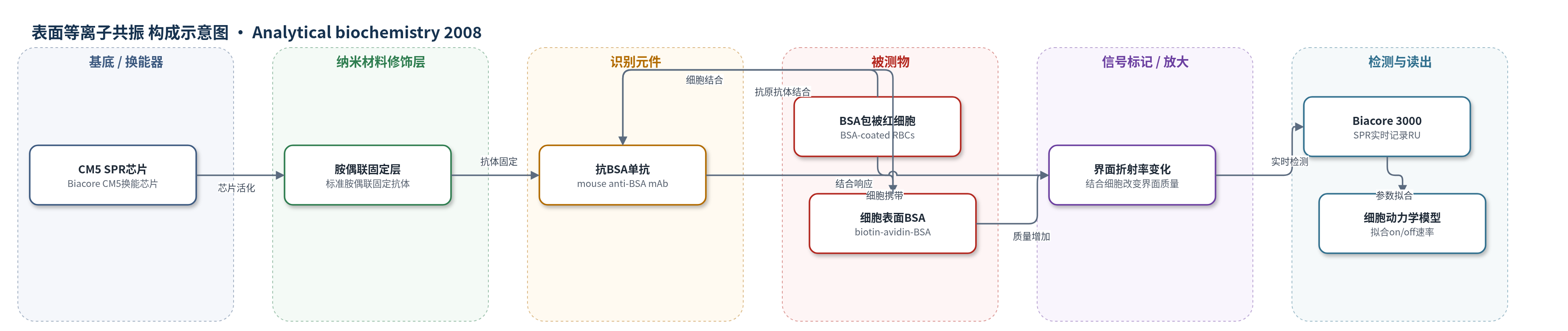
点击图片查看大图 · 依据论文自动绘制
传感器类型
表面等离子共振(SPR)生物传感器
检测对象
BSA 包被人红细胞(BSA-coated human red blood cells, RBCs)/红细胞表面 BSA(BSA on RBC surface),样品基质为 EAS45+ 红细胞保存液与 PBS 流动缓冲液
检测原理
该检测基于 SPR 光学换能。mouse anti-BSA mAb 通过标准胺偶联固定于 CM5 芯片表面,BSA 包被红细胞在 PBS 流动相中流过芯片。红细胞表面 BSA 与固定抗体发生特异性抗原-抗体结合,使芯片界面附近质量与折射率发生变化;SPR 反射信号随之改变,Biacore 3000 将其转换为 response unit (RU) 传感器图。结合相中 RU 随结合细胞数增加而上升,解离相中 RU 随细胞脱离而下降。作者用二维细胞动力学模型描述:dRU/dt=Kc_on(RUmax-RU)-kc_off RU,解离相 dRU/dt=-kc_off RU,从而从传感器图拟合 Kc_b、kc_off,并计算 Kc_on 与亲和力 Kc_a。高抗体位点密度(约 9000–12000 RU)用于提高可测结合响应。
检测灵敏度
原文未报告 LOD、线性范围、灵敏度斜率或相关系数。
效应效果
方法特异性良好:BSA 与 anti-BSA mAb 同时存在时 RU 显著高于无抗体通道,非特异响应由空白通道扣除。各条件重复三次,以 mean±SE 表示。流动时间 10→15 min 时,1、5、10 µl/min 下峰值 RU(RUP)分别提高约 1.6、1.3、1.3 倍;流速 1→5、10 µl/min 时,10 min 下 RUP 提高约 1.7、1.9 倍,15 min 下提高约 1.3、1.5 倍。拟合得 Kc_b 为 1.8、4.4、4.7×10^-3 s^-1,kc_off 为 7.9、8.7、8.1×10^-4 s^-1;BSA 位点密度 45、82 µm^-2 时 Kc_b 为 2.0、2.9×10^-3 s^-1。3D BSA-anti-BSA 动力学为 1.4×10^3 M^-1 s^-1 和 1.8×10^-4 s^-1,Ka 0.8×10^7 M^-1,与文献 1.1×10^7 M^-1 一致。作者认为该方法可定量细胞表面分子结合,适用于临床诊断、预后和制药研究。
传感器的构成
- 换能芯片:CM5 芯片,Biacore SPR 换能表面,用于固定识别分子并检测界面折射率变化
- 固定化层:10 mM sodium acetate (pH 5.0) 中标准胺偶联法,将 mouse anti-BSA mAb 共价固定于 CM5 芯片通道
- 识别元件:mouse anti-BSA mAb,特异性捕获 BSA 包被红细胞,固定量约 9000–12000 RU
- 流动介质:PBS running buffer,维持细胞与抗体环境,用于结合、解离和再生
- 信号读出:Biacore 3000 SPR 仪器,实时记录 response unit (RU) 传感器图
中文摘要
表面等离子共振(SPR)技术与 Biacore 生物传感器已被广泛用于实时测量流体相中生物分子相互作用的动力学。近十年来,该检测进一步扩展到两个相对表面上锚定分子之间的反应动力学,但细胞结合动力学仍缺乏定量描述。本文报道了一种细胞动力学模型,并建立了相应的细胞结合动力学测量与数据分析流程,用于预测每个细胞的结合速率。实验以牛血清白蛋白(BSA)包被的人红细胞(RBCs)和固定在芯片上的抗 BSA 单克隆抗体(mAbs)为体系,使用商用 Biacore 3000 生物传感器获得 BSA 包被红细胞结合与解离的传感器图,并用所建模型进行分析。结果表明,模型能够良好拟合数据,并从曲线拟合中预测细胞结合速率、解离速率和结合亲和力。研究还系统考察了流动时间、流速以及 BSA 位点密度对结合动力学的影响,进一步验证了新方法的可行性与可靠性。
英文摘要
Surface plasmon resonance (SPR) technology and the Biacore biosensor have been widely used to measure the kinetics of biomolecular interactions in the fluid phase. In the past decade, the assay was further extended to measure reaction kinetics when two counterpart molecules are anchored on apposed surfaces. However, the cell binding kinetics has not been well quantified. Here we report development of a cellular kinetic model, combined with experimental procedures for cell binding kinetic measurements, to predict kinetic rates per cell. Human red blood cells coated with bovine serum albumin and anti-BSA monoclonal antibodies (mAbs) immobilized on the chip were used to conduct the measurements. Sensorgrams for BSA-coated RBC binding onto and debinding from the anti-BSA mAb-immobilized chip were obtained using a commercial Biacore 3000 biosensor, and analyzed with the cellular kinetic model developed. Not only did the model fit the data well, but it also predicted cellular on and off-rates as well as binding affinities from curve fitting. The dependence of flow duration, flow rate, and site density of BSA on binding kinetics was tested systematically, which further validated the feasibility and reliability of the new approach.