组成图示
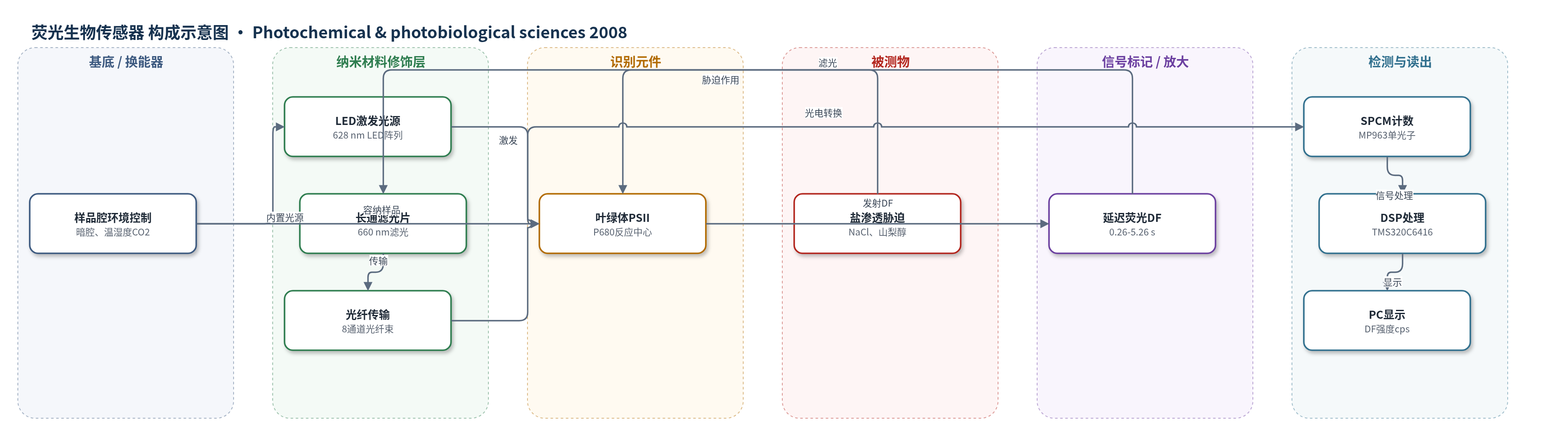
点击图片查看大图 · 依据论文自动绘制
传感器类型
荧光生物传感器
检测对象
盐胁迫(NaCl)、渗透胁迫(sorbitol);样品基质:拟南芥(Arabidopsis thaliana)活体叶片/营养液培养幼苗
检测原理
该传感器以活体叶片为样品,628 nm LED阵列照射叶绿素,激发PSII反应中心P680发生电荷分离。光激发停止后,PSII中反向电子传递/逆光化学反应使激发态重新复合并发射延迟荧光(DF)。盐胁迫(NaCl)和渗透胁迫(sorbitol)使PSII光化学效率下降、光合电子传递受抑、叶绿素含量降低,从而降低DF强度。DF强度I_DF与吸收光强PFDa及PSII开放反应中心量子效率Fv′/Fm′成正比,并与PSII电子传递速率Re相关。系统通过660 nm长通滤光片去除散射光,光纤将DF导入SPCM,在0.26–5.26 s窗口积分计数,以cps输出。因此DF强度随NaCl或山梨醇浓度升高而下降,可非侵入、实时反映光合作用损伤。
检测灵敏度
原文未报告LOD、线性范围、灵敏度斜率或相关系数。
效应效果
该多通道DF生物传感器与LI-6400测得的Pn高度一致:200 mM NaCl处理18 h后DF和Pn分别降至对照的51.8%和49.5%;400 mM山梨醇处理18 h后分别降至63.4%和67.1%。动态实验中,200 mM NaCl使DF和Pn在27 h降至34.6%和37.7%,108 h几乎消失;400 mM山梨醇在27 h降至54.1%和56.5%后基本稳定。50 μM苯妥英可逆转NaCl诱导的慢速离子损伤,但不影响快速渗透损伤。NaCl 13.5 h后完全恢复,50 h后不可恢复;山梨醇27 h后仍可恢复至89.4%和85.6%。DF 7个重复测量少于10 s,适合高通量非侵入筛选。
传感器的构成
- 样品腔/环境控制层:8个暗样品腔(dark sample chambers),内置湿度、温度和CO2控制器,用于活体叶片原位测量与环境控制
- 激发光源层:超高亮LED阵列(LED,λ=628 nm,半峰宽20 nm,单管输出光通量20 lm),环形均匀排列,0.2 s照射叶片
- 生物识别/信号源层:叶绿体PSII反应中心(P680),通过逆光化学反应发射内源延迟荧光(DF),反映光合电子传递效率
- 滤光层:660 nm长通滤光片,置于光纤前,阻挡散射激发光并保护SPCM
- 光传输层:8通道光纤/光纤束,将样品腔内DF信号传输至SPCM
- 光电转换层:超高灵敏单光子计数模块(SPCM,MP963,Perkin-Elmer),检测波长185–850 nm,放大和甄别DF光子
- 信号处理层:数字信号处理器(DSP,TMS320C6416),本地控制模式处理DF信号
- 存储读出层:存储器(AT29C020)与PC,记录并显示DF强度(cps)
中文摘要
叶绿体是对盐和渗透胁迫最敏感的系统之一。本研究基于叶绿体延迟荧光(DF)的定量测量,利用自制多通道生物传感器,研究了拟南芥幼苗在盐胁迫和渗透胁迫下光合作用的损伤。结果表明,随着NaCl或山梨醇浓度升高,DF强度与净光合速率(Pn)呈相似下降趋势。200 mM NaCl处理诱导DF强度和Pn先快速可逆下降,随后发生缓慢且不可逆的损失;快速下降主要与渗透胁迫有关,而缓慢下降为离子胁迫所特有,并可被Na+通道阻断剂逆转至与山梨醇处理相近水平。DF强度与Pn对光照强度的响应也高度一致。研究还通过胞间CO2浓度(Ci)、气孔导度(Gs)、叶绿素荧光参数和叶绿素含量分析,阐明了DF强度与Pn在盐和渗透胁迫下相关性的机制。结果表明DF是检测盐和渗透胁迫造成光合作用损伤的优良标记,该技术有望用于体内动态监测植物胁迫响应。
英文摘要
Chloroplasts are one of the most susceptible systems to salt and osmotic stresses. Based on quantitative measurements of delayed fluorescence (DF) of the chloroplasts, we have investigated the damage to photosynthesis caused by these two kinds of stresses in Arabidopsis seedlings by using a custom-built multi-channel biosensor. Results showed that the DF intensity and net photosynthesis rate (Pn) decreased in a similar way with increasing NaCl or sorbitol concentration. Incubation of the seedlings in 200 mM NaCl induced a rapid and reversible decline and subsequent slow and irreversible loss in both the DF intensity and Pn. The rapid decline was dominantly related to osmotic stress, whereas the slow declines in the DF intensity and Pn were specific to ionic stress and could be reversed to a similar extent by a Na+-channel blocker. The DF intensity and Pn also exhibited a similar response to irradiation light under NaCl or sorbitol stress. All results indicated that the DF intensity correlated well with Pn under salt and osmotic stresses. We thus conclude that DF is an excellent marker for detecting the damage to photosynthesis caused by these two stresses. The mechanism of the correlation between the DF intensity and Pn under salt and osmotic stresses was also analyzed in theory and investigated with experiments by measuring intercellular CO2 concetration (Ci), stomatal conductance (Gs), chlorophyll fluorescence parameter, and chlorophyll content. This proposed DF technique holds the potential to be a useful means for analyzing the dynamics of salt and osmotic stresses in vivo and elucidating the mechanism by which plants respond to stress.