组成图示
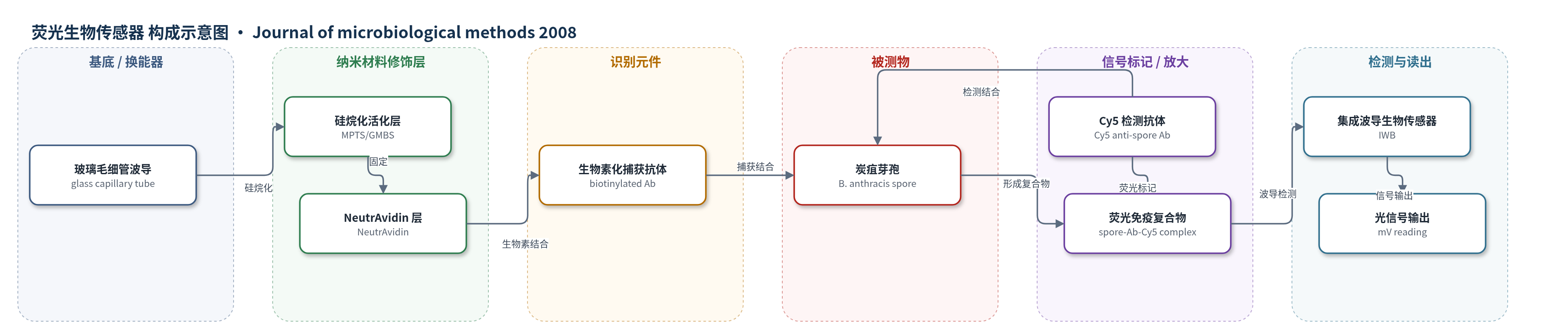
点击图片查看大图 · 依据论文自动绘制
传感器类型
荧光生物传感器
检测对象
炭疽芽孢杆菌芽孢(Bacillus anthracis spores,Sterne 株);样品基质:环境灰尘拭子提取液(office vacuum cleaner dust,PBSTB)、孢子悬液。
检测原理
检测采用液相免疫识别与光学波导换能。首先,B. anthracis 芽孢在 PBSTB 中同时与生物素化抗芽孢抗体和 Cy5 标记抗芽孢抗体孵育,形成“捕获抗体–芽孢–荧光检测抗体”免疫复合物;未结合抗体经离心过滤去除。随后复合物进入 NeutrAvidin 修饰的玻璃毛细管,生物素与 NeutrAvidin 高亲和结合,将免疫复合物捕获在波导内表面。Cy5 标记物在 IWB 光路中产生可被检测的光学信号,仪器输出 mV 读数。芽孢浓度越高,被捕获的 Cy5 标记复合物越多,信号越强。捕获后的芽孢可在 BHI 肉汤中萌发并释放为营养细胞,用于 PCR 确认毒力基因。
检测灵敏度
LOD: about 10^4 spores per capillary (sandwich); about 2×10^3 spores per capillary (liquid-phase); ca. 10^3 spores per capillary (environmental dust). 对应浓度: 2×10^5 spores/mL (sandwich, 50 µL capillary volume); 4×10^4 spores/mL (liquid-phase, 50 µL capillary volume). 理论 LOD: about 10^3 bound spores per capillary. 空白: 13.7±1.0 mV (sandwich); 13.1±1.2 mV (liquid-phase); 11.5±0.6 mV (dust). LOD 定义为空白均值+3SD。
效应效果
液相法较传统夹心法灵敏度提高约 5 倍,夹心法 LOD 约 10^4 芽孢/毛细管(2×10^5 芽孢/mL),液相法约 2×10^3 芽孢/毛细管(4×10^4 芽孢/mL);环境灰尘加标样品中表观 LOD 约 10^3 芽孢/毛细管,灰尘未明显干扰检测。实验以三次重复报告均值±标准差,空白信号分别为 13.7±1.0 mV(夹心)和 13.1±1.2 mV(液相)。BHI 肉汤 37°C 孵育 50 min 可释放约 90% 免疫捕获芽孢为营养细胞,且不影响 PCR;单独 BHI 中 >99% 芽孢 5 min 内萌发。方法可在数小时内完成筛查、存活评估和毒力确认,适用于环境样品快速检测。
传感器的构成
- 基底/换能器:玻璃毛细管(glass capillary tubes,52 mm,1.66 mm O.D.,1.23 mm I.D.),作为集成波导(IWB)光路载体。
- 表面修饰:3-mercaptopropyl trimethoxysilane 硅烷化层与 4-maleimidobutyric acid N-hydroxysuccinimide ester(GMBS)活化层,用于固定 NeutrAvidin。
- 亲和素层:NeutrAvidin(生物素结合蛋白),通过高亲和生物素–亲和素作用捕获生物素化抗体–芽孢复合物。
- 识别元件:生物素化抗 B. anthracis 芽孢多克隆抗体(biotinylated anti-B. anthracis spore antibody,goat polyclonal antibody),特异性结合芽孢表面抗原。
- 信号标记物:Cy5 标记抗 B. anthracis 芽孢抗体(Cy5-labeled anti-spore antibody,FluoroLink-Ab Cy5 labeling kit),提供荧光光学信号。
- 封闭剂:PBSTB(PBS 含 0.05% Tween-20 和 2% BSA),封闭剩余位点并降低非特异结合。
- 释放/萌发介质:BHI 肉汤(BHI broth),用于免疫捕获芽孢萌发、生长和释放,供 PCR 确认。
中文摘要
炭疽芽孢杆菌是重要生物恐怖威胁,其芽孢易形成气溶胶、环境持久且耐常规消毒。免疫检测可快速识别高浓度芽孢,但低浓度检测易受近缘芽孢杆菌交叉反应干扰,需 PCR 进一步确认毒力株。本文报道一种基于集成波导生物传感器(Integrating Waveguide Biosensor, IWB)的快速敏感免疫检测方法,用于环境样品中炭疽芽孢杆菌芽孢的检测与后续回收。采用“液相”免疫检测,使芽孢同时与生物素化捕获抗体和 Cy5 标记检测抗体孵育,再捕获于 NeutrAvidin 修饰的毛细管波导中,检出限约 10^3 个芽孢/毛细管。随后在毛细管内加入 BHI 肉汤孵育,可快速诱导免疫捕获芽孢萌发、生长并释放为营养细胞,便于裂解和 PCR 鉴定,从而兼顾快速筛查、存活评估与毒力确认。
英文摘要
Bacillus anthracis is considered a major threat as an agent of bioterrorism. B. anthracis spores are readily dispersed as aerosols, are very persistent, and are resistant to normal disinfection treatments. Immunoassays have been developed to rapidly detect B. anthracis spores at high concentrations. However, detection of B. anthracis spores at lower concentrations is problematic due to the fact that closely related Bacillus species (e.g., B. thuringiensis) can cross-react with anti-B. anthracis antibodies, resulting in false positive detections. Subsequent polymerase chain reaction (PCR) analysis is required to differentiate virulent strains. We report here on a protocol for the rapid, sensitive detection of B. anthracis spore using the Integrating Waveguide Biosensor followed by a method for the rapid release and germination of immunocaptured spores. A detection limit of ca. 10(3) spores was achieved by incubating spores simultaneously with capture and detection antibodies ("liquid-phase" assay) prior to capture on capillary tubes/waveguides. Subsequent incubation with BHI broth directly in capillary tubes allowed for rapid germination, outgrowth, and release of spores, resulting in vegetative cells for PCR analysis.