组成图示
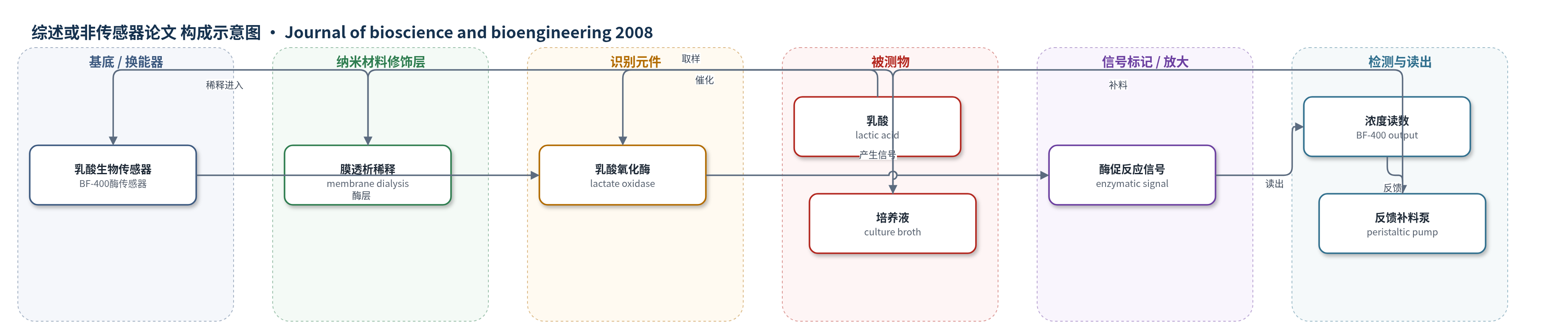
点击图片查看大图 · 依据论文自动绘制
传感器类型
综述或非传感器论文
检测对象
乳酸(lactic acid)、BGS(bifidogenic growth stimulator);样品基质:厌氧培养液及培养上清(TPY medium/culture broth supernatant)
检测原理
该工艺中的在线检测基于乳酸生物传感器。培养液样品经膜透析稀释后进入BF-400控制器,乳酸氧化酶(lactate oxidase, EC 1.13.12.4)特异性催化乳酸氧化,酶促反应引起传感器可检测信号变化;BF-400将该信号转换为乳酸浓度值,并每20 min自动测量一次。当培养液中乳酸低于设定值(约3 g/l)时,控制器驱动蠕动泵补加含50 g/l乳酸的TPY培养基,使乳酸维持在低浓度,避免底物抑制并促进BGS合成。该检测无额外化学放大,主要依靠酶识别、膜稀释和在线反馈控制实现稳定生产。
检测灵敏度
原文未报告LOD、线性范围、灵敏度斜率或相关系数。
效应效果
与常规批次相比,连续过滤培养在D=0.075 h−1下平均BGS为2.4 mg/l,BavD为1.8×10−1 mg·l−1·h−1,为批次9.4×10⁻²的1.9倍;补料分批在线乳酸控制将乳酸维持在3.3 g/l,最大BGS为30.7 mg/l,BavD为2.1×10−1 mg·l−1·h−1,为批次的2.2倍。新耦合系统连续培养BGS达46.8 mg/l(摘要约47 mg/l),BavD为3.5 mg·l−1·h−1,为批次的37倍;按培养基体积计生产力为0.168 mg·l−1·h−1,为批次的2.1倍。连续过滤可去除丙酸、乙酸等抑制代谢物,在线乳酸反馈控制避免乳酸底物抑制,作者认为该组合显著提高BGS连续生产水平。
传感器的构成
- 检测模块:在线乳酸控制器 BF-400,自动测定培养液乳酸浓度并反馈控制
- 识别元件:乳酸氧化酶(lactate oxidase, EC 1.13.12.4),酶法识别并催化乳酸
- 样品预处理:膜透析装置(membrane dialysis device),将培养液稀释至适宜检测浓度
- 反馈执行:蠕动泵(peristaltic pump)与水平控制器,补加含50 g/l乳酸的TPY培养基
中文摘要
本研究以乳酸为碳源,比较不同培养方式下丙酸杆菌 Propionibacterium shermanii 生产胞外双歧杆菌生长刺激物(BGS)的效果。在稀释率0.075 h−1的连续生物反应器中,微滤装置持续去除抑制性代谢物并完全回收细胞,平均BGS浓度为2.4 mg/l,按培养时间计的生产力为1.8×10−1 mg·l−1·h−1,为常规批次培养(9.4×10⁻² mg·l−1·h−1)的1.9倍。采用在线乳酸控制器进行补料分批培养时,乳酸氧化酶生物传感器将培养液乳酸维持在约3.3 g/l,避免底物抑制,BGS最高达31 mg/l,生产力为2.1×10−1 mg·l−1·h−1,为批次的2.2倍。将连续过滤与在线乳酸反馈控制耦合的新系统中,BGS可连续维持在47 mg/l,按培养时间计生产力达3.5 mg·l−1·h−1,按培养基体积计为1.7×10⁻¹ mg·l−1·h−1,分别为批次的37倍和2.1倍。结果表明,连续过滤去除丙酸和乙酸等抑制物,并配合乳酸浓度反馈控制,可显著提高BGS产量。
英文摘要
Production of a bifidogenic growth stimulator (BGS) by Propionibacterium freudenreichii subsp. shermanii (Propionibacterium shermanii) using lactic acid as a carbon source was investigated using different cultivation methods. When a continuous bioreactor system with a filtration device was used at a dilution rate of 0.075 h(-1), the average BGS concentration was 2.4 mg/l, which corresponds to a BGS productivity per cultivation time of 1.8 x 10(-1) mg x l(-1) x h(-1). The BGS productivity per cultivation time in continuous cultivation with filtration was 1.9-fold that (9.4 x 10(-2) mg x l(-1).h(-1)) in a conventional batch cultivation. In fed-batch cultivation with feed-back control using an on-line lactic acid controller with a lactic acid biosensor, it was possible to prevent substrate inhibition by maintaining the lactic acid concentration in culture broth low at 3.3 g/l, and an enhanced BGS production (31 mg/l) was successfully attained. The BGS productivity per cultivation time (2.1x10(-1) mg x l(-1) x h(-1)) in the fed-batch cultivation with feed-back control was 2.2-fold that in the conventional batch cultivation. A new bioreactor system was developed by coupling a continuous bioreactor system with a filtration device to an on-line lactic acid controller. Using the new bioreactor system, we produced BGS continuously at a high level of 47 mg/l. The BGS productivities per cultivation time (3.5 mg.l(-1) x h(-1)) and the total volume of medium used (1.7 x 10(-1) mg x l(-1) x h(-1)) obtained in the new bioreactor system were 37-fold and 2.1-fold those in the conventional batch cultivation, respectively. These results described above clearly demonstrate the positive effects of both the continuous filtration for removal of metabolites (propionic and acetic acids) inhibitory to cell growth and feed-back control of lactic acid concentration in the culture broth on BGS production by P. shermanii. This paper is the first report on BGS production by the propionic acid bacterium using lactic acid as a carbon source.