组成图示
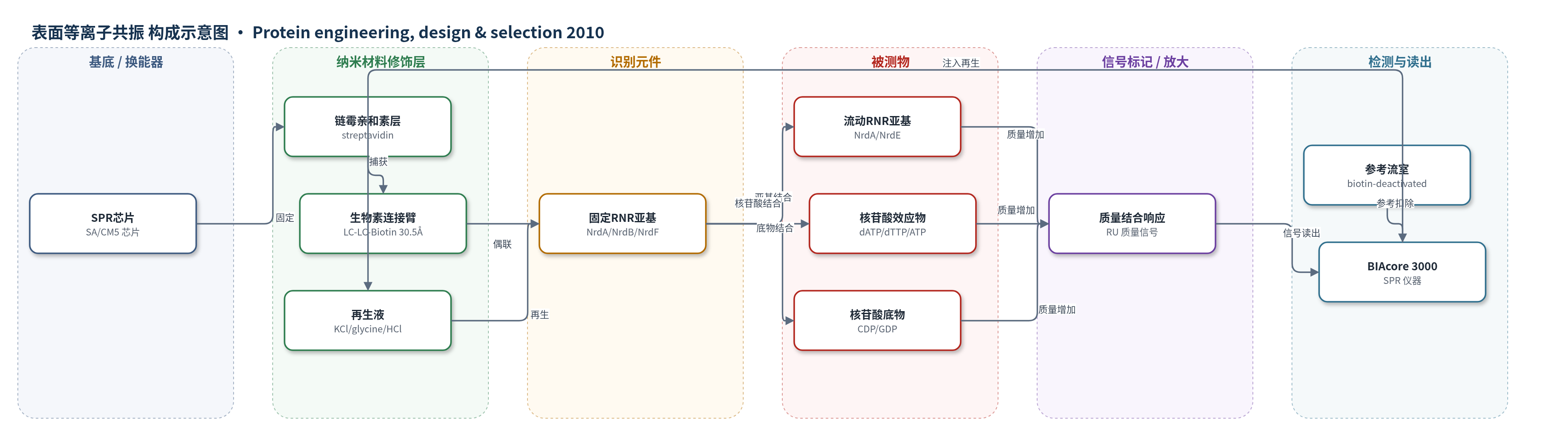
点击图片查看大图 · 依据论文自动绘制
传感器类型
表面等离子共振(SPR)生物传感器
检测对象
核糖核苷酸还原酶亚基(ribonucleotide reductase subunits, NrdA/NrdB/NrdE/NrdF)、核苷酸效应物/底物(dATP、dTTP、ATP、CDP、GDP);样品基质:SPR 运行缓冲液(10 mM HEPES pH 7.4、0.15 M NaCl、10 mM MgCl2、2 mM DTT、0.005% P20)
检测原理
生物素化 RNR 亚基通过 EZ-Link Sulfo-NHS-LC-LC-Biotin 的 30.5 Å 连接臂固定于链霉亲和素 SPR 芯片表面,形成可再生识别层。流动相中的未标记互补 RNR 亚基或核苷酸与固定亚基结合后,界面质量增加,改变表面等离子体共振条件,产生与结合质量成正比的共振单位(RU)响应。稳态 RU 随分析物浓度升高而增加,经参考流室扣除非特异结合后拟合得到 KD。核苷酸结合可诱导 RNR 构象或寡聚化变化,使亚基间相互作用增强或减弱,表现为结合容量、解离速率和稳态响应改变。该方法无酶促放大,依靠高固定密度、长连接臂和 SPR 质量灵敏度实现蛋白-蛋白及蛋白-小分子相互作用检测。
检测灵敏度
未报告 LOD、线性范围、灵敏度斜率或相关系数。
效应效果
生物素化后酶活性保留:大肠杆菌 NrdA 约 70%、NrdB 约 60%,Aeh1 NrdB 55%,炭疽杆菌 NrdF 88%。固定量 200–5260 RU,表面稳定 2–3 天。非特异结合多为 2–15%,高浓度核苷酸参考结合 40–97%。SPR 与活性法一致:大肠杆菌 NrdA–NrdB 在 0.1 μM dTTP+CDP 下 KD 1.34±0.31 μM,活性法 0.95±0.23 μM;Aeh1 在 ATP+CDP 下 SPR 0.25±0.051 μM,活性法 0.19±0.0029 μM。可检测弱结合 CDP(KD 333±28 μM),适用于高通量筛选 RNR 抑制剂。
传感器的构成
- 换能器基底:SA/CM5 SPR 传感器芯片,提供表面结合与光学换能
- 表面捕获层:链霉亲和素(streptavidin, SA)或 CM5 羧甲基葡聚糖,固定生物素化/氨基偶联蛋白
- 连接修饰层:EZ-Link Sulfo-NHS-LC-LC-Biotin(30.5 Å 生物素连接臂),将 RNR 亚基连接至 SA 表面
- 识别配体层:生物素化 RNR 亚基(NrdA、NrdB、NrdF、Aeh1 NrdB)或氨基偶联 His6-NrdB,识别互补亚基/核苷酸
- 分析物层:未标记 RNR 亚基或核苷酸(NrdA、NrdE、dATP、dTTP、ATP、CDP、GDP),与固定配体结合
- 信号标记物:无外源标记,结合质量直接产生 SPR 响应
- 参考与再生:生物素灭活空白流室作参考;0.5 M KCl、glycine-HCl pH 2.0、0.1 M HCl/50 mM NaOH 再生表面
中文摘要
核糖核苷酸还原酶(RNR)负责合成 DNA 复制与修复所需的脱氧核糖核苷酸,其活性受核苷酸对调节位点差异亲和性的复杂变构调控。作者开发了一种稳健且灵敏的方法,通过 30.5 Å 连接臂将生物素化 RNR 偶联到表面等离子共振(SPR)链霉亲和素生物传感器芯片上。对三种 RNR 的系统研究表明,效应核苷酸可增强全酶亚基间相互作用,而底物对亚基相互作用无影响。不同 RNR 对结合 ATP 锥结构域的负变构效应物 dATP 的响应不同:具有功能 ATP 锥的大肠杆菌 Ia 类 RNR 形成紧密复合物;缺乏 ATP 锥的人类病原体炭疽杆菌 Ib 类 RNR 未观察到亚基相互作用增强;具有分裂催化亚基和非功能 ATP 锥、但保留部分 dATP 调节特征的水生气单胞菌噬菌体 Aeh1 Ia 类 RNR 仅出现中等增强。作者还成功固定了具有催化功能的大肠杆菌 NrdA 亚基,便于研究核苷酸相互作用。该 SPR 方法有望为任意 RNR 的核苷酸介导调控提供生物学洞见,并可用于高通量筛选潜在 RNR 抑制剂。
英文摘要
Ribonucleotide reductase (RNR) synthesizes deoxyribonucleotides for DNA replication and repair and is controlled by sophisticated allosteric regulation involving differential affinity of nucleotides for regulatory sites. We have developed a robust and sensitive method for coupling biotinylated RNRs to surface plasmon resonance streptavidin biosensor chips via a 30.5 A linker. In comprehensive studies on three RNRs effector nucleotides strengthened holoenzyme interactions, whereas substrate had no effect on subunit interactions. The RNRs differed in their response to the negative allosteric effector dATP that binds to an ATP-cone domain. A tight RNR complex was formed in Escherichia coli class Ia RNR with a functional ATP cone. No strengthening of subunit interactions was observed in the class Ib RNR from the human pathogen Bacillus anthracis that lacks the ATP cone. A moderate strengthening was seen in the atypical Aeromonas hydrophila phage 1 class Ia RNR that has a split catalytic subunit and a non-functional ATP cone with remnant dATP-mediated regulatory features. We also successfully immobilized a functional catalytic NrdA subunit of the E.coli enzyme, facilitating study of nucleotide interactions. Our surface plasmon resonance methodology has the potential to provide biological insight into nucleotide-mediated regulation of any RNR, and can be used for high-throughput screening of potential RNR inhibitors.