组成图示
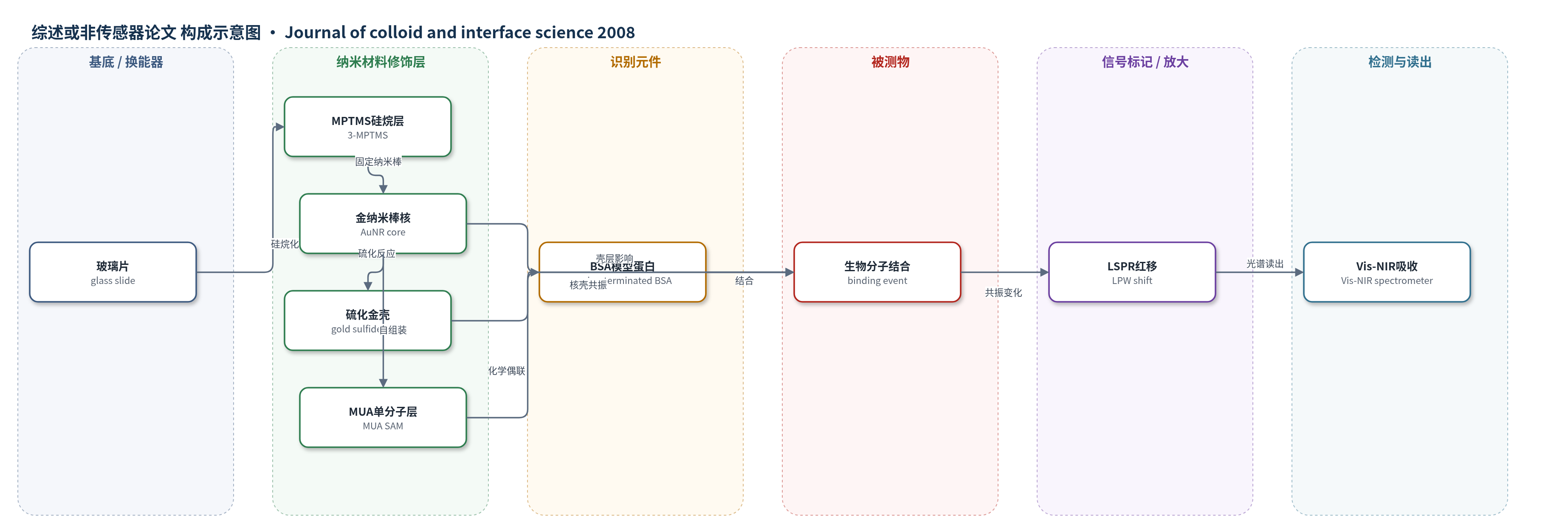
点击图片查看大图 · 依据论文自动绘制
传感器类型
综述或非传感器论文
检测对象
未明确报道特定分析物;仅以牛血清白蛋白(BSA)作为模型结合物,样品基质为水、氯仿等溶剂及玻璃片表面
检测原理
金纳米棒具有横向等离子体波长(TPW)和纵向等离子体波长(LPW),其中 LPW 强烈依赖长径比及周围介质折射率。Na2S2O3 或 Na2S 与金纳米棒反应时,表面生成硫化金壳层,同时金核收缩,使有效长径比增大,导致 LPW 红移。将金纳米棒固定于 MPTMS 修饰玻璃片后,再经 MUA 自组装和 EDC/NHS 偶联 BSA,生物分子结合会改变纳米棒界面附近的折射率和距离,引起 LSPR 峰位移动。蠕虫状核壳结构因壳层包覆和核收缩而对界面变化更敏感,因此 BSA 结合引起更大红移。信号通过 Vis–NIR 吸收光谱读取 LPW 变化,文中未采用 HCR、RCA、CRISPR-Cas 或酶催化沉积等放大策略。
检测灵敏度
原文未报告 LOD、线性范围、灵敏度斜率或相关系数。
效应效果
作者未报告选择性、抗干扰、重现性(RSD)、实际样品加标回收率或与 ELISA/HPLC/qPCR 等方法的定量对比。实验显示,固定于玻璃片的蠕虫状金纳米棒对周围溶剂折射率变化更敏感,Table 1 中部分样品在水到氯仿中 LPW 由 860 nm 移至 915 nm、由 879 nm 移至 937 nm;BSA 结合后,常规金纳米棒 LPW 红移约 10 nm,而蠕虫状金纳米棒红移约 30 nm。蠕虫状金纳米棒水分散稳定性优于原始金纳米棒,Na2S 体系在室温下可稳定数月。作者认为其高 LSPR 敏感性可用于生物分子识别研究和生物传感器制备。
传感器的构成
- 基底:玻璃片(glass slide),承载纳米棒并用于 Vis–NIR 吸收测量
- 硅烷化层:3-巯基丙基三甲氧基硅烷(MPTMS),在玻璃表面形成含巯基自组装层,用于固定金纳米棒
- 纳米材料核:金纳米棒(AuNR),提供横向和纵向局域表面等离子体共振(LSPR)信号
- 纳米材料壳:硫化金壳(gold sulfide shell),由 Na2S2O3 或 Na2S 诱导形成,改变长径比并增强 LSPR 敏感性
- 识别/模型生物分子层:十一烷硫醇(MUA)自组装单分子层(SAM),提供羧基用于 EDC/NHS 偶联
- 模型结合物:牛血清白蛋白(BSA),经 EDC/NHS 偶联到 MUA 上,用于模拟生物结合事件
- 读出层:Vis–NIR 吸收光谱仪,监测纵向等离子体波长(LPW)红移
中文摘要
本文报道了一类蠕虫状金纳米棒的合成与光学性质。常规金纳米棒与硫代硫酸钠(Na2S2O3)或硫化钠(Na2S)反应后,形成由收缩的金纳米棒核和包覆壳层组成的蠕虫状结构,即金–硫化金核壳结构,区别于原始金纳米棒。透射电子显微镜(TEM)和 X 射线光电子能谱(XPS)证实了金硫族化合物壳层的形成,且壳层厚度可通过反应条件控制。由于壳层增厚与金核收缩同时发生,可调节纳米棒的等离子体共振。通过调整反应时间、温度、添加剂等条件,可获得具有目标纵向等离子体波长(LPW)且尺寸分布较窄的蠕虫状金纳米棒,其上限受起始金纳米棒性质限制。该方法可选择性改变金纳米棒的 LPW。此外,所得蠕虫状金纳米棒在局域表面等离子体共振(LSPR)方面比原始金纳米棒具有更高敏感性。作者利用可见–近红外(Vis–NIR)吸收、荧光和共振光散射等光谱方法表征了其特殊性质,并认为其可用于生物分子识别研究和生物传感器制备。
英文摘要
A type of worm-like nanorods was successfully synthesized through conventional gold nanorods reacting with Na2S2O3 or Na2S. The generated worm-like gold nanorods comprise shrunk nanorod cores and enwrapped shells. Therefore, a gold-gold sulfide core-shell structure is formed in the process, distinguishing from their original counterparts. The formation of the gold chalcogenide layers was confirmed by transmission electron microscopy and X-ray photoelectron spectroscopy. Experimental results showed that the thickness of the gold chalcogenide layers is controllable. Since the increase of shell thickness and decrease of gold nanorod core take place simultaneously, it allows one to tune the plasmon resonance of nanorods. Proper adjustment of reaction time, temperature, additives and other experimental conditions will produce worm-like gold nanorods demonstrating desired longitudinal plasmon wavelength (LPW) with narrow size distributions, only limited by properties of starting original gold nanorods. The approach presented herein is capable of selectively changing LPW of the gold nanorods. Additionally, the formed worm-like nanorods possess higher sensitive property in localized surface plasmon resonance than the original nanorods. Their special properties were characterized by spectroscopic methods such as Vis-NIR, fluorescence and resonance light scattering. These features imply that the gold nanorods have potential applications in biomolecular recognition study and biosensor fabrications.