组成图示
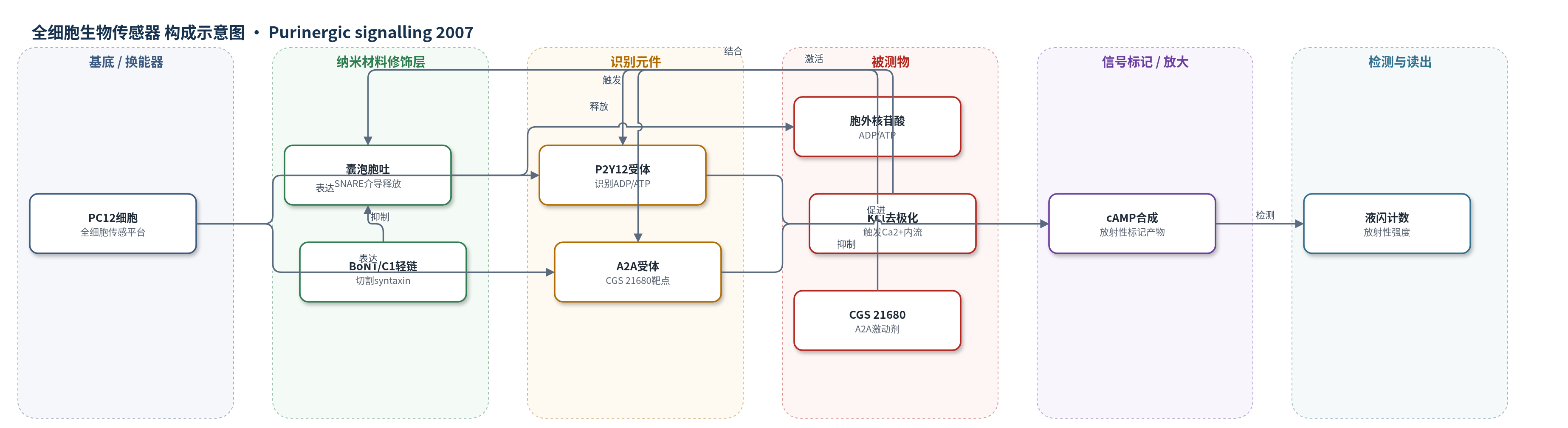
点击图片查看大图 · 依据论文自动绘制
传感器类型
全细胞生物传感器
检测对象
内源嘌呤核苷酸(nucleotides, ADP/ATP),样品基质为PC12细胞培养上清/细胞外液
检测原理
PC12细胞膜上的内源P2Y12受体识别胞外ADP/ATP等嘌呤核苷酸,作为G蛋白偶联受体负调控腺苷酸环化酶,使cAMP合成下降。实验先用[3H]腺嘌呤标记细胞嘌呤池,并以A2A受体激动剂CGS 21680刺激cAMP积累作为基线;胞外核苷酸浓度越高,P2Y12激活越强,放射性cAMP掺入越低。100 mM KCl去极化诱导Ca2+内流和囊泡胞吐,释放更多内源核苷酸,从而增强cAMP抑制。apyrase降解胞外核苷酸或2-MesAMP阻断P2Y12可恢复cAMP,证明信号来自自分泌/旁分泌核苷酸。BoNT/C1轻链切割syntaxin阻断胞吐,用于区分自发非囊泡释放与去极化诱导囊泡释放。
检测灵敏度
未报告LOD、线性范围、灵敏度斜率或相关系数。
效应效果
该细胞P2Y12生物传感器表现出明确的自分泌/旁分泌选择性:10 μM ADP在野生型和BoNT/C1表达克隆中抑制cAMP的程度相同,说明受体功能未受转染影响;1 U/ml apyrase或100 μM 2-MesAMP均使CGS 21680诱导的cAMP增加约两倍,且不同细胞类型间无显著差异,表明自发核苷酸释放不依赖囊泡胞吐。100 mM KCl去极化在野生型中使cAMP抑制达到与ADP相近水平,但在BT2克隆中消失、在BT7克隆中显著减弱,证明去极化诱导释放主要依赖Ca2+依赖囊泡胞吐。统计差异达p<0.05、p<0.01或p<0.001。作者主张该方法可用于研究神经内分泌细胞核苷酸释放机制。
传感器的构成
- 细胞基底/换能器:PC12神经内分泌细胞(PC12 cells),提供内源P2Y12受体、腺苷酸环化酶-cAMP信号通路和放射性标记嘌呤池。
- 识别元件:内源P2Y12受体(P2Y12 receptor),识别胞外ADP/ATP等嘌呤核苷酸并负调控腺苷酸环化酶。
- 信号标记物:[3H]腺嘌呤([3H]adenine),掺入细胞嘌呤池,使新生cAMP具有放射性。
- 信号读出试剂:RO 20-1724(磷酸二酯酶抑制剂)与腺苷脱氨酶(adenosine deaminase),维持cAMP积累并减少腺苷干扰。
- 基线信号刺激:CGS 21680(A2A受体激动剂),激活A2A受体促进cAMP合成,形成可被P2Y12抑制的基线。
- 验证/阻断元件:2-MesAMP(P2Y12受体拮抗剂)和apyrase(核苷酸酶),分别阻断P2Y12或降解胞外核苷酸以验证信号来源。
- 释放触发元件:100 mM KCl去极化,诱导电压门控Ca2+内流和囊泡胞吐释放内源核苷酸。
- 读出仪器:液闪计数器(liquid scintillation counter, Packard Tri-Carb 2100 TR),检测cAMP放射性强度。
中文摘要
核苷酸不仅可由神经元释放,也可由成纤维细胞、上皮细胞、内皮细胞和胶质细胞等释放。非神经细胞ATP释放常为Ca2+独立且多非囊泡性,而神经元ATP释放通常被认为通过胞吐发生。为评估神经内分泌细胞核苷酸释放是否包含非囊泡成分,作者将P2Y12受体的自分泌/旁分泌激活作为PC12细胞核苷酸释放的生物传感器。稳定表达肉毒毒素C1轻链(BoNT/C1)的PC12细胞中,免疫印迹显示syntaxin 1减少;与未转染细胞相比,转染细胞自发及去极化诱导的预掺入[3H]去甲肾上腺素释放显著降低,表明胞吐受损。在表达BoNT/C1轻链的细胞中,ADP对cAMP合成的抑制与未转染细胞相同;P2Y12受体阻断或apyrase降解胞外核苷酸对cAMP合成的增强也无差异。然而,去极化诱导内源核苷酸释放所致的cAMP合成抑制在表达细胞中消失或明显减弱。结果表明,神经内分泌细胞自发核苷酸释放可独立于囊泡胞吐,而去极化诱导释放主要依赖胞吐机制。
英文摘要
Nucleotides are released not only from neurons, but also from various other types of cells including fibroblasts, epithelial, endothelial and glial cells. While ATP release from non-neural cells is frequently Ca(2+) independent and mostly non-vesicular, neuronal ATP release is generally believed to occur via exocytosis. To evaluate whether nucleotide release from neuroendocrine cells might involve a non-vesicular component, the autocrine/paracrine activation of P2Y(12) receptors was used as a biosensor for nucleotide release from PC12 cells. Expression of a plasmid coding for the botulinum toxin C1 light chain led to a decrease in syntaxin 1 detected in immunoblots of PC12 membranes. In parallel, spontaneous as well as depolarization-evoked release of previously incorporated [(3)H]noradrenaline from transfected cells was significantly reduced in comparison with the release from untransfected cells, thus indicating that exocytosis was impaired. In PC12 cells expressing the botulinum toxin C1 light chain, ADP reduced cyclic AMP synthesis to the same extent as in non-transfected cells. Likewise, the enhancement of cyclic AMP synthesis either due to the blockade of P2Y(12) receptors or due to the degradation of extracellular neucleotides by apyrase was not different between non-transfected and botulinum toxin C1 light chain expressing cells. However, the inhibition of cyclic AMP synthesis caused by depolarization-evoked release of endogenous nucleotides was either abolished or greatly reduced in cells expressing the botulinum toxin C1 light chain. Together, these results show that spontaneous nucleotide release from neuroendocrine cells may occur independently of vesicle exocytosis, whereas depolarization-evoked nucleotide release relies predominantly on exocytotic mechanisms.