组成图示
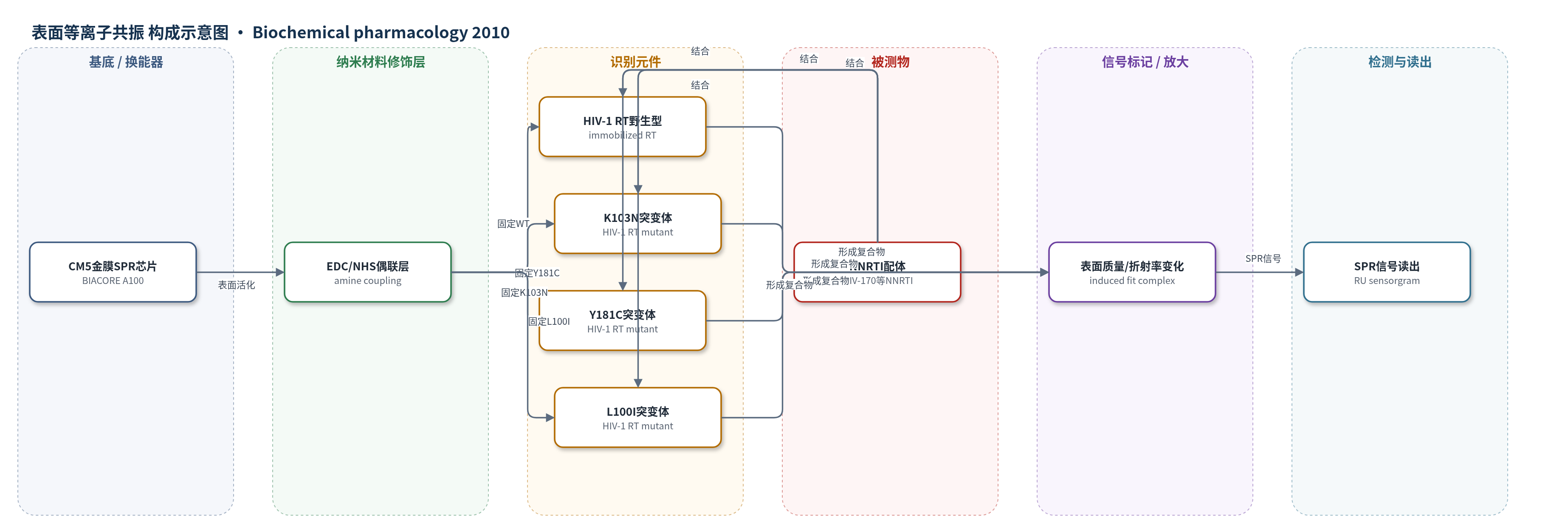
点击图片查看大图 · 依据论文自动绘制
传感器类型
表面等离子共振(SPR)生物传感器
检测对象
非核苷逆转录酶抑制剂(NNRTIs,MIV-170、delavirdine、efavirenz、nevirapine、TMC-120);样品基质:DMSO 溶液/PBS-P 含 3% DMSO 流动相
检测原理
SPR 芯片表面经氨基偶联固定 HIV-1 RT 野生型及突变体。注入 NNRTI 后,配体与固定酶结合形成初始 encounter complex(E1I),随后发生构象变化形成更稳定的 induced complex(E2I),即诱导契合机制。结合导致芯片表面质量/折射率增加,SPR 共振角改变,BIACORE A100 以共振单位(RU)记录传感器图。信号上升幅度反映复合物形成量,解离/松弛速率决定信号下降斜率。由于结合紧密且解离极慢,无法用常规回归定量速率常数,作者用模拟传感器图定性比较 k1–k4。方法无标记、无酶催化放大,通过平行检测区与参考区扣除提高比较可靠性。
检测灵敏度
未报告
效应效果
SPR重复图相似,MIV-170在WT及K103N/Y181C/L100I上形成最大复合物,10 min内未检测到解离;TMC-120几乎不可逆但溶解度<0.3–1.2 mM致信号低,delavirdine/efavirenz对突变体结合减弱,nevirapine与WT结合弱。MT-4 EC50(nM):MIV-170对WT/L100I/K103N/Y181C为0.97/9/3.2/5.3,优于efavirenz(1.6/88/20/3.9)、TMC-120(1.2/40/5.5/16)、delavirdine(110/7900/6400/5000)、nevirapine(170/1200/>10000/>10000)。PBMC中MIV-170 EC50为2.1 nM(0.2–25),支持其微杀菌剂潜力。
传感器的构成
- 换能器/基底:BIACORE A100 金膜 SPR 芯片(Sensor Chip CM5),提供表面等离子共振检测界面并转换结合质量/折射率变化。
- 表面化学修饰层:CM5 芯片表面经 EDC/NHS 氨基偶联化学活化,用于共价固定 HIV-1 RT。
- 识别元件:HIV-1 逆转录酶(HIV-1 RT)野生型及 K103N、Y181C、L100I 突变体(含 E478Q),固定于 DA1/DA2/DA4/DA5,特异性结合 NNRTI。
- 参考区:DA3 仅活化/去活化的空白参考区,用于扣除非特异信号与折射率漂移。
- 流动相/缓冲层:PBS-P(10 mM phosphate、2.7 mM KCl、0.14 M NaCl、0.05% P20)含 3% DMSO,维持流动并匹配溶剂折射率。
中文摘要
本研究考察非核苷逆转录酶抑制剂(NNRTIs)缓慢解离对抗HIV-1疗效的重要性。作者采用表面等离子共振(SPR)生物传感器技术,分析一系列NNRTIs与野生型及耐药突变体HIV-1逆转录酶(RT)的相互作用,并在MT-4细胞和外周血单个核细胞(PBMC)中测定抗病毒效应。由于解离极慢且机制复杂,速率常数无法定量,故用模拟传感器图进行定性分析。能充分描述相互作用的简单模型为诱导契合机制,即先形成初始酶-抑制剂复合物,再转变为更稳定的诱导复合物。初始复合物解离速率与诱导复合物松弛速率的差异,解释了复合物形成量、稳定性及抗病毒效力差异,也与NNRTI结合位点突变相关。MIV-170在细胞培养中对野生型和突变型HIV-1抑制最好,对应最大复合物量及最慢松弛/解离速率。研究支持抗HIV疗效依赖靶标缓慢解离、延长抑制时间的假说,并体现模拟数据对紧密结合药物定性分析的价值。
英文摘要
The importance of slow dissociation of non-nucleoside reverse transcriptase inhibitors (NNRTIs) for antiviral effect has been investigated. The kinetic characteristics of a series of NNRTIs interacting with wild type and drug resistant variants of HIV-1 RT (EC 2.7.7.49) were analyzed by SPR biosensor technology. The antiviral effect was determined in MT-4 and peripheral blood mononuclear cells. Due to extremely slow dissociation rates and a complex interaction mechanism, rate constants could not be quantified. Instead, interaction characteristics were qualitatively analyzed using simulated sensorgrams. The simplest model describing these interactions adequately was an induced fit mechanism, i.e. a mechanism involving the formation of an initial enzyme-inhibitor complex subsequently transformed into a more stable complex. Differences in rates of dissociation from the initial complex and rates of relaxation from the induced complex explained (1) the differences in the amounts of formed complex, (2) the stability of the complex and (3) the antiviral efficacies of the compounds. The effect of NNRTI binding site mutations also correlated with these kinetic characteristics. MIV-170 was the most effective inhibitor of wild type and mutant HIV-1 in cell culture, a property that was associated with the formation of the largest amount of complex and the slowest relaxation and dissociation rates. This study supports the hypothesis that the efficacy of anti-HIV drugs is dependent on slow dissociation from the target, thereby maximizing the duration of the inhibitory effect. It also illustrates the strength of simulating interaction data for qualitative analysis of tight-binding drugs and the importance of resolving the kinetic mechanism of drug-target interactions.