组成图示
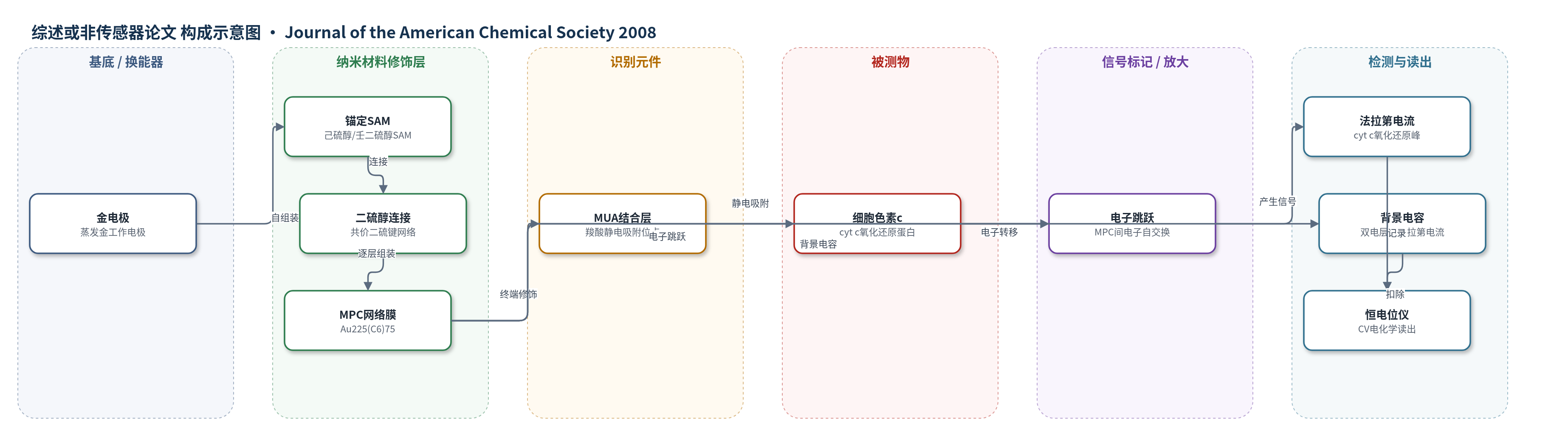
点击图片查看大图 · 依据论文自动绘制
传感器类型
综述或非传感器论文
检测对象
细胞色素c(cytochrome c, cyt c);样品基质为4.4 mM磷酸钾缓冲液(pH 7),非实际生物/环境样品基质。
检测原理
该体系并非以定量检测某分析物为目的,而是以cyt c为模型蛋白研究界面电子转移。金电极先形成己硫醇/壬二硫醇SAM,再通过二硫醇连接剂逐层组装Au225(C6)75 MPC网络膜,终端引入MUA配体或MUA封端MPC。带正电的cyt c通过静电作用吸附于MUA羧酸位点,其血红素铁中心与电极之间发生直接电子转移。MPC网络中的电子自交换/电子跳跃可介导长距离ET,使蛋白即使位于约13.5 nm厚的膜外仍保持较高kET°。法拉第峰电流正比于吸附cyt c的表面覆盖量Γ;背景双电层电容由膜核尺寸、配体链长和连接机制决定。通过降低极性基团、优化MUA含量和亲水性,可减小背景并均匀化吸附环境,使峰宽接近理想90 mV。
检测灵敏度
原文未报告LOD、线性范围、灵敏度斜率或相关系数。
效应效果
论文未做实际样品加标回收、选择性抗干扰或RSD评价。MUA SAM和MHDA SAM的cyt c峰宽分别为127 mV和146 mV,偏离理想90 mV;亲水MPC膜峰宽降至90、91和93 mV,显著优于MUA SAM。MUA封端MPC膜的kET°为6.8±3.6 s-1,与MUA SAM的6.4±3.3 s-1无显著差异,而ET距离约为SAM的8–9倍。薄膜厚度约13.5±0.9 nm。纯MUA MPC体系5天内变性最轻;Max-MUA-MPC加过量MUA首日覆盖量约10.1 pmol/cm2,接近MUA SAM的11.1 pmol/cm2,但随后出现可重复下降。作者认为其利于生物传感器工程。
传感器的构成
- 基底/换能器电极:蒸发金(evaporated gold)工作电极,面积0.32 cm2,提供电子转移界面并用于电化学读出。
- 初始锚定SAM:己硫醇/壬二硫醇混合自组装单分子层(hexanethiol/nonanedithiol SAM)或MUA SAM,用于固定MPC膜并屏蔽金表面形貌。
- MPC网络膜主体:Au225(C6)75单层保护簇(monolayer-protected clusters, MPCs),通过逐层组装形成低介电纳米颗粒网络,降低背景电容并介导电子跳跃。
- 连接剂:二硫醇(dithiol linker,如nonanedithiol)形成共价二硫键网络,替代金属离子/酯键连接,减少极性基团和双电层电容。
- 识别/吸附元件:11-巯基十一烷酸(MUA)配体修饰的MPC或MUA封端MPC,提供羧酸结合位点,通过静电和疏水作用吸附带正电cyt c。
- 模型蛋白:细胞色素c(cytochrome c, cyt c),作为氧化还原蛋白模型,其血红素中心直接参与电子转移。
- 信号读出:循环伏安法(CV)与恒电位仪(potentiostat),测量法拉第峰电流、双电层电容、峰宽和电子转移速率常数。
中文摘要
本文研究非水相纳米颗粒组装膜——单层保护簇(MPCs)作为蛋白质单层电化学(PME)中的吸附平台,用于研究氧化还原蛋白的电子转移。作者采用静电和共价等不同连接方式组装MPC膜修饰电极,并固定细胞色素c(cyt c)进行电化学分析。结果表明,体系背景信号(非法拉第电流)与MPC膜的结构和组成直接相关,包括纳米颗粒核尺寸、保护配体性质以及组装连接机制。二硫键连接的Au225(C6)75膜被确定为最适合PME的膜,既能有效抑制有害背景电流,又具有易于工程化的界面性质,以调控cyt c的吸附和电活性。通过精确操控外层MPC的组成,可决定吸附cyt c的表面浓度和变性速率。使用特殊设计的亲水MPC作为终端膜层可获得近理想的cyt c伏安特性,说明该体系能在分子水平控制界面相互作用和柔性,使蛋白在大面积基底上均匀结合。MPC膜上cyt c的电子转移速率常数未因MPC组装引入的较大电子转移距离而显著降低,与传统自组装单分子层策略相比具有优势。该纳米颗粒蛋白吸附平台对生物传感器工程和基础生物电子转移研究具有启示。
英文摘要
Assembled films of nonaqueous nanoparticles, known as monolayer-protected clusters (MPCs), are investigated as adsorption platforms in protein monolayer electrochemistry (PME), a strategy for studying the electron transfer (ET) of redox proteins. Modified electrodes featuring MPC films assembled with various linking methods, including both electrostatic and covalent mechanisms, are employed to immobilize cytochrome c (cyt c) for electrochemical analysis. The background signal (non-Faradaic current) of these systems is directly related to the structure and composition of the MPC films, including nanoparticle core size, protecting ligand properties, as well as the linking mechanism utilized during assembly. Dithiol-linked films of Au225(C6)75 are identified as optimal films for PME by sufficiently discriminating against detrimental background current and exhibiting interfacial properties that are readily engineered for cyt c adsorption and electroactivity (Faradaic current). Surface concentrations and denaturation rates of adsorbed cyt c are dictated by specific manipulation of the individual MPCs composing the outer layer of the film. The use of specially designed, hydrophilic MPCs as a terminal film layer results in near-ideal cyt c voltammetry, attributed to a high degree of molecular level control of the necessary interfacial interactions and flexibility needed to create a uniform and effective binding of protein across large areas of a substrate. The electrochemical properties of cyt c at MPC films, including ET rate constants that are unaffected by the large ET distance introduced by MPC assemblies, are compared to traditional strategies employing self-assembled monolayers to immobilize cyt c. The incorporation of nanoparticles as protein adsorption platforms has implications for biosensor engineering as well as fundamental biological ET studies.