组成图示
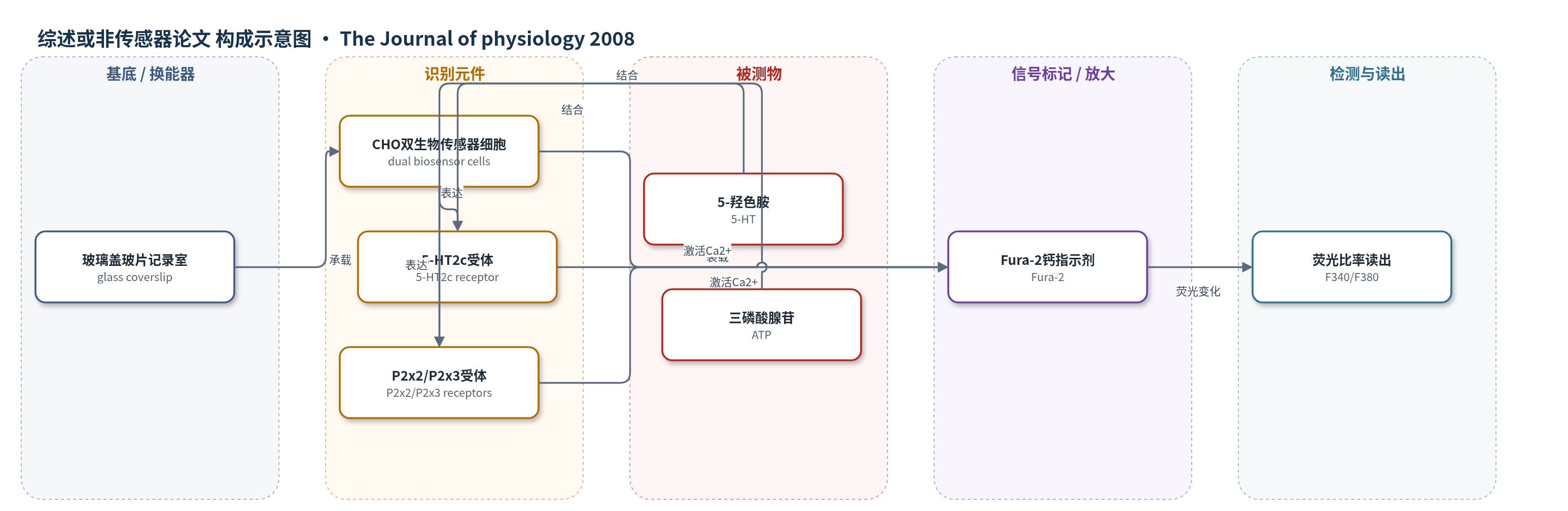
点击图片查看大图 · 依据论文自动绘制
传感器类型
综述或非传感器论文
检测对象
5-羟色胺(serotonin, 5-HT)、三磷酸腺苷(ATP);样品基质:离体小鼠味蕾细胞浴液/舌切片味觉孔释放的神经递质。
检测原理
酸味刺激(醋酸 HOAc)作用于味蕾后,膜可通透的中性醋酸分子进入突触前(Type III)细胞并在胞内解离,引起细胞内酸化;较强酸化触发 Ca2+ 内流,进而通过囊泡胞吐释放 5-羟色胺(5-HT)。释放的 5-HT 扩散至邻近 CHO 双生物传感器细胞,结合其表面 5-HT2c 受体;若检测 ATP,则 ATP 结合 P2x2/P2x3 受体。受体激活引起胞内 Ca2+ 升高,Fura-2 与 Ca2+ 结合后在 340 nm 与 380 nm 激发下产生不同荧光,F340/F380 比率随递质浓度升高而增大。通过 ATP 或 5-HT 预孵育脱敏相应受体,可分别选择性检测 5-HT 或 ATP。
检测灵敏度
原文未报告 LOD、线性范围或灵敏度斜率。
效应效果
该生物传感器细胞系统具有选择性:通过 ATP 预孵育脱敏 P2x2/P2x3 受体后可检测 5-HT,通过 5-HT 预孵育脱敏 5-HT2c 受体后可检测 ATP;实验验证其对 KCl、甜味/苦味混合刺激、醋酸和醋酸钠无直接响应。酸味刺激使突触前(Type III)细胞发生 Ca2+ 内流并释放 5-HT,去除胞外 Ca2+ 可消除该释放;受体(Type II)细胞虽出现 Ca2+ 库释放,但不释放 ATP。分离细胞中酸味 Ca2+ 内流阈值约为 2–5 mM HOAc,舌切片聚焦刺激阈值约为 30 mM HOAc;同 pH 的 HCl 响应明显弱于醋酸。作者据此主张 Type III 细胞是酸味受体细胞,5-HT 是酸味神经递质,细胞内酸化是酸味近端刺激。
传感器的构成
- 基底/换能器:玻璃盖玻片记录室(glass coverslip recording chamber),承载细胞并允许荧光成像。
- 识别元件:CHO 双生物传感器细胞(dual biosensor cells),共表达 5-HT2c 与 P2x2/P2x3 受体,作为全细胞识别平台。
- 识别元件:5-HT2c 受体(5-HT2c receptor),特异性识别 5-羟色胺(5-HT)。
- 识别元件:P2x2/P2x3 受体(P2x2/P2x3 receptors),特异性识别三磷酸腺苷(ATP)。
- 信号标记物:Fura-2 钙指示剂(Fura-2),报告胞内 Ca2+ 变化。
- 选择性控制:ATP 或 5-HT 预孵育(ATP/5-HT preincubation),脱敏相应受体以选择性检测另一递质。
- 样品/刺激:醋酸(acetic acid, HOAc)浴液或聚焦刺激,诱导味觉细胞释放递质。
中文摘要
味蕾中含有两类直接参与味觉转导的细胞:受体(Type II)细胞和突触前(Type III)细胞。受体细胞响应甜、苦和鲜味刺激,但此前直接响应酸味(酸)刺激的身份主要依据原位记录、行为研究和候选酸味转导分子的免疫染色推断。本研究利用单细胞钙成像和生物传感器细胞检测神经递质释放,证明突触前(Type III)细胞特异性地响应酸味刺激并释放 5-羟色胺(5-HT)。通过记录从味蕾分离的细胞以及舌切片中味觉细胞对滴定至不同 pH 的醋酸的响应,进一步表明酸味转导的有效刺激是膜可通透的中性醋酸分子(CH3COOH),而非游离质子(H+)。该结果支持酸味的近端刺激是细胞内酸化,而不是细胞外质子本身。这些发现也可能对痛觉感受器等其他响应酸的感官受体具有启示意义。
英文摘要
Taste buds contain two types of cells that directly participate in taste transduction - receptor (Type II) cells and presynaptic (Type III) cells. Receptor cells respond to sweet, bitter and umami taste stimulation but until recently the identity of cells that respond directly to sour (acid) tastants has only been inferred from recordings in situ, from behavioural studies, and from immunostaining for putative sour transduction molecules. Using calcium imaging on single isolated taste cells and with biosensor cells to identify neurotransmitter release, we show that presynaptic (Type III) cells specifically respond to acid taste stimulation and release serotonin. By recording responses in cells isolated from taste buds and in taste cells in lingual slices to acetic acid titrated to different acid levels (pH), we also show that the active stimulus for acid taste is the membrane-permeant, uncharged acetic acid moiety (CH(3)COOH), not free protons (H(+)). That observation is consistent with the proximate stimulus for acid taste being intracellular acidification, not extracellular protons per se. These findings may also have implications for other sensory receptors that respond to acids, such as nociceptors.