组成图示
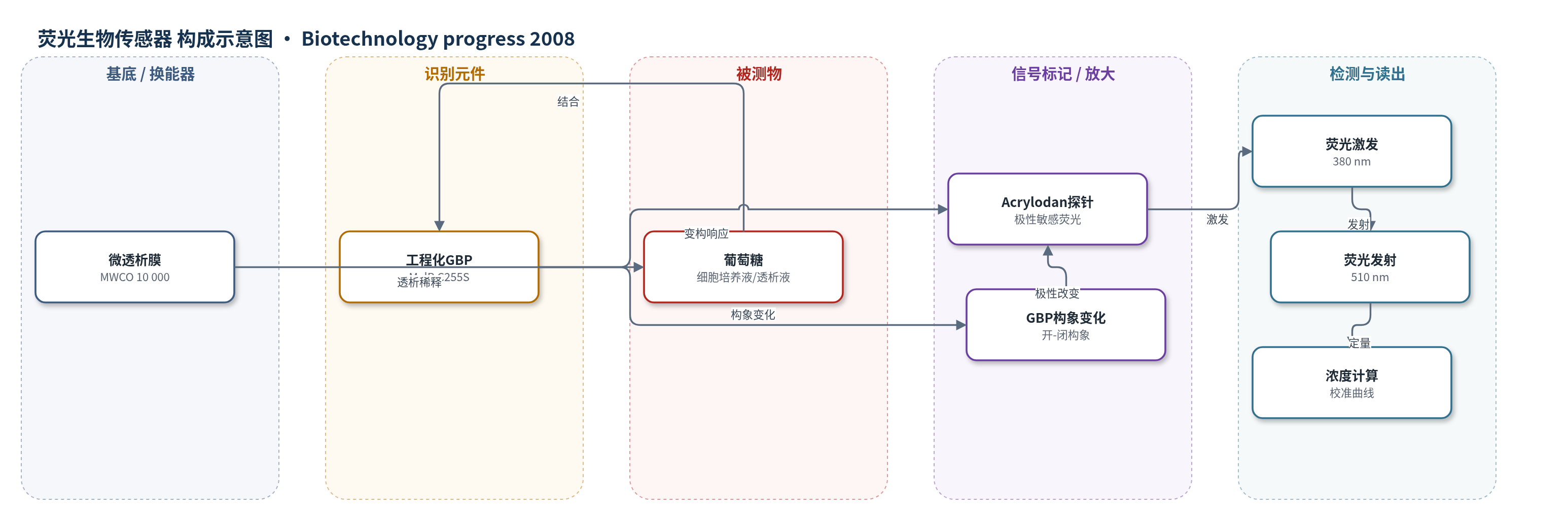
点击图片查看大图 · 依据论文自动绘制
传感器类型
荧光生物传感器
检测对象
葡萄糖(glucose,Glc);样品基质:哺乳动物细胞培养液、微透析透析液、缓冲液
检测原理
该传感器以工程化葡萄糖结合蛋白(GBP)为识别元件。GBP具有双域铰链结构,葡萄糖结合于靠近铰链的位点,使蛋白由开放态转变为闭合态。C255位点共价连接极性敏感荧光探针acrylodan,葡萄糖结合后探针微环境极性改变,导致380 nm激发下510 nm发射荧光强度下降。信号变化ΔF与葡萄糖浓度G按结合等温线ΔF=ΔFmaxG/(Kd+G)变化,Kd为微摩尔级(25 °C约0.82 µM,35 °C约1.99 µM)。微透析膜将培养液中毫摩尔级葡萄糖稀释至微摩尔级透析液,使信号落在灵敏区间。该体系无酶催化放大,主要依靠可逆蛋白结合、构象变构和多次平均降低噪声;温度会改变Kd与荧光强度,因此需严格控温。
检测灵敏度
LOD: 0.04 µM
效应效果
该GBP荧光传感器可重复使用,4 °C保存6个月不损失灵敏度,多次回收后校准曲线无显著变化。2.0 µM处平均相对误差最低为2.1%;1%荧光强度误差可造成10%以上浓度误差,多次平均最多可将检出限降低5倍。选择性上,对葡萄糖响应最强,对半乳糖较弱,对果糖、岩藻糖、甘露糖、麦芽糖和蔗糖影响较小。温度影响显著,Kd从15 °C的0.25 µM升至35 °C的1.99 µM,需控温。微透析中10 µL/min时效率约5%,延迟时间小于1 min,而高透析效率方法滞后约30–35 min。作者认为其适合复杂动态细胞培养的近实时葡萄糖监测,但需优化透析膜并抗生物污损。
传感器的构成
- 采样/换能基底:微透析膜(Snakeskin pleated dialysis tubing,MWCO 10 000),作为葡萄糖采样与稀释界面
- 识别元件:工程化葡萄糖结合蛋白(GBP,E. coli K12 MglB 来源,C255S 单半胱氨酸突变),识别葡萄糖并诱导构象变化
- 信号标记物:极性敏感荧光探针 acrylodan(6-丙烯酰-2-二甲氨基萘),共价连接于 GBP C255,葡萄糖结合引起荧光强度变化
- 反应介质:PBS 缓冲液或细胞培养基/灌注缓冲液,维持蛋白构象与荧光测量环境
- 读出系统:荧光分光光度计(Varian Cary Eclipse)或酶标仪(SpectraMax M5),380 nm 激发、510 nm 发射读取荧光信号
中文摘要
尽管毫摩尔级灵敏度葡萄糖传感器仍为主流,但微摩尔级灵敏度传感器因快速微透析、离子导入和激光打孔提取组织间液等微创采样技术而受到关注。葡萄糖结合蛋白(GBP)对葡萄糖的结合常数处于微摩尔范围,因而特别相关。GBP是革兰氏阴性菌周质空间中的可溶性结合蛋白之一。由于其铰链样三级结构,葡萄糖结合会诱导显著构象变化;将极性敏感荧光探针连接至对葡萄糖结合具有变构响应的位点,即可实现葡萄糖传感,所得光学生物传感器具有微摩尔级灵敏度。由于结合可逆,该传感器可重复使用,并在4 °C保存6个月而不损失灵敏度。本文展示了使用GBP生物传感器监测微透析中葡萄糖的可行性,测定了灌注速率、本体葡萄糖浓度和温度对微透析效率的影响,并监测了哺乳动物细胞培养中的葡萄糖浓度,以证明该传感器在复杂动态过程中长期应用的价值。由于传感器对微摩尔葡萄糖敏感,当本体葡萄糖处于毫摩尔生理范围时,无需高透析效率;因此可采用10 µL/min或更快的灌注速率,延迟时间不超过1 min。
英文摘要
Although glucose sensors with millimolar sensitivity are still the norm, there is now a developing interest in glucose sensors with micromolar sensitivity for applications in minimally invasive sampling techniques such as fast microdialysis and extraction of interstitial fluid by iontophoresis and laser poration. In this regard, the glucose binding protein (GBP) with a binding constant for glucose in the micromolar range is of particular relevance. GBP is one of the soluble binding proteins found in the periplasmic space of Gram-negative bacteria. Because of its hinge-like tertiary structure, glucose binding induces a large conformational change, which can be used for glucose sensing by attaching a polarity sensitive fluorescent probe to a site on the protein that is allosterically responsive to glucose binding. Correspondingly, the resulting optical biosensor has micromolar sensitivity to glucose. Because binding is reversible, the biosensor is reusable and can be stored at 4 degrees C for 6 months without losing its sensitivity. In this paper, we show the feasibility of using the GBP biosensor to monitor glucose in microdialysis. The effect of perfusion rate, bulk glucose concentration and temperature on microdialysis efficiency was determined. Additionally, the glucose concentrations in mammalian cell culture were monitored to demonstrate the applicability of this sensor in complex and dynamic processes over a period of time. As the sensor is sensitive to micromolar glucose, high dialysis efficiency is not required when the bulk glucose concentration is within the millimolar physiological range. Thus, a perfusion rate of 10 microL/min or faster can be used, resulting in delay times of 1 min or less.