组成图示
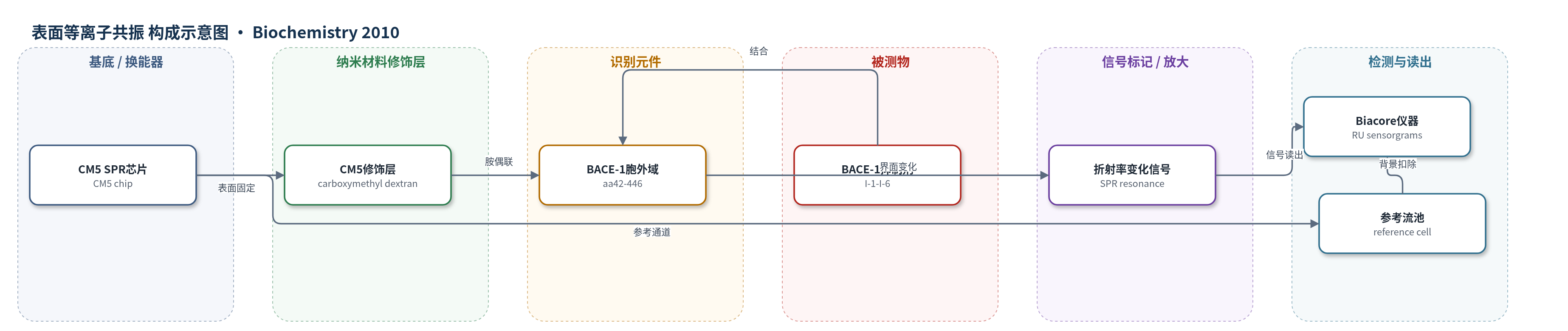
点击图片查看大图 · 依据论文自动绘制
传感器类型
表面等离子共振(SPR)生物传感器
检测对象
BACE-1抑制剂(BACE-1 inhibitors,I-1至I-6,包括OM99-2、OM00-3等);样品基质:SPR运行缓冲液(10 mM Hepes pH 7.4或10 mM醋酸钠pH 4.5,0.15 M NaCl,3% DMSO)
检测原理
将BACE-1胞外结构域通过胺偶联固定于CM5 SPR芯片表面,形成识别层。将不同浓度的BACE-1抑制剂注入流动池,抑制剂与固定酶活性位点结合,使金表面附近质量与折射率发生变化,SPR共振角/共振单位(RU)随结合量增加而上升;解离时信号回落。通过记录结合-解离sensorgram,并用1:1结合模型加质量传递拟合,得到结合/解离速率和KD。pH改变可滴定残基质子化状态,改变酶-抑制剂静电/氢键相互作用,从而改变亲和力;本方法无化学放大,信号直接来自结合质量变化。
检测灵敏度
未报告 LOD、线性范围、灵敏度斜率或相关系数。
效应效果
SPR在pH 4.5与7.4下区分不同化学基团抑制剂:I-3至I-5可逆结合,KD为93±17/16±3、105±34/42±20、4±0.3/5±0.8 nM;I-1、I-2在pH 4.5及I-6在两pH解离慢,KD<10 nM。计算复现pH升高时全部亲和力排序及低pH多数趋势。细胞Aβ ELISA的IC50为I-1 940、I-2 <10、I-3 22、I-4 86、I-5 3、I-6 0.1 nM;酸性/中性均高亲和的HEA类细胞活性最佳,表明SPR结合趋势与细胞活性相关,支持用于细胞活性BACE-1抑制剂设计。
传感器的构成
- 基底/换能器:CM5 SPR芯片,提供表面等离子共振换能并检测结合引起的折射率变化
- 修饰层:CM5芯片表面(carboxymethyl dextran,CM5),提供羧基用于胺偶联
- 识别元件:BACE-1胞外结构域(amino acids 42-446),通过胺偶联固定,作为结合靶标
- 参考通道:活化/去活化的参考流池,用于扣除非特异背景
- 运行缓冲液:10 mM Hepes pH 7.4或10 mM醋酸钠pH 4.5,0.15 M NaCl,3% DMSO,维持pH与溶解度
- 信号读出:Biacore 2000/S51记录共振单位(RU)随时间变化
中文摘要
BACE-1是参与β-淀粉样肽切割的天冬氨酸蛋白酶,其催化APP水解是阿尔茨海默病淀粉样斑块形成的限速步骤。寻找新型BACE-1抑制剂的关键问题之一是抑制剂与酶结合的最适pH:酶在酸性pH催化活性最高,而细胞活性抑制剂可能在较高pH结合最优。本研究采用基于表面等离子共振(SPR)生物传感器的方法,测定一组化学基团多样的抑制剂对BACE-1胞外结构域在pH 4.5和7.4下的结合亲和力。为解释不同抑制剂最适pH差异,作者计算了BACE-1-配体复合物的滴定曲线,发现蛋白可滴定残基的pKa随配体化学结构改变,与以往观点不一致。以pH 4.5和7.4下预测质子化状态的酶-抑制剂结构为起点,计算复现了pH升高时全部亲和力排序及多数抑制剂结合趋势,尤其低pH。细胞实验表明,在酸性和中性pH均具高亲和力的抑制剂往往具有最佳细胞反应,为寻找细胞水平有效的BACE-1抑制剂提供新途径。
英文摘要
BACE-1 is one of the aspartic proteases involved in the cleavage of beta amyloid peptide, an initial step in the formation of amyloid plaques whose toxicity induces neuron death in Alzheimer's disease patients. One of the central issues in the search of novel BACE-1 inhibitors is the optimum pH for the binding of inhibitors to the enzyme. It is known that the enzyme has optimal catalytic activity at acidic pH, while cell active inhibitors may bind optimally at higher pH. In this work we determine the effect of the pH on the affinities of a set of inhibitors, with a variety of chemical motifs, for the ectodomain region of BACE-1 by a surface plasmon resonance (SPR) biosensor based assay. In order to understand the molecular interactions that underlie the diverse optimum pH for the binding of the various inhibitors as observed experimentally, we have calculated the titration curves for a set of BACE-1 ligand complexes. The results indicate that the pK(a) values of the titratable residues of the protein depend on the nature of the ligand involved, in disagreement with previous work. The enzyme-inhibitor structures with the resulting protonation states at pH values 4.5 and 7.4 served as the starting point for the prediction of the pH-dependent binding ranking. Our calculations reproduced the entire affinity ranking observed upon pH increase and most of the binding trends among inhibitors, especially at low pH. Finally, our cell-based assays indicate a possible correlation between high inhibitor affinity at both acidic and neutral pH values, with optimal cell response, a result that may open new venues for the search of potent BACE-1 inhibitors that are active at the cellular level.