组成图示
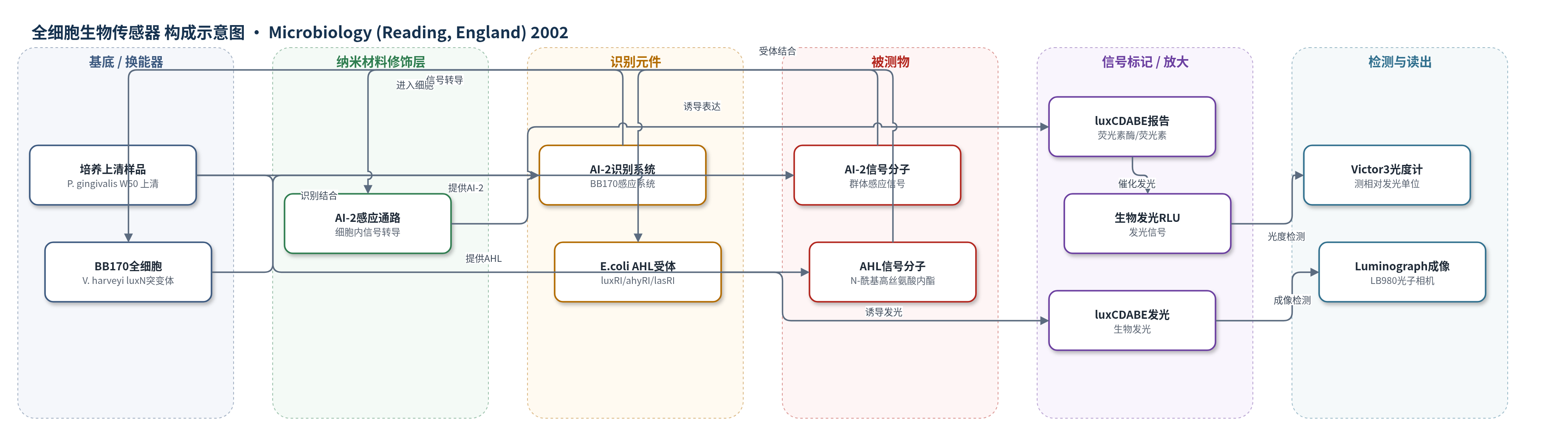
点击图片查看大图 · 依据论文自动绘制
传感器类型
全细胞生物传感器
检测对象
自诱导物-2(AI-2)、N-酰基高丝氨酸内酯(AHLs);样品基质:牙龈卟啉单胞菌 W50 无细胞培养上清(BHI 或化学定义培养基 DM)
检测原理
本方法为全细胞群体感应生物传感器。待测培养上清中的 AI-2 扩散进入 V. harveyi BB170(luxN 突变体),被细胞内 AI-2 感应/信号转导系统识别,激活下游 luxCDABE 报告基因转录;荧光素酶/荧光素系统催化产生生物发光,用 Victor3 光度计测 RLU,发光强度随 AI-2 浓度升高而增强。AHL 检测则利用 E. coli JM109 携带 luxRI/ahyRI/lasRI::luxCDABE 融合,AHL 结合相应 LuxR 型受体后启动发光;C. violaceum CV026 在 AHL 诱导下产生紫色素 violacein,可经 TLC 或成像读出。无额外酶促或核酸放大,信号放大依赖细胞内报告基因转录表达。
检测灵敏度
原文未报告 LOD、线性范围、灵敏度斜率或相关系数。
效应效果
该全细胞生物传感器可区分 AI-2 与 AHL:P. gingivalis W50 上清未检出 AHL,但能激活 V. harveyi BB170 发光,luxS 突变株上清无 AI-2 活性,显示方法具有信号分子特异性。AI-2 活性在化学定义培养基中于对数中期最高,进入稳定期消失,而 LuxS 蛋白持续增加,提示检测受信号分子稳定性/代谢限制。luxS 突变株 Rgp 蛋白酶活性较野生株低约 45%,Kgp 低约 30%,血凝素效价由 1:32 降至 1:8(四倍降低)。小鼠软组织感染模型中,luxS 突变株与野生株平均存活时间无显著差异,而 kgp 突变株明显减毒,说明 AI-2/LuxS 调控毒力因子但非急性感染必需。
传感器的构成
- 全细胞换能器:Vibrio harveyi BB170(luxN 突变体)完整细胞,作为 AI-2 识别与生物发光换能单元。
- 识别元件:BB170 细胞内 AI-2 感应/信号转导系统,识别 AI-2 并启动报告基因表达。
- 报告基因:luxCDABE 荧光素酶/荧光素系统,催化产生生物发光(RLU)。
- 读出仪器:EG&G Wallac Victor3 光度计,测量相对发光单位 RLU。
- AHL 对照传感器:E. coli JM109(pSB401/pSB536/pSB1075) 含 luxRI/ahyRI/lasRI::luxCDABE,检测 AHL 并产生生物发光;C. violaceum CV026 产生紫色素 violacein。
中文摘要
牙龈卟啉单胞菌(Porphyromonas gingivalis)是一种与人类牙周病相关的革兰阴性黑色素专性厌氧菌,其毒力与半胱氨酸蛋白酶 Arg-gingipain(Rgp)和 Lys-gingipain(Kgp)的产生有关,这些蛋白酶在高菌体密度下表达。为判断群体感应是否调控 Rgp 和 Kgp,作者首先使用可检测 N-酰基高丝氨酸内酯(AHLs)或 LuxS 依赖性自诱导物 AI-2 的生物传感器检测培养上清。结果未检出 AHLs,但 V. harveyi BB170 生物传感器被 P. gingivalis W50 培养上清激活。克隆的 P. gingivalis luxS 基因可恢复 E. coli luxS 突变株 DH5α 的 AI-2 产生;luxS 突变使 P. gingivalis 失去 AI-2 产生。Western blot 显示 LuxS 蛋白随生长持续增加,而 AI-2 活性仅在对数中期最高,稳定期消失。luxS 突变株 Rgp 活性较亲本低约 45%,Kgp 低约 30%,血凝素效价降低四倍;但这些毒力因子降低不足以在小鼠病灶模型中减弱 luxS 突变株毒力。
英文摘要
Porphyromonas gingivalis is a Gram-negative black-pigmented obligate anaerobe implicated in the aetiology of human periodontal disease. The virulence of P. gingivalis is associated with the elaboration of the cysteine proteases Arg-gingipain (Rgp) and Lys-gingipain (Kgp), which are produced at high bacterial cell densities. To determine whether quorum sensing plays a role in the regulation of Rgp and Kgp, biosensors capable of detecting either N-acylhomoserine lactone (AHLs) or the luxS-dependent autoinducer (AI-2) quorum-sensing signalling molecules in spent culture supernatants were first employed. While no AHLs could be detected, the Vibrio harveyi BB170 biosensor was activated by spent P. gingivalis W50 culture supernatants. The P. gingivalis luxS gene was cloned and demonstrated to restore AI-2 production in the Escherichia coli luxS mutant DH5alpha. Mutation of luxS abolished AI-2 production in P. gingivalis. Western blotting using antibodies raised against the recombinant protein revealed that LuxS levels increased throughout growth even though AI-2 activity was only maximally detected at the mid-exponential phase of growth and disappeared by the onset of stationary phase. Similar results were obtained with E. coli DH5alpha transformed with luxS, suggesting that AI-2 production is not limited by a lack of LuxS protein. Analysis of Rgp and Kgp protease activities revealed that the P. gingivalis luxS mutant produced around 45% less Rgp and 30% less Kgp activity than the parent strain. In addition, the luxS mutant exhibited a fourfold reduction in haemagglutinin titre. However, these reductions in virulence determinant levels were insufficient to attenuate the luxS mutant in a murine lesion model of P. gingivalis infection.