组成图示
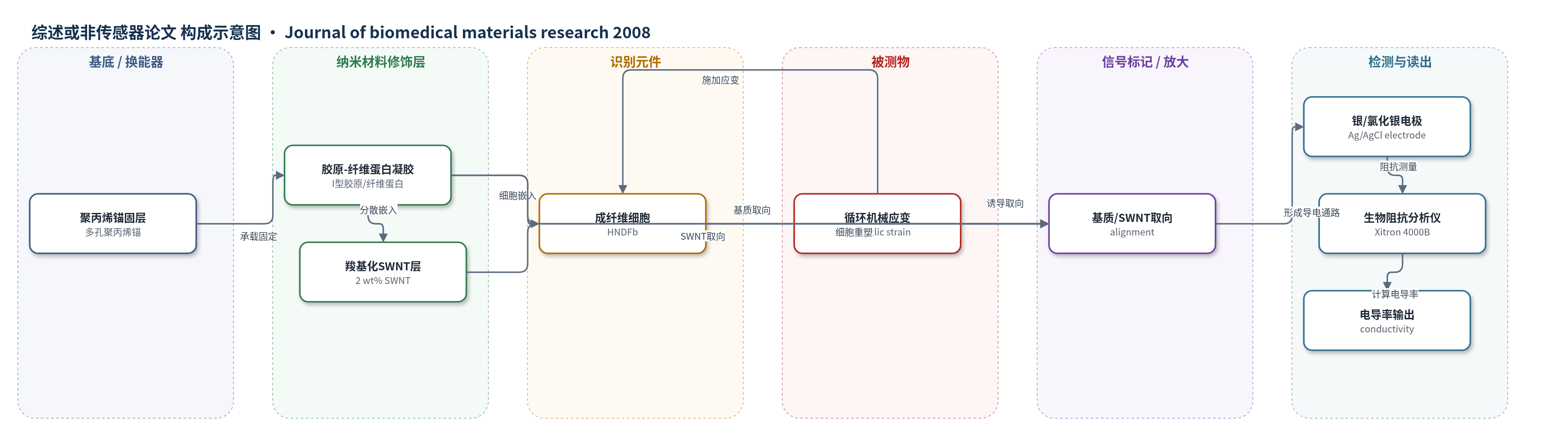
点击图片查看大图 · 依据论文自动绘制
传感器类型
综述或非传感器论文
检测对象
无明确生物分析物;测量对象为体外胶原-纤维蛋白-SWNT 水凝胶构建体的电导率/生物阻抗(electrical conductivity/bioimpedance)
检测原理
该文并非针对特定分析物的传感检测,而是研究导电生物材料的电学响应。羧基化SWNT分散于I型胶原-纤维蛋白三维水凝胶中,与蛋白纤维形成导电网络;成纤维细胞嵌入凝胶后通过收缩重塑基质。施加8%循环应变时,细胞和胶原/纤维蛋白纤维沿应变方向取向,SWNT随之沿纵向排列,使纵向电子/离子导电通路更连续,电阻降低。测量采用两点银/氯化银电极,在5–500 kHz交流频率下记录生物阻抗,并取200–320 kHz频率无关区平均,按欧姆定律计算电导率。因此电导率随SWNT负载量和应变诱导取向程度增加,而非随某生物分析物浓度变化。
检测灵敏度
原文未报告 LOD、线性范围、灵敏度斜率或相关系数。
效应效果
所有构建体3天内压缩至初始体积15%–20%,SWNT未显著影响压缩;应变组压缩更快,第3天显著更压缩。细胞活力均>90%,SWNT未明显改变活力和形态,静态样品更星状、突起更多,应变样品更梭形。SEM显示静态基质随机各向同性,应变后胶原纤维沿应变方向排列。生物阻抗显示电导率1200–1600 mS/m;加入2 wt% SWNT平均提高95.6±8.24 mS/m,应变SWNT纵向电导率较横向及其他SWNT测量平均高122.2±7.7 mS/m。结果可重复且显著,作者认为可用于组织工程和生物传感器开发。
传感器的构成
- 基底/支撑层:多孔聚丙烯锚(porous polypropylene anchors),用于固定胶原-纤维蛋白-SWNT 构建体并承受应变
- 水凝胶基质层:I型胶原(Type I collagen)与纤维蛋白(fibrin)自组装形成三维纤维网络,承载细胞与SWNT
- 导电纳米材料层:2 wt%羧基化单壁碳纳米管(carboxylated SWNT),分散于蛋白基质中提高电导率
- 生物活性元件:人新生儿真皮成纤维细胞(HNDFb),嵌入水凝胶并介导凝胶压缩与基质重塑
- 交联/培养介质:DMEM、10% FBS、牛凝血酶(bovine thrombin)和0.1 M NaOH,维持pH并促进纤维蛋白凝胶化
- 保护剂:ε-氨基己酸(ACA),抑制纤维蛋白的纤溶降解
- 测量电极:银片/银线(silver sheet/leads)与硅胶绝缘(silicone insulation)构成的两点银/氯化银电极,用于生物阻抗测量
中文摘要
本研究制备了含成纤维细胞、I型胶原、纤维蛋白和2 wt%羧基化单壁碳纳米管(SWNT)的复合生物材料,并与不含SWNT的对照构建体进行比较。通过三天内三次、每次12 h的8%循环机械应变刺激诱导基质取向。所有构建体均发生细胞介导的凝胶压缩,最终体积降至初始体积的15%–20%,且SWNT负载不影响压缩程度。机械应变提高了压缩速率,第3天应变构建体比未应变对照显著更压缩。对照与SWNT构建体中细胞活力和形态相似,但未应变样品呈更明显的星状并具更多细胞突起。机械应变使细胞和基质均沿应变方向清晰取向。生物阻抗测量表明,SWNT负载提高了复合构建体的电导率,而机械诱导的基质/SWNT取向进一步增加电导率。结果表明,SWNT可用于增强三维蛋白水凝胶的电学性能,基质各向异性可进一步增强该性能。此类导电生物聚合物在组织工程和生物传感器开发中具有潜在应用。
英文摘要
Composite biomaterials incorporating fibroblast cells, collagen Type I, fibrin, and 2 wt % carboxylated SWNT were created, and their properties were compared with similar control constructs without SWNT. Alignment of the matrix was stimulated by application of 8% cyclic strain for three 12-h periods over three days. All constructs underwent cell-mediated gel compaction to 15-20% of their initial volume, which was not affected by SWNT loading. Mechanical strain increased the rate of compaction, and strained constructs were significantly more compacted than unstrained controls by day 3. Cell viability and morphology were similar in both control and SWNT-loaded constructs, but unstrained samples exhibited a more stellate appearance with more numerous cellular projections. Application of mechanical strain caused clear alignment of both the cells and matrix in the direction of the applied strain. Bioimpedance measurements showed that SWNT loading increased the electrical conductivity of composite constructs, and that mechanically-induced alignment of the matrix/SWNT caused a further increase in conductivity. These results demonstrate that SWNT can be used to augment the electrical properties of 3D protein hydrogels, and that anisotropy in the matrix further enhances these properties. Such electrically conductive biopolymers may have a variety of applications in tissue engineering and biosensor development.