组成图示
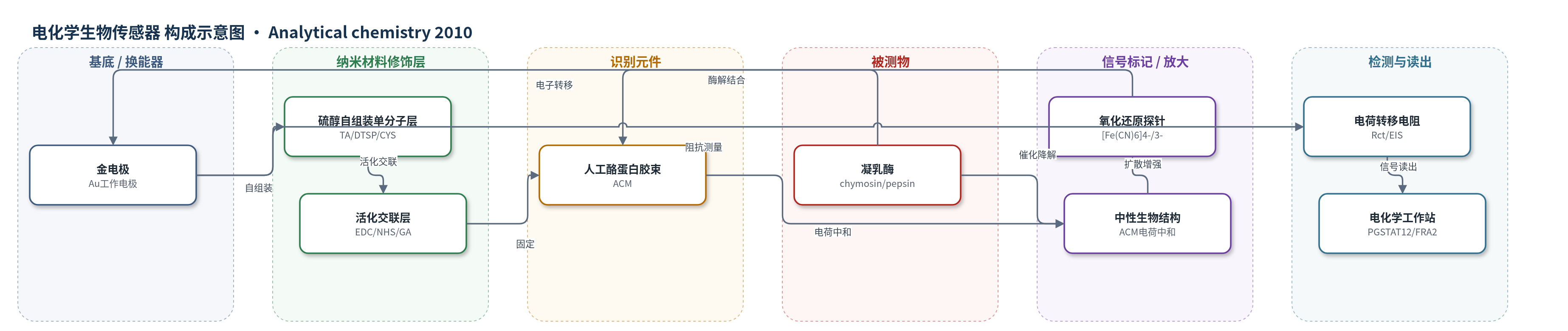
点击图片查看大图 · 依据论文自动绘制
传感器类型
电化学生物传感器
检测对象
凝乳酶凝乳活性(milk-clotting activity of rennet,含chymosin/pepsin);样品基质:液态或固态商业凝乳酶样品,溶于/稀释于20 mM咪唑缓冲液(pH 5–6.5)。
检测原理
金电极经硫醇自组装单分子层(TA/DTSP/CYS SAM)修饰后,通过EDC/NHS或戊二醛(GA)将人工酪蛋白胶束(ACM)固定于表面,形成带负电的界面层。凝乳酶中的凝乳酶(chymosin)特异性水解κ-酪蛋白的Phe105-Met106键,释放糖巨肽(GMP),使ACM净负电荷降低并发生部分聚集,界面由负电屏障变为较中性/开放结构。该变化降低对六氰合铁(II)/(III)电对的静电排斥,增加氧化还原探针向电极表面的扩散通量,使法拉第电荷转移电阻Rct下降。凝乳酶浓度越高或孵育时间越长,Rct相对下降越大(ΔS%负值越大),通过EIS读取Rct变化评估凝乳活性。该策略利用酶解引起的界面电荷中和与胶束聚集实现信号增强。
检测灵敏度
原文未报告LOD、线性范围、灵敏度斜率或相关系数。
效应效果
该传感器为一次性使用,对凝乳酶作用具有选择性,空白咪唑缓冲液在pH 6.5–5.8内无明显干扰;Ca2+使Rct升高,MOPS/HEPES缓冲液信号低于咪唑。戊二醛交联固定ACM后凝乳酶无响应,证明信号来自酶解而非非特异吸附。Au/DTSP/ACM性能最佳,15 min信号变化-32%,30 min达-55%,5 min即可获得可用信号;Au/TA/ACM在pH 5为-34%,pH 5.2为-22%,30 min为-15%;Au/CYS/ACM为-45%。商业样品中ΔS与Berridge法凝乳力一致:Hansen液态1:36 600为-24,Danisco液态1:61 900为-51,Hansen固态1:130 000为-44/-42,Ipirotopoula固态1:48 500为-12/-14;均值标准偏差9–16%(n=3)。作者认为可用于常规检测。
传感器的构成
- 工作电极基底:金电极(Au),2 mm活性面积,抛光清洗后作为法拉第阻抗换能器。
- 自组装单分子层:硫辛酸(TA)、双硫代双-N-琥珀酰亚胺基丙酸酯(DTSP)或半胱胺(CYS)硫醇SAM,提供负、中、正电荷界面和连接位点。
- 活化/交联层:EDC/NHS活化TA羧基,或2.5%戊二醛(GA)活化CYS氨基并交联固定ACM;DTSP可直接结合氨基。
- 识别/模拟基质层:人工酪蛋白胶束(ACM),由酪酸钠、CaCl2、K2HPO4/NaOH制备,模拟牛奶酪蛋白胶束并作为凝乳酶作用对象。
- 封闭层:赖氨酸(lysine)溶液封闭剩余氨基活性位点,降低非特异结合。
- 氧化还原探针:六氰合铁(II)/(III)([Fe(CN)6]4-/3-)电对,存在于50 mM咪唑pH 6.5含100 mM KCl测量液中,用于EIS/CV信号。
- 参比/辅助电极:Ag/AgCl/3 M KCl参比电极和铂丝辅助电极,构成三电极测量体系。
- 读出装置:Metrohm Autolab PGSTAT12/FRA2电化学分析仪,EIS频率10^-1–10^5 Hz、+0.200 V、10 mV rms,读取Rct。
中文摘要
奶酪生产依赖凝乳酶制剂(rennet,主要含凝乳酶 chymosin 与胃蛋白酶 pepsin)作用于牛奶酪蛋白胶束。本文首次利用电化学阻抗谱监测该相互作用,开发了一种法拉第阻抗生物传感器,用于评估凝乳酶制剂的凝乳活性,以六氰合铁(II)/(III)电对作为氧化还原探针。金电极分别用不同硫醇自组装单分子层修饰,包括硫辛酸、双硫代双-N-琥珀酰亚胺基丙酸酯和半胱胺,并在修饰金表面固定人工酪蛋白胶束。该方法基于测量电荷转移电阻变化:凝乳酶将带负电的固定酪蛋白胶束降解为中性生物结构,使氧化还原探针向电极表面扩散通量增加,Rct下降。优化了胶束负载量、反应时间、凝乳酶浓度和工作pH等参数。除EIS外,还进行了循环伏安、傅里叶变换红外光谱和原子力显微镜表征。最后将该生物传感器成功应用于多种商业凝乳酶样品。
英文摘要
Cheese production is relied upon the action of rennet (a mixture of chymosin and pepsin) onto casein micelles of milk. For the first time, the monitoring of this interaction with electrochemical impedance spectroscopy (EIS) was used to develop a faradic impedimetric biosensor for the assessment of the clotting activity of rennet, using hexacyanoferrate(II)/(III) couple as a redox probe. Gold electrodes were modified with self-assembled monolayers of different thiols (thioctic acid, dithiobis-N-succinimidyl propionate, and cysteamine), and (artificial) casein micelles were immobilized on the modified gold surfaces. The proposed method is based on the measurement of charge-transfer resistance (R(ct)) changes attributed to the degradation of the negatively charged immobilized casein micelles by rennet to neutral biostructures. This action results in the increase of the flux of the redox probe, which exists in the bulk solution, to the surface of the electrode and, consequently, in the decrease of R(ct). Experimental parameters such as the micelle loading, the reaction time, the concentration of rennet, and the working pH, were optimized. Besides EIS measurements, cyclic voltammetry, FT-IR, and atomic force microscopy (AFM) experiments were also performed before and after the interaction of the immobilized micelles with rennet. Finally, the proposed biosensors were successfully tried for various commercial samples.