组成图示
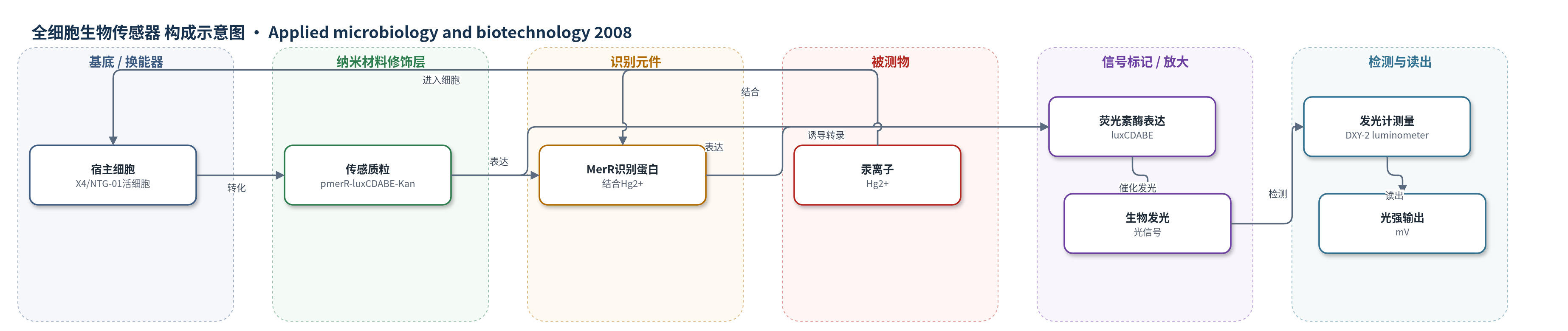
点击图片查看大图 · 依据论文自动绘制
传感器类型
全细胞生物传感器
检测对象
无机汞离子(Hg2+);样品基质:LB 培养基、土壤水提液
检测原理
传感器以全细胞为基质。无 Hg2+ 时,MerR 蛋白结合汞诱导启动子 Pmer,抑制 luxCDABE 转录。当 Hg2+ 进入细胞并与 MerR 的高亲和结合位点(含三个保守半胱氨酸)结合后,MerR 发生构象变化,RNA 聚合酶得以结合启动子,诱导 luxCDABE 表达。表达的细菌荧光素酶催化底物氧化,产生生物发光。在低浓度范围内,Hg2+ 浓度越高,转录诱导越强,光强越大;高浓度 Hg2+ 因细胞毒性使发光下降。信号经发光计读取为光强(mV),并与标准曲线比较实现半定量检测。
检测灵敏度
LOD: 100 pM
效应效果
两种传感器对 Hg2+ 选择性较好:100 pM–100 nM 范围内 Cd2+、Zn2+、Co2+、Cu2+、Pb2+ 不干扰;高浓度重金属仅弱诱导,X4 对 Cd2+、Zn2+、Co2+、Pb2+、Cu2+ 最大发光分别为 68、52、53、22、62 mV,NTG-01 对 Cd2+、Cu2+ 最大为 60、30 mV。LOD 为 100 pM。土壤水提液加标 25、50、100 μg/g 时,X4 测得 0.38±0.06、0.75±0.16、2.31±0.21 μg/mL,NTG-01 为 0.28±0.20、0.73±0.05、2.89±0.26 μg/mL,化学法为 0.45、0.98、3.56 μg/mL,生物法略低,说明仅反映水可提取汞。作者认为可用于污染土壤及环境样品中 Hg2+ 的半定量检测。
传感器的构成
- 宿主细胞:Pseudomonas putida X4 或 Enterobacter aerogenes NTG-01,作为活细胞基质与汞摄取/代谢载体
- 传感质粒:pmerR-luxCDABE-Kan,携带汞诱导启动子 Pmer、调控基因 merR、报告基因 luxCDABE 和卡那霉素抗性基因 Kan
- 识别元件:MerR 蛋白,结合 Hg2+ 后构象变化并启动 Pmer 驱动的转录
- 报告基因:luxCDABE 细菌荧光素酶基因,表达荧光素酶催化生物发光
- 选择标记:Kan 基因,用于筛选转化子
- 检测介质:LB 培养基、PBS 及抗生素,维持细胞活性并用于发光测量
中文摘要
本研究以细菌荧光素酶基因 luxCDABE 为报告基因,以无质粒假单胞菌 Pseudomonas putida X4 和产气肠杆菌 Enterobacter aerogenes NTG-01 为宿主,构建了两个 Hg2+ 特异性生物传感器,并在相同检测条件下比较其性能。结果表明,X4 生物传感器的最大生物发光出现在指数生长期中期,NTG-01 则出现在指数生长期晚期;两种传感器的最短诱导时间均为 30 min,最大光信号分别在培养 4 h 和 5 h 出现。在 28 °C、pH 7、初始菌量为 10^6 CFU/mL 条件下,两种传感器对汞的最低可检测浓度均为 100 pM。纳摩尔水平的 Cd2+、Zn2+、Co2+、Cu2+ 和 Pb2+ 不干扰测定。结果表明,两种生物传感器的灵敏度足以用于大多数受污染环境中 Hg2+ 的检测。
英文摘要
Two Hg2+-specific biosensors were constructed using bacterial luciferase as reporter gene and plasmid-free Pseudomonas putida X4 and Enterobacter aerogenes NTG-01 as host strains. The performance of X4 biosensor was compared with that of NTG-01 biosensor in the same assay conditions. The maximum bioluminescence for X4 (pmerRluxCDABE-Kan) biosensor was found during the midexponential phase and that for NTG-01 (pmerRluxCDABE-Kan) was at the late exponential phase. The shortest induction time of two biosensors was 30 min. The maximum light signal output for NTG-01 and X4 sensors was observed at the incubation time of 5 and 4 h, respectively. The lowest detectable concentration of mercury by the two biosensors were both of 100 pM at 28 degrees C, pH 7 and an initial cell number of 10(6) CFU ml(-1). Cd2+, Zn2+, Co2+, Cu2+, and Pb2 + ions at nanomolar level did not interfere with the measurement by the biosensors. These results show that the sensitivity of the two biosensors is sufficient for the detection of Hg2+ under most contaminated environments.