组成图示
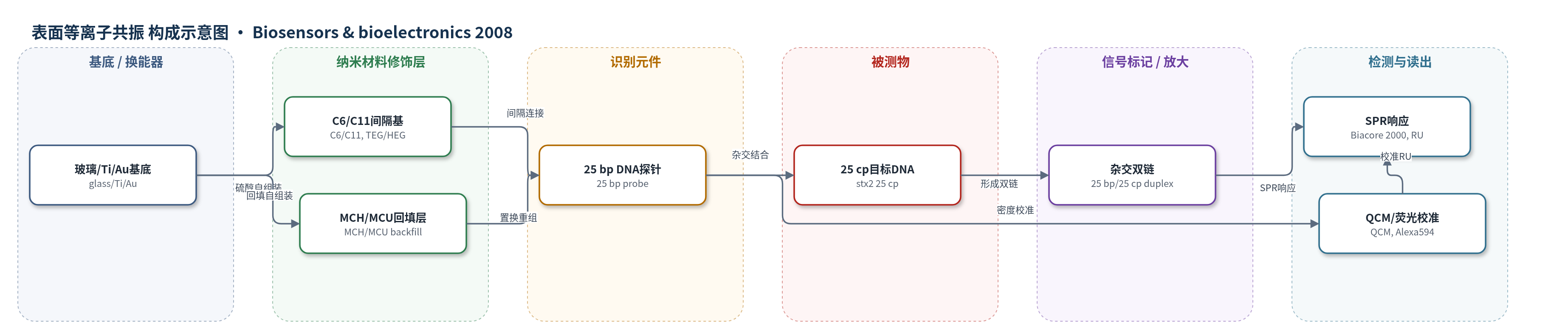
点击图片查看大图 · 依据论文自动绘制
传感器类型
表面等离子共振(SPR)生物传感器
检测对象
目标单链DNA(25 cp,志贺毒素2基因 stx2 互补序列);样品基质:SPR运行缓冲液(1 M NaCl、10 mM Tris–HCl、2 mM EDTA,pH 7.0)
检测原理
硫醇化25 bp探针通过C6或C11烷硫醇间隔基自组装到金表面,MCH/MCU回填形成混合DNA/烷硫醇膜。目标25 cp在流动缓冲液中与表面探针杂交,形成双链,使界面质量和折射率增加。SPR通过监测共振单位(RU)变化读出信号,信号随25 cp浓度升高而增大,直至饱和。C11间隔基增强烷链间范德华作用,使膜更有序、探针更垂直于表面,提高表面密度和杂交可及性,从而提升灵敏度、降低检测限并改善重现性;PEG单元可调节亲水性和柔性,但在此体系中其影响被较高表面密度部分掩盖。流动辅助固定化通过引入对流加速固定化和杂交,减少扩散限制,优于静态扩散控制。该体系未使用HCR/RCA等信号放大策略。
检测灵敏度
LOD: 0.3 ± 0.2 nM;线性范围/动态范围: 0.3–20 nM;灵敏度斜率: 99.2 ± 13.7 RU/nM(C11,流动辅助);其他:C6 LOD 21.6 ± 1.9 nM,线性范围/动态范围 21.6–160 nM,灵敏度 3.6 ± 2.1 RU/nM;C6-TEG LOD 11.5 ± 2.9 nM,线性范围/动态范围 11.5–80 nM,灵敏度 7.1 ± 0.9 RU/nM;C6-HEG LOD 5.7 ± 1.3 nM,线性范围/动态范围 5.7–80 nM,灵敏度 9.6 ± 0.6 RU/nM;C11-TEG LOD 1.2 ± 0.3 nM,线性范围/动态范围 1.2–20 nM,灵敏度 70.6 ± 6.7 RU/nM;C11-HEG LOD 2.3 ± 0.7 nM,线性范围/动态范围 2.3–20 nM,灵敏度 69.0 ± 3.5 RU/nM;C6 no flow LOD 12.9 ± 31.0 nM,线性范围/动态范围 12.9–40 nM,灵敏度 2.3 ± 0.9 RU/nM;C11 no flow LOD 8.4 ± 0.71 nM,线性范围/动态范围 8.4–40 nM,灵敏度 4.7 ± 0.2 RU/nM。
效应效果
SPR检测25 cp,非特异25 np信号0–5 RU,特异性好。C11表面密度更高(2.3±0.02×10^13 molecules/cm2),杂交效率23.3–31.0%(C6-TEG最高31.0%),稳定性优于C6。C11灵敏度99.2±13.7 RU/nM,LOD 0.3±0.2 nM,动态范围0.3–20 nM,重现性优于C6(3.6±2.1 RU/nM,21.6±1.9 nM)。流动固定化优于扩散,后者最大杂交信号降>70%,C6/C11灵敏度降至2.3±0.9和4.7±0.2 RU/nM。作者认为长烷链间隔基和流动固定化利于低浓度DNA检测。
传感器的构成
- 基底/换能器:玻璃基底上电子束蒸发沉积2 nm Ti和50 nm Au,作为SPR金表面与换能基底
- 识别/间隔元件:5′-硫醇修饰25 bp DNA探针,经C6或C11烷硫醇间隔基连接,可选TEG/HEG聚乙二醇单元,用于固定识别序列并调节探针-表面距离
- 回填/封闭层:6-巯基-1-己醇(MCH)或11-巯基-1-十一醇(MCU),与探针间隔基长度匹配,回填金表面、置换弱结合探针并降低非特异结合
- 信号标记物:无(SPR直接检测杂交质量/折射率变化;Alexa594荧光标记仅用于表面密度校准)
- 目标物:25 cp互补单链DNA(stx2基因互补序列),在流动缓冲液中与表面探针杂交
- 读出介质:SPR运行缓冲液(1 M NaCl、10 mM Tris–HCl、2 mM EDTA,pH 7.0)及2.5 mM HCl再生液
中文摘要
DNA探针的固定化是DNA生物传感器开发中的关键步骤。混合DNA/烷硫醇自组装膜常被用于将DNA探针共价偶联到传感器表面,但引入间隔基以增加特定DNA序列与表面距离的效果很少被系统评估。本研究旨在评价多种间隔基,并考察其对灵敏度、重现性等性能的影响。除常用的巯基己基(C6)间隔基外,还选择了更长的巯基十一烷基(C11)间隔基,并研究了二者与三乙二醇(TEG)和六乙二醇(HEG)的组合。采用表面等离子共振(SPR)考察不同间隔基对固定化程度及后续杂交的影响。结果表明,使用更长的C11间隔基时,混合DNA/烷硫醇膜堆积更紧密;进一步杂交研究显示,C11修饰探针可提高灵敏度、降低检测限并改善重现性。此外,比较了流动辅助与扩散控制两种固定化途径对杂交效率的影响,数据表明流动辅助方法有利于DNA固定化和杂交事件。结论:间隔基对生物传感器性能有显著影响,流动辅助固定化方法也很重要。
英文摘要
The immobilization of DNA strands is an essential step in the development of any DNA biosensor. Self-assembled mixed DNA/alkanethiol films are often used for coupling DNA probes covalently to the sensor surface. Although this strategy is well accepted, the effect of introducing a spacer molecule to increase the distance between the specific DNA sequence and the surface has rarely been assessed. The major goal of this work was to evaluate a number of such spacers and to assess their impact on for example the sensitivity and the reproducibility. Besides the commonly used mercaptohexyl (C(6)) spacer, a longer mercapto-undecyl (C(11)) spacer was selected. The combination of both spacers with tri(ethylene)glycol (TEG) and hexa(ethylene)glycol (HEG) was studied as well. The effect of the different spacers on the immobilization degree as well as on the consecutive hybridization was studied using surface plasmon resonance (SPR). When using the longer C(11) spacer the mixed DNA/alkanethiol films were found to be more densely packed. Further hybridization studies have indicated that C(11) modified probes improve the sensitivity, the corresponding detection limit as well as the reproducibility. In addition two different immobilization pathways, i.e. flow vs. diffusion controlled, were compared with respect to the hybridization efficiency. These data suggest that a flow-assisted approach is beneficial for DNA immobilization and hybridization events. In conclusion, this work demonstrates the considerable impact of spacers on the biosensor performance but also shows the importance of a flow-assisted immobilization approach.