组成图示
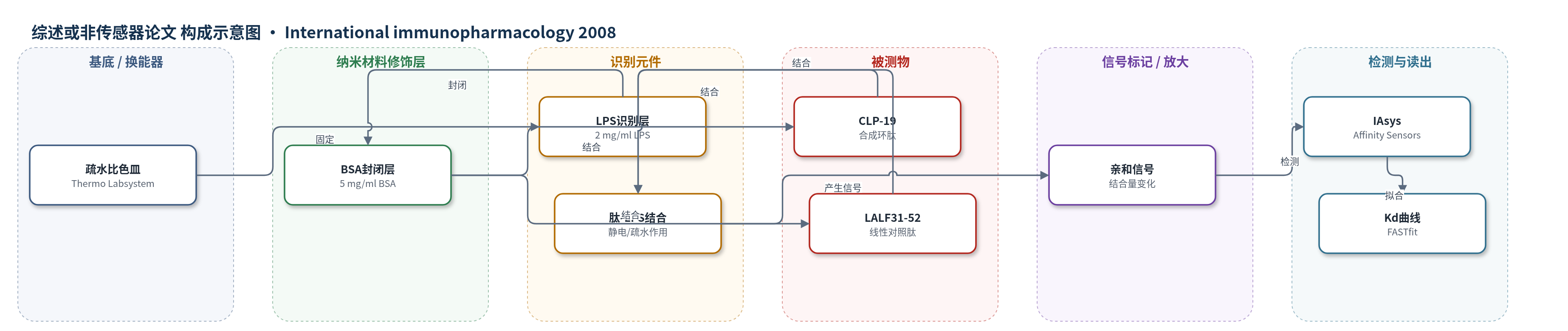
点击图片查看大图 · 依据论文自动绘制
传感器类型
综述或非传感器论文
检测对象
脂多糖/内毒素(lipopolysaccharide, LPS)、环肽 CLP-19/LALF31–52(亲和传感器分析物);样品基质:体外缓冲液、小鼠血清
检测原理
本文主要评价 CLP-19 中和 LPS 的活性。在亲和生物传感器方法中,LPS 先固定于疏水比色皿表面,经 PBS/AE 洗涤并用 BSA 封闭后,加入不同浓度 CLP-19 或 LALF31–52。肽分子依靠正电荷与 LPS 脂质 A 磷酸基团的静电吸引,以及疏水残基与脂质 A 脂肪酸链的疏水作用结合到固定 LPS 上;结合量随肽浓度升高而增加,IAsys 亲和传感器记录结合曲线,FASTfit 计算 Kd。LAL 试验中,游离 LPS 激活鲎细胞裂解物引起凝固反应,浊度随游离 LPS 浓度升高而升高;CLP-19 与 LPS 结合后降低游离 LPS,使浊度下降,从而反映中和能力。该过程无额外信号放大,主要依赖直接结合与凝固反应。
检测灵敏度
Kd: CLP-19 8.26 μM;Kd: LALF31–52 47.80 μM
效应效果
CLP-19 在 LAL 试验中以剂量依赖方式中和 LPS,最低和最高浓度下中和率分别超过 65% 和 90%,同浓度下略强于 LALF31–52。亲和传感器显示 CLP-19 的 Kd 为 8.26 μM,低于 LALF31–52 的 47.80 μM,提示更高 LPS 结合亲和力。CLP-19 能剂量依赖抑制 LPS 刺激的 RAW264.7 细胞释放 TNF-α,MTT 试验未见明显细胞毒性。小鼠内毒素血症模型中,LPS 20 mg/kg 24 h 内致死率 100%;CLP-19 处理后 7 天存活率超过 60%(60–80%),LALF31–52 为 50–80%。血清 TNF-α 抑制率分别为 91.4% 和 87.4%,血清内毒素显著降低。作者认为 CLP-19 是潜在抗 LPS 候选药物。
传感器的构成
- 基底/换能器:疏水比色皿(hydrophobic cuvette, Thermo Labsystem),提供 LPS 固定表面并用于 IAsys 亲和检测。
- 识别/捕获层:LPS(lipopolysaccharide, LPS,2 mg/ml 氯仿溶液)固定于比色皿表面,用于结合肽分子。
- 洗涤缓冲液:PBS/AE(磷酸盐缓冲液含 0.025% 叠氮化钠和 1 mM EDTA),用于清洗非特异结合。
- 封闭层:BSA(bovine serum albumin,5 mg/ml),封闭非特异结合位点。
- 分析物/识别配体:CLP-19(合成环肽)或 LALF31–52(线性对照肽),与固定 LPS 结合。
- 检测仪器:Affinity Sensors IAsys,记录结合曲线并计算 Kd。
中文摘要
内毒素又称脂多糖(LPS),是革兰阴性菌感染所致脓毒性休克的主要介质。近年来,具有 LPS 解毒潜力的阳离子肽受到关注。鲎抗 LPS 因子(LALF)是鲎(Limulus polyphemus)中的一种蛋白,已被证明具有显著抗 LPS 活性。本研究合成了一种环肽 CLP-19,并在体外和体内评价其生物活性。采用鲎细胞裂解物(LAL)试验检测 CLP-19 体外中和 LPS 的能力,并用亲和生物传感器方法测定其 LPS 结合亲和力;以 LALF 第 31–52 位残基合成肽 LALF31–52 作为阳性对照。结果显示,CLP-19 能显著拮抗 LPS,且对小鼠巨噬细胞无明显细胞毒性;CLP-19 可直接结合 LPS,并在 LAL 试验中以剂量依赖方式中和 LPS。此外,CLP-19 还能显著保护小鼠免受致死性 LPS 攻击,并通过降低体内血清 LPS 水平抑制 LPS 诱导的肿瘤坏死因子 α(TNF-α)释放。该研究提示 CLP-19 可作为潜在抗 LPS 药物用于脓毒性休克治疗,值得进一步研究。
英文摘要
Endotoxin, also known as lipopolysaccharide (LPS), is the major mediator of septic shock due to Gram-negative bacterial infections. Recently, much attention has been focused on cationic peptides which possess the potential to detoxify LPS. Limulus anti-LPS factor (LALF), a protein found in the horseshoe crab (Limulus polyphemus), has been proved with striking anti-LPS effects. We synthesized a cyclic peptide (CLP-19), and then investigated its bioactivity both in vitro and in vivo. The ability of CLP-19 to neutralize LPS in vitro was tested using a Limulus amebocyte lysate (LAL) assay and the LPS-binding affinity was measured with an affinity biosensor method. The synthetic peptide LALF31-52 (residues 31 to 52 of LALF) was used as the positive control peptide in this study. It was found that CLP-19 exhibited the significant activity to antagonize LPS without observable cytotoxicity effect on mouse macrophages. CLP-19 directly bound to LPS, and neutralized it in a dose-dependent manner in the LAL assay. Moreover, CLP-19 also showed the remarkable ability to protect mice from lethal LPS attack and to inhibit the LPS-induced tumor necrosis factor alpha (TNF-alpha) release by decreasing serum LPS in vivo. Our work suggests that this peptide is worthy of further investigation as a potential anti-LPS agent in the treatment of septic shock.