组成图示
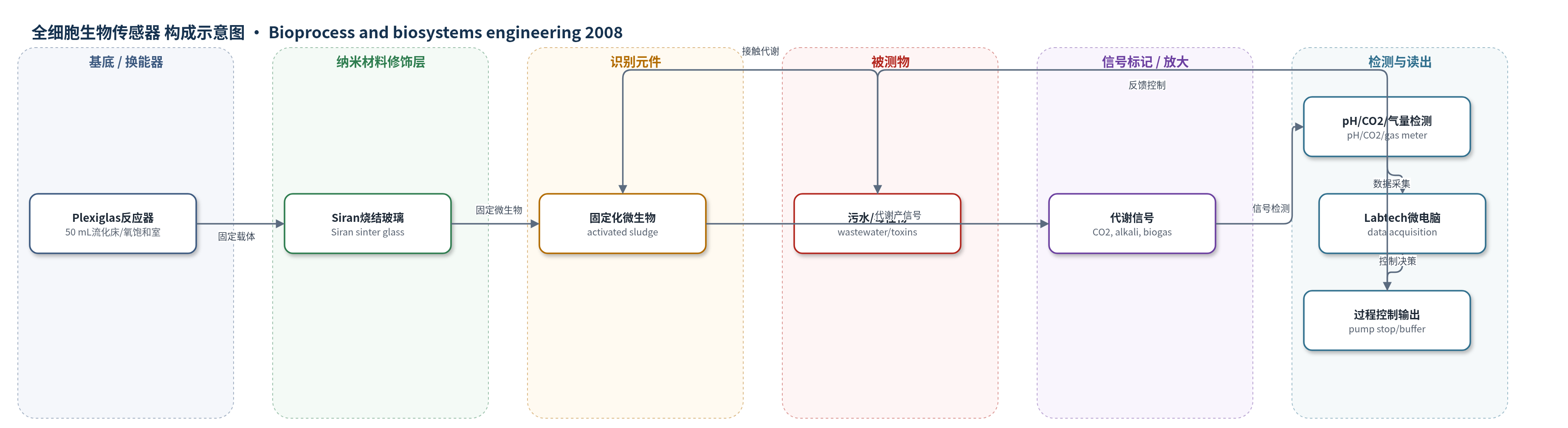
点击图片查看大图 · 依据论文自动绘制
传感器类型
全细胞生物传感器
检测对象
有机污染负荷(BOD/COD)、毒性物质(苯酚 phenol、偶氮活性染料 azo-reactive dyes、肉桂醛 crotonaldehyde)、过/欠负荷;样品基质:市政/工业废水、污水处理厂进水与出水、厌氧消化器进水。
检测原理
固定化微生物作为识别元件接触污水后,执行硝化、好氧降解或厌氧呼吸。硝化每氧化1 mol NH4+-N约产生1.98 mol质子,导致pH下降;好氧降解产生CO2;厌氧发酵/产甲烷产生沼气并伴随碱消耗变化。传感器通过pH controller维持恒定pH,用peristaltic pump补充NaOH或Na2CO3,碱消耗速率反映质子生成和微生物活性;CO2 analyzer检测尾气CO2浓度,volumetric gas meter检测沼气产量。微电脑将信号数字化并与基线比较,活性下降或波动表示毒性、过/欠负荷。固定化高生物量和流化床结构提高响应稳定性,无化学放大。
检测灵敏度
原文未报告LOD、线性范围、灵敏度斜率或相关系数。
效应效果
该传感器在好氧硝化控制中,以碱消耗速率作为活性指标。在苯酚500 mg/L、1.5 L/h、停留时间30 h的冲击实验中,传感器约1 h内识别毒性,并在活性抑制50%时于1.5 h后启动停泵;中试反应器氨氮转化在8 h仅下降6%,12 h下降20%。闭环控制下系统约1周恢复,而未控制7 d未显著恢复。好氧CO2模式可显示偶氮活性染料对活性污泥的抑制,并与BOD/COD建立相关,用于市政污水在线监测。厌氧模式在肉桂醛冲击下表现为碱消耗升高、沼气产量下降,适应后恢复基线,可提前中断进水。现场应用于石化厂和厌氧中试,证明其可实时预警毒性、过/欠负荷并支持过程控制。
传感器的构成
- 反应器基底:Plexiglas 锥形流化床反应器(50 mL)与圆柱形氧饱和室/控制室(50 mL),提供微生物接触、液体流通与气体空间。
- 固定化载体:reticulated sinter glass(Siran),固定化微生物并提高生物量浓度。
- 识别元件:固定化微生物/活性污泥生物量(activated sludge biomass),执行硝化、好氧降解或厌氧呼吸。
- pH 换能层:pH controller 与 peristaltic pump,添加 NaOH 或 Na2CO3,通过碱消耗速率反映质子生成与代谢活性。
- 气体换能层:CO2 analyzer 与 volumetric gas meter,分别检测尾气 CO2 浓度和沼气产量。
- 数据采集层:microcomputer、Labtech software 与 data interface,将 pH/CO2 模拟信号转为数字信号并计算碱消耗。
- 控制输出层:process control unit,根据信号启动停泵或缓冲罐策略,实现闭环控制。
中文摘要
本文报道了一种可用于污水处理厂过程控制的微生物传感器,其可在好氧和厌氧条件下监测废水的有机污染程度、毒性以及过负荷或欠负荷。由于硝化过程伴随质子生成,需要补充碱以维持pH,作者开发了好氧微生物传感器,通过在线监测Na2CO3消耗速率来反映硝化活性,并用于毒性预警和硝化过程控制。由于好氧降解产生CO2,且CO2浓度与有机污染程度相关,该传感器还可用于在线监测毒性及BOD/COD。在厌氧条件下,通过在线监测NaOH消耗和沼气产量,可检测进水毒性事件和过/欠负荷。该传感器布置在工艺上游,可尽早接触废水,为保护敏感生物处理单元和实施控制策略提供时间。
英文摘要
This paper demonstrates the functionality, laboratory testing and field application of a microbial sensor, which can be modified to monitor organic pollution extent, toxicity and over-(under)load of wastewaters both under anaerobic and aerobic conditions. Since nitrification is related to protons formation and the addition of alkaline is necessary for pH control, an aerobic biosensor monitoring Na(2)CO(3) consumption was developed and practically implemented to control the nitrification process. As CO(2) is the respiration product from aerobic degradation which can be correlated to the organic pollution extent, the previous biosensor was modified to monitor and measure the online toxicity and BOD/COD. Under anaerobic conditions, the online measurement of NaOH consumption and biogas production allowed the detection of toxicity incidents and over-(under)load in the influent. Such toximeters get in contact with the wastewater the earliest possible, providing sufficient time for protection of sensitive biological wastewater treatment processes and for the implementation of control and management strategies.