组成图示
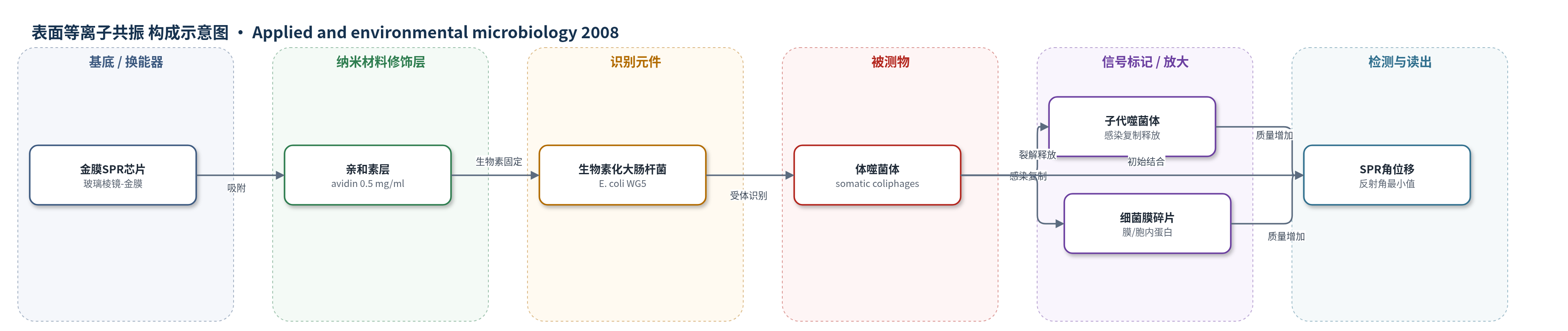
点击图片查看大图 · 依据论文自动绘制
传感器类型
表面等离子共振(SPR)生物传感器
检测对象
体噬菌体(somatic coliphages,含参考噬菌体 φX174);样品基质:城市污水处理厂废水、实验室富集噬菌体悬液
检测原理
SPR 利用 P 偏振光在玻璃棱镜-金膜界面激发表面等离子体,共振角取决于金膜上方介电常数与质量密度。金膜上先吸附亲和素(avidin),再通过 avidin-biotin 相互作用固定生物素化大肠杆菌 WG5(E. coli WG5)。废水中的体噬菌体识别宿主表面受体并吸附,高浓度时产生初始结合信号;随后噬菌体进入宿主复制并裂解细胞,释放子代噬菌体及细菌膜、胞内蛋白碎片附着于金膜,使界面质量密度增加,SPR 反射角最小值随时间上升。裂解出现的时间延迟与噬菌体浓度成反比,单个噬菌体可产生大量子代,形成生物放大。通过实时监测角位移变化可估计噬菌体浓度。
检测灵敏度
LOD: around 102 PFU/ml(原文上标丢失,按上下文为 10^2 PFU/ml);注入量: 1 PFU/ml(120 min 孵育)
效应效果
方法选择性依赖宿主-噬菌体相互作用的特异性。三个城市污水处理厂废水样品(体噬菌体 3.8–4.9 log PFU/ml)经 SPR 检测,响应曲线与参考噬菌体 φX174 相似,阈值时间与双层琼脂法定量结果一致,表明可用于实际废水样品。实验均进行三次重复,文中以标准误差表示重复性,但未报告 RSD;未报告加标回收率、长期稳定性或抗干扰数据。与双层琼脂法相比,SPR 可实时监测初始结合与延迟裂解,并用于浓度估计;检测限约 10^2 PFU/ml,需 120 min 孵育。作者认为该法兼具高特异性和高灵敏度,可发展为自动化、便携式 SPR 生物传感器,用于废水粪便指标及工业噬菌体快速检测。
传感器的构成
- SPR换能基底:玻璃棱镜-金膜双通道微流控芯片(Eco Chemie Autolab ESPRIT),提供表面等离子共振光场并响应界面质量密度变化
- 亲和素固定层:亲和素(avidin,0.5 mg/ml)直接吸附于金膜,作为生物素化细菌的固定层
- 识别元件:生物素化大肠杆菌 WG5(E. coli WG5,Sulfo-NHS-XX-Biotin 标记表面蛋白),通过 avidin-biotin 结合固定,作为体噬菌体宿主受体
- 被测物:体噬菌体(somatic coliphages,含参考噬菌体 φX174),从废水或富集悬液加入
- 信号放大事件:噬菌体感染宿主并裂解,释放子代噬菌体及细菌膜/胞内蛋白碎片附着金膜,增加表面质量密度
- 信号读出:SPR 反射角最小值/共振角实时变化,反映结合与裂解引起的界面质量密度变化
中文摘要
表面等离子共振(SPR)技术是测量分子与表面结合及结合常数的成熟方法。本研究将该方法拓展用于噬菌体-细菌相互作用研究,采用双通道微流控 SPR 传感器芯片检测废水中的体噬菌体(somatic coliphages)。体噬菌体被提议作为水体粪便污染的指示物,研究以其宿主大肠杆菌 WG5(E. coli WG5)作为选择性识别靶标。大肠杆菌 WG5 通过亲和素-生物素相互作用固定于金传感器芯片上,随后加入从废水中提取的噬菌体。高浓度噬菌体可观察到初始结合信号;此外还观察到与时间延迟相关的细胞裂解事件,该事件对低浓度噬菌体敏感。注入反应室的噬菌体低至 1 PFU/ml 时,经 120 min 孵育即可被检测,相当于约 10^2 PFU/ml 的检出限。噬菌体-细菌相互作用引起表面固定细菌结构变化,可能为细胞崩解,表现为芯片表面质量密度增加。结果表明该方法可用于未来生物传感器技术及噬菌体浓度定量。
英文摘要
The surface plasmon resonance (SPR) technique is a well-established method for the measurement of molecules binding to surfaces and the quantification of binding constants between surface-immobilized proteins and proteins in solution. In this paper we describe an extension of the methodology to study bacteriophage-bacterium interactions. A two-channel microfluidic SPR sensor device was used to detect the presence of somatic coliphages, a group of bacteriophages that have been proposed as fecal pollution indicators in water, using their host, Escherichia coli WG5, as a target for their selective detection. The bacterium, E. coli WG5, was immobilized on gold sensor chips using avidin-biotin and bacteriophages extracted from wastewater added. The initial binding of the bacteriophage was observed at high concentrations, and a separate, time-delayed cell lysis event also was observed, which was sensitive to bacteriophage at low concentrations. As few as 1 PFU/ml of bacteriophage injected into the chamber could be detected after a phage incubation period of 120 min, which equates to an approximate limit of detection of around 10(2) PFU/ml. The bacteriophage-bacterium interaction appeared to cause a structural change in the surface-bound bacteria, possibly due to collapse of the cell, which was observed as an increase in mass density on the sensor chip. These results suggest that this methodology could be employed for future biosensor technologies and for quantification of the bacteriophage concentration.