组成图示
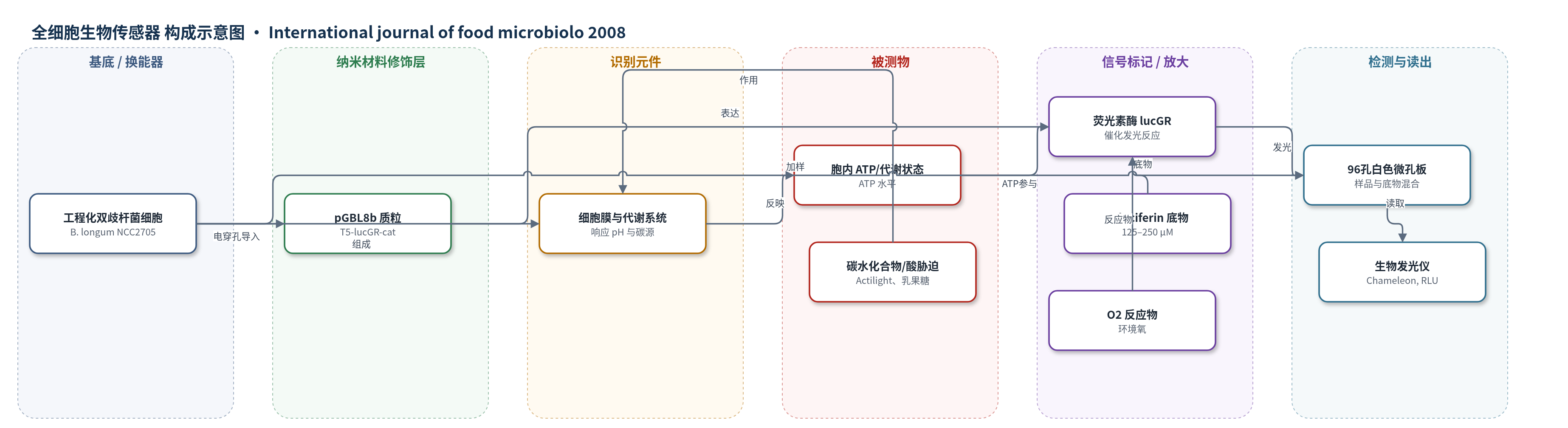
点击图片查看大图 · 依据论文自动绘制
传感器类型
全细胞生物传感器
检测对象
胞内 ATP(ATP)、细胞代谢状态(metabolic state);样品基质:工程化 Bifidobacterium longum 细胞悬液(cMRS 培养基或甘氨酸-HCl 缓冲液,pH 3 酸胁迫样品)
检测原理
工程化长双歧杆菌携带pGBL8b质粒,噬菌体T5启动子驱动昆虫荧光素酶lucGR表达。活菌在pH、碳源和酸胁迫等环境中发生代谢响应,胞内ATP水平随之变化。加入D-luciferin后,底物进入细胞,荧光素酶催化ATP、D-luciferin和O2生成AMP、焦磷酸、CO2、氧化荧光素,并释放约560 nm黄光。发光强度以相对光单位(RLU)读出,与活菌数和胞内ATP水平相关;早期对数期细胞中RLU与CFU呈线性关系。酸胁迫下,不同碳水化合物通过影响碳代谢和ATP维持改变发光衰减速度,从而实现对细胞生理状态的实时、非破坏性监测。
检测灵敏度
LOD: about 4000 cells(minimum number of cells detected over the background number)
效应效果
重组株在含10 μg/ml氯霉素的cMRS中生长速率与野生型相近,形态一致,转化率为2×10^2 clones/μg DNA。发光重复测量变异小于10%。最低可检测约4000个细胞,pH 7.0时D-luciferin掺入最佳,125 μM以上出现底物饱和。pH 3酸胁迫1 h后平板计数显示最多99.9%细胞不可培养,而生物发光能更敏感地区分不同碳水化合物对ATP的保护作用:Actilight®和乳果糖效果最好,葡萄糖和菊粉仍有效,肌醇无显著作用。作者认为该系统可快速、非破坏性实时监测厌氧菌生理状态。
传感器的构成
- 全细胞传感元件:工程化 Bifidobacterium longum biovar longum NCC2705,作为活菌识别与代谢响应单元
- 报告基因载体:质粒 pGBL8b,含噬菌体 T5 启动子、昆虫荧光素酶基因 lucGR 和氯霉素乙酰转移酶基因 cat,驱动荧光素酶表达
- 识别/响应元件:细菌细胞膜与胞内代谢系统,响应 pH、碳源和酸胁迫等环境变化
- 信号酶:昆虫荧光素酶 lucGR,催化 ATP、D-luciferin 和 O2 生成氧化荧光素并释放 560 nm 黄光
- 底物/信号标记物:D-luciferin,加入后进入细胞并参与发光反应
- 反应辅因子:ATP 和 O2,ATP 水平反映细胞代谢状态,O2 在环境氧条件下参与反应
- 读出装置:Chameleon 多标签检测平台(Hidex)生物发光仪,在 96 孔白色微孔板中测量相对光单位 RLU
中文摘要
本研究旨在构建一种可用于分析细胞代谢状态的双歧杆菌生物传感器。作者通过电穿孔将携带叩头虫(Pyrophorus plagiophthalamus)昆虫荧光素酶基因的人源肠道菌长双歧杆菌长亚种(Bifidobacterium longum biovar longum)进行转化,所用载体为pGBL8b,并研究了影响该生物发光表型产光的基本参数。结果显示,最低可检测细胞数约为4000个,表明昆虫荧光素酶在长双歧杆菌中表达效率很高,且测量只需在环境氧条件下孵育数分钟。pH 7.0有利于底物D-荧光素(D-luciferin)进入细胞,底物饱和效应出现在125 μM。作者利用发光长双歧杆菌快速评价不同碳水化合物在酸性条件下维持细胞生理状态的能力,发现益生元化合物Actilight®和乳果糖在pH 3孵育过程中防止胞内ATP损失的作用最强,葡萄糖和菊粉作用较弱但仍有效。结果表明,携带pGBL8b质粒的发光长双歧杆菌是快速研究不同环境条件下厌氧细菌生理状态的重要工具。
英文摘要
The aim of this work was to construct a bifidobacterial biosensor that could be used to analyze the metabolic state of cells. We transformed by electroporation the human intestinal bacterium Bifidobacterium longum biovar longum with a vector (pGBL8b) containing the insect luciferase gene from a click beetle (Pyrophorus plagiophthalamus) and studied the basic parameters affecting light production in the bioluminescent phenotype. We detected a minimum of 4000 cells, which indicates that the insect luciferase expression in Bifidobacterium longum is extremely good, and a measurement requires only a few minutes of incubation in ambient oxygen conditions. A pH of 7.0 was optimal for incorporating the substrate d-luciferin, and the substrate saturation effect occurred at 125 microM. We employed bioluminescent B. longum for a quick test of the efficacy of different carbohydrates to preserve cell physiology under acidic conditions. The prebiotic compounds Actilight and lactulose were the most active in preventing loss of intracellular ATP during incubation at pH 3. Glucose and inulin were less active, though still effective. In sum, our results show that bioluminescent B. longum, transformed with the pGBL8b plasmid, is a valuable tool for rapidly studying the physiological state of anaerobic bacterial cells under different environmental conditions.